


Fall Management And Wintering Of Bees. Continued
Description
This section is from the book "Beekeeping for Beginners", by G. H. Cale, Jr.. Also available from Amazon: Beekeeping for Beginners.
Fall Management And Wintering Of Bees. Continued
With a good queen, plenty of young bees, and careful attention to the amount of available stores the beginner should have little or no trouble in bringing his colonies through the winter.
As plant life becomes dormant, brood rearing and the field activities of the colony decline until they finally cease entirely. The population of the colony decreases rapidly in the fall until only bees from four to six weeks old are left in the hive. Since they have done little or no work these young bees are capable of living through the winter.

Dead drones at the entrance to a colony in late fall.
At a temperature of around 57 degrees F. the bees start to form their winter cluster. When the temperature has dropped as low as 43 degrees F. all of the bees have joined the winter cluster. With the formation of the cluster one of the first indications of approaching winter is the action of the colony in relation to its male population-the drones. The worker bees chase the drones out of the hive where they soon die from starvation and cold. Since the drones have no useful task in a normal functioning colony they are a useless burden most of the time. The worker bees tolerate the drones during the spring and summer when there is a chance that they may be needed to mate with a queen, but the first hint of cold weather is the signal for a general forced exodus of the drones.
There has been much controversy in this country on the question of whether to pack bees or not to pack them. For many years the standard practice was to pack the hives in a heavy coating of straw, leaves, or some other insulating material. The material used to insulate was usually held in place by a tar paper pack which went around, under, and over the colony. The theory was that this packing would so insulate the colony that the natural colony warmth would be retained within the hive and allow the bees to move freely to their food reserve wherever it was stored in the hive. Some even insulated too heavily with the result that during warm days in the winter the colony was so warm that it was forced to move outside the hive.
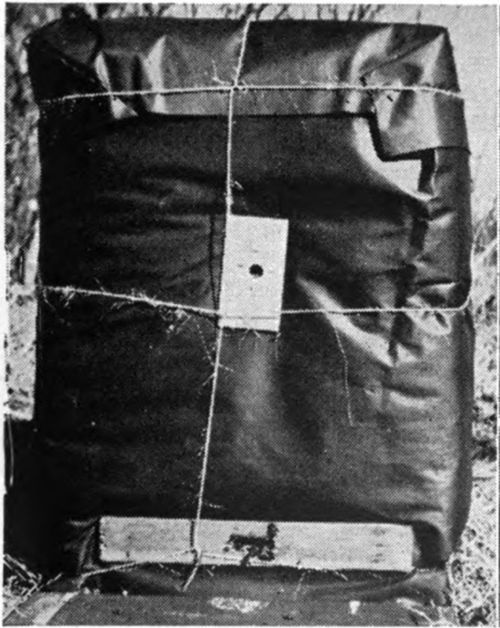
A hive packed with tar paper and straw. Note the reduced lower entrance and the auger hole top entrance.
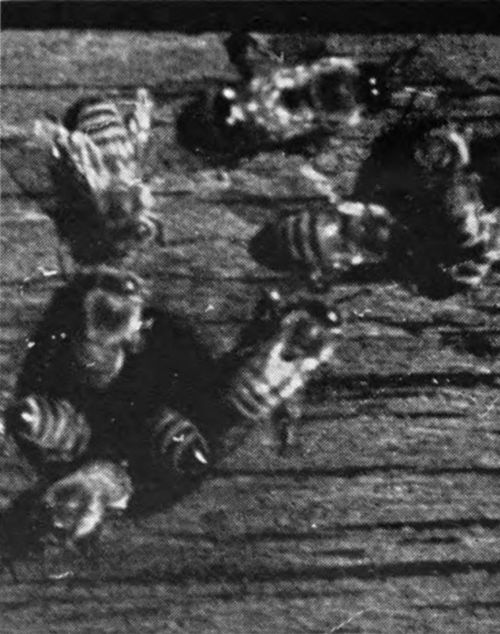
A close-up view of the top entrance in early autumn. On warm days in the winter the bees will fly from this entrance before using the bottom one.
During the last fifteen years there has been a general trend away from the heavy packing and insulation of the colony during winter. Lighter packing was tried and when that proved successful, colonies were wintered with no packing. The unpacked colony wintered as well as the packed colonies had done and today the majority of the commercial beekeepers do not pack their colonies.
Whether the colony is packed or not packed, two of the requisites for successful wintering are a reduced bottom entrance and a small top entrance. The entrance closer supplied with the original hive should be placed in the bottom entrance of the colony leaving only the smallest opening for the bees to fly from. It should not be necessary to close the entrance down so far until cold weather has set in for the winter. In addition to the reduced bottom entrance the bees should be supplied with a top entrance. A one-inch auger hole is bored just below the hand hold in the front of the super which is left on the colony. This top entrance allows the bees to fly freely from the top of the cluster during days when the temperature rises to 45 degrees or higher and also allows some circulation in the hive to help dissipate excess moisture. If the bottom entrance should become choked with dead bees or other material the top entrance will then act as a safety exit from the hive.

A wooden fence used as a windbreak for wintering bees.
The beginner will have to use his own judgment about wintering his bees. If it is felt that the climate is too cold and severe for successful wintering with unpacked colonies then by all means take the time and trouble to place some kind of light packing around the hives. But remember-packed or unpacked always use the reduced bottom entrance and the auger hole top entrance.
Beekeepers in many localities are bothered during the winter by field mice. The mice enter through the lower entrance and remain in the hive during the winter, usually chewing up the combs during their stay in the hive. If mice abound in your particular locality it may be well to use some sort of a guard at the entrance to the hive.
Although some beekeepers ignore wind protection, there are many who prefer to have some protection from prevailing winter winds. This is accomplished by several means: placing the hives on the southern slope of a hill, in a grove, or putting a snow fence or some other windbreak between the hives and the direction of the prevailing winds. Natural windbreaks are best since they entail no extra management or work on the part of the beekeeper.
If no windbreak is available, moderate packing is likely desirable. Remember, that with a packing case, a small entrance should always be provided, so the bees may fly on moderate days during the winter thus being able to remove the dead, and to void themselves of accumulated excrement, since bees never void themselves within the hive.
Generally, no packing is considered necessary south of the Mason and Dixon line.
The conditions necessary for successful wintering may be put down in a brief form, as follows:
(1) A good queen early in the fall.
(2) Plenty of young bees.
(3) A minimum of fifty pounds of stores - honey, sugar sirup, or both.
(4) Reduced lower entrance and a 1-inch auger hole in super.
(5) Protection from prevailing winter winds.
(6) Exposure to winter sunshine.
Continue to:


My Books

