


Rearing Queens - Queen Introduction. Continued
Description
This section is from the book "Beekeeping for Beginners", by G. H. Cale, Jr.. Also available from Amazon: Beekeeping for Beginners.
Rearing Queens - Queen Introduction. Continued
Miller Method
Dr. C. C. Miller described a method of securing a number of good cells that may be used for requeening operations for home use with a minimum amount of effort, in many ways being as good as the commercial methods used by the extensive queen breeders. We quote his method from the American Bee Journal, August 1912, as follows:
Into an empty brood-frame, at a distance of 2 or 3 inches from each end, fasten a starter of foundation about 2 inches wide at the top, and coming down to a point within an inch or two of the bottom-bar. Put it in the hive containing your best queen. To avoid having it filled with dronecomb, take out of the hive, either for a few days or permanently, all but two frames of brood, and put your empty frame between these two. In a week or so you will find this frame half filled with beautiful virgin comb such as bees delight to use for queen-cells. It will contain young brood with an outer margin of eggs. Trim away with a sharp knife all the outer edge of the comb which contains eggs, except perhaps, a very few eggs next to the youngest brood. This, you will see, is very simple. Any bee-keeper can do it the first time trying, and it is all that is necessary to take the place of preparing artificial cells.
Now put this "queen-cell stuff, " if I may thus call the prepared frame, into the middle of a very strong colony from which the queen has been removed. The bees will do the rest, and you will have as good cells as you can possibly have with any kind of artificial cells. You may think the bees will start "wild cells" on their own comb. They won't; at least never any to amount to anything, and, of course, you needn't use those. The soft, new comb with abundant room at the edge, for cells, is so much more to their taste that it has a practical monopoly of all the cells started. In about 10 days the sealed cells are ready to be cut out and used wherever desired.
While it is possible to rear queens in northern climates, the season there is so short as to limit the volume of queens which can be produced, except in ideal seasons. Most of the breeders of both package bees and queens are, as a result, located in the southern states or in California.
Commercial Queen Rearing
The queen breeder furnishes his heavily fed queenless and broodless cell-starting colonies with numbers of embryo queen cells prepared by one of several methods. Most use the Doolittle plan. Rows of artificial wax cell cups are fastened, open end down on cell-bars on a frame which can be inserted in place of a frame in the cell-starters. Each of these cell cups is supplied with a small amount of royal jelly, and a very young larva (preferably less than one day old) is "grafted" or transferred into it from the chosen mother queen's brood. The starter colonies under ideal conditions accept and start building a large percentage of queen cells from these introductions. Twenty-four hours after introdutcion, the batch of started cells are removed and placed in strong cell finishing colonies.
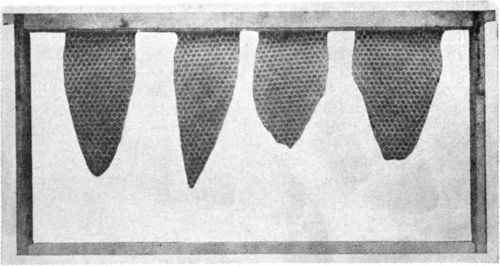
The partly built comb containing eggs and young larvae. Note that the two combs on the right have been cut away along the edges leaving young larvae on the edge of the comb, Miller Method.
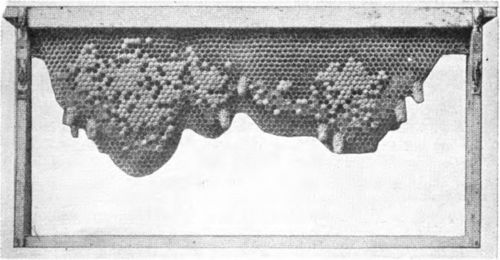
Queen cells constructed along the edge of the partly built comb.
The last step in the process is to remove these cells as soon as sealed, or before the young queens emerge, placing them in small queenless mating nuclei, where the young queens eventually emerge and are mated. After she has proved her mating by the laying of eggs which develop into worker brood, the queen is caught, placed in a queen cage provided with a few worker bee attendants and sugar candy provision sufficient for their maintenance until they reach the customer through the mails.
Queen Introduction
Benton cages in which most commercially reared queens are packed have accompanying them, directions for introduction of these queens. The cage is provided with a screen front and a small hole in the end where the sugar candy has been provided. A cardboard paper covers the outside of this hole. When the queen is to be introduced into the colony, this small cardboard is removed from the candy and the wire screen side of the cage is either inserted between the frames or just over them with the bees exposed through the screen to the bees of the hive. By the time the bees have eaten through the candy into the cage, they are acquainted with their new queen and she walks out onto the combs to proceed with her duties.
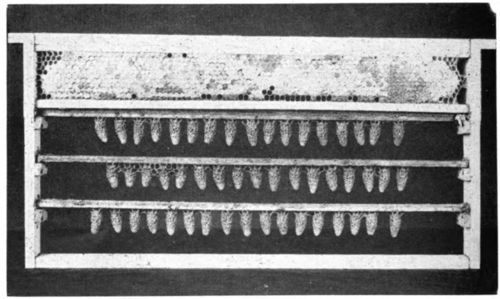
Frame containing three cell bars of finished queen cells removed from the center of the cell-finishing colony. (Photo courtesy John S. Shackelford)
Some recommend that all attendant bees be removed from the cage before introduction is attempted. Others, during a honeyflow may endeavor to "run the queen in" the entrance with little more than a few puffs of heavy smoke to accompany her. During periods of heavy honeyflow oftentimes they succeed, many times not.
A surer way is by a "push in" cage made of wire, by which the queen is imprisoned in a small cage on the sealed brood of a comb in which the queen is to be introduced. The emerging bees within the cage surround the queen. She gets the odor of the hive, the recognition of these young bees and in 24 to 36 hours may be released in the colony.

Note the queen bee in the center of one of the holes of the queen cage. In this manner the queen is mailed to the beekeeper.
With a very valuable queen a similar method may be used. The new queen is given a hive or nucleus of her own, with no entrance. She is released on two or three frames of sealed brood-no bees. This must be in warm weather or both the brood and the queen might suffer. As the bees emerge from the brood they proceed to feed the queen. After sufficient emergence for colony defense has taken place, a small entrance may be given to the colony, from whence it develops into a full colony.
Continue to:


My Books

