


About Beehives, Kinds Of Hives, Double Walled Hives
Description
This section is from the book "A Living From Bees", by Frank C. Pellett. Also available from Amazon: A Living From Bees.
About Beehives, Kinds Of Hives, Double Walled Hives
About Beehives
In reading over a number of questions about hives one notes that the subject is one of considerable interest to the novice. One man enquires what advantage comes from using a "patent" hive over any kind of box which happens to be handy.
No hive in common use in America today is patented. A half century ago many hives were patented and patent rights were widely sold. All these patents have long since expired and any man is free to make any of the standard hives now in use. The name "Langstroth hive" or "Dadant Hive" indicates a particular style of hive. These can usually be secured from any dealer in bee supplies so there need be no worry about the payment of royalties or the infringement of any patents on standard equipment.
As to the advantages, they are numerous and very apparent. Hives with movable frames are made for the convenience of the beekeeper and not for the bees. Hives now generally used are so constructed that they can be taken apart and every corner examined. Every frame can be removed and replaced at will. The beekeeper can ascertain from an examination of the interior the exact condition of his bees. If there be disease he is able to see it, if there is an old and failing queen he can find her. He can tell whether the bees have plenty of honey to supply their needs and whether they need more room. If they need additional room it can be supplied by the addition of a super. As many units can be added as needed and at times during a heavy flow it is not uncommon to see hives six or more stories high.
The bees are quite as well content in a box as in a hive. If the box is big enough they will store as much honey. However, for lack of facilities for expansion and contraction the beekeeper seldom gets a profitable crop of honey from bees in a box.
Kinds Of Hives
The arguments in favor of any special hive are usually based in the personal preference of the user. A good beekeeper can succeed with almost any kind of hive. He does so because he understands the fundamental behavior of the bees and adapts his equipment to the needs of the moment. One lacking this information is likely to fail no matter what kind of equipment he has.
It is true, however, that small hives require more attention than larger ones. The bees left to themselves are more likely to survive neglect for a long period of time in big hives than in small ones. The reason is simply that there is more room in which to store up a reserve supply of honey against the day of need.
The large hives such as are commonly known as
Jumbo hives and Dadant hives are not popular with the mass of beekeepers because of the higher first cost. They are higher in price simply because they contain more material and cost more to build. The difference in price, however, is more apparent than real. With the smaller hives it requires two bodies to serve the purpose of a brood chamber instead of one. It also requires more supers to hold the same amount of honey. When fully equipped to serve the needs of a strong colony of bees in the hands of a skillful beekeeper, it costs as much or more for the small hives.
The man who likes the large hives argues that they require less manipulation and that one can care for more bees with less labor all of which is true. The small hive advocate on the other hand calls attention to the fact that because of its size the big hive is awkward to handle and heavy to lift which is also true.
Double Walled Hives
One man wants to know whether one can produce more honey in double walled hives than in single walled hives. That all depends upon other conditions. If the single walled hive is properly prepared for winter and is protected from the chilly winds of spring by means of a good windbreak there will be no difference. The double wall is merely a measure of protection. It costs more of course, but the bees feel the changes in the weather much less. There is less labor in packing the bees for winter and unpacking them again in spring. The cost of a winter packing case is saved also. Perhaps this should be qualified by saying it is saved in localities where the climate is not too severe to winter the bees outside in such a hive.
In localities where there is an occasional mild day during winter when it is warm enough for the bees to fly out and relieve themselves of accumulated waste matter, the double walled hive is quite satisfactory. My own bees have been in double walled hives. When placed in the shelter of a good natural windbreak, it is only necessary to fill the big cover with a bag of dry leaves and reduce the entrance to about three or four inches wide and they are ready for winter.
Over the hive-body is placed an inner cover with an opening one inch by four inches. This permits the moisture to pass into the dry leaves above the frames. A one inch hole is bored in the end of the cover to permit the moisture to pass off into the air. Results have been very satisfactory in these hives which are of the Dadant dimensions.
Because I like them, however, does not mean necessarily that they would be the best hives for you. The common opinion seems to favor the ten-frame Langstroth hive which is regarded as standard in many localities. This hive is manufactured in a double walled pattern by several firms. Some which I tried gave poor results in wintering because the inner cover had no hole to permit the escape of moisture. It accordingly condensed within the hive and left the bees in bad shape after a long continued cold spell. This could be easily remedied by using an inner cover with small opening and by boring a hole in the end of the outer cover to permit the moisture to escape as taken up by the leaves packed above the brood nest.
It is always easier to sell bees in the kind of hives in common use in one's home neighborhood. This has little weight with me since I am much more likely to buy than to sell, although I no longer keep the large number of colonies of former years when I gave my attention to honey production as a source of my living.
Half the fun of beekeeping comes from trying something different and in arguing with other beekeepers over the merits of a particular piece of equipment or a particular method of operation. This being the case, one who takes up beekeeping as a hobby is not likely to be satisfied until he has tried the different kinds of hives for himself.
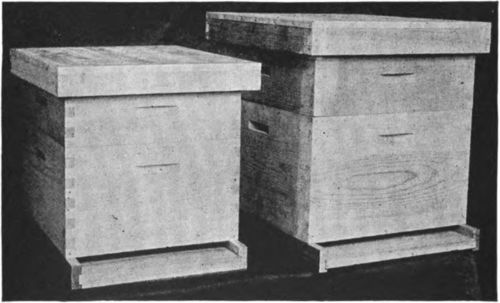
Langstroth and Dadant hives showing comparative size. The Dadant hive is the larger.
Of late the demand for double walled hives has been so small that few of them are now manufactured. Only three hives are now readily available. They are the eight-frame and ten-frame Langstroth and the Dadant. The eight-frame Langstroth hive is too small and requires expert attention for success.
Continue to:


My Books

