


Chapter Five. The Drone's Story
Description
This section is from the book "Queendom Of The Honey Bees", by Phillip C. Lance. Also available from Amazon: Queendom Of The Honey Bees.
Chapter Five. The Drone's Story
We are curious to learn more about the work of the bees hut we can't remain longer in the hive. When we leave we pass before another hive where a drone is lounging about. We ask him to tell us more about the work of these busy little creatures. This is what he tells us.
The chief work of the queen bee is egg laying. After the queen lays an egg, she pays no more attention to it. This is the job of the young bees who have not yet left the hive to gather honey. These young workers attend to the brooding of the eggs and watch over the newly hatched bees. These little helpers are called "nurse bees. "
You may think the eggs need no care because for three days after they have been laid no change can be observed in them. However, the nurse bees know better than you do. They know that if an egg is to hatch it must be kept warm. The bees do not have feathers for this purpose like birds, but they do cluster over the combs so that the heat from their protecting bodies will supply the necessary warmth to the eggs. They will warm the eggs in this way until they hatch. Three days are required to hatch a bee from an egg.
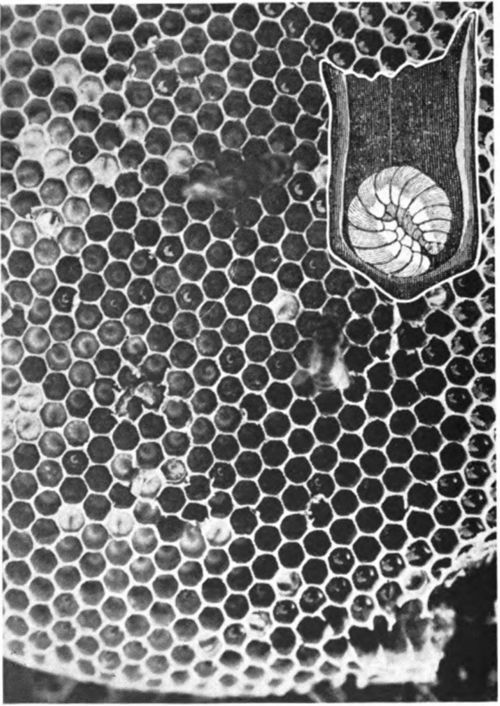
The baby bee, in its first stage of growth, is a queer creature. It looks like a worm or grub and is called a larva. It has no beautiful wings or active legs. It can neither fly nor walk, but it is always hungry. Nurse bees are kept busy feeding the larva a mixture of twice digested honey called bee milk. The nurse bees place this bee milk in the hundreds of cells which contain the newly batched bees and they keep close watch to see that the supply of food is always there.
For the first three days the worker larva and drone larva are fed royal jelly; afterwards, a coarser food such as nectar and pollen is fed to them. The queen larva, however, is fed royal jelly throughout the larval stage which lasts for five and one-half days.
The larva grows very rapidly hut it is not allowed to grow too large. The nurses stop feeding it at the end of the third day when it has grown large enough to fill the cradle cell. A human baby will cry if it does not get food when it is hungry. The little larva does not cry or fuss-it just waits.
Only a bee knows what to do next. A funny thing occurs. The nurse bees cover the end of the cell with a wax cap and seal the baby in its cradle. The cap is porous; that is, holes are in it so that air can go to the larva. Now the sleeping baby bee has nothing to eat and starts to draw a long silk thread from its upper lip. The larva wraps this silk thread around and around the upper part of its body to keep it warm. The baby bee sleeps now in its gossamer wrap. Twenty-one days after the egg was laid, the prisoner becomes very, very hungry and bites its way through the porous cap. A beautiful, soft, light colored, hungry worker bee emerges. Soon it will be ready to begin its labors.
It takes twenty-one days for an egg to become a worker bee, twenty-four days for an egg to become a drone bee, and sixteen days for an egg to become a queen bee.
We thank the drone for his interesting story and thoughtfully depart from the beautiful homes of these industrious creatures.
Continue to:


My Books

