


We Visit A Bee Farm. Part 4
Description
This section is from the book "Queendom Of The Honey Bees", by Phillip C. Lance. Also available from Amazon: Queendom Of The Honey Bees.
We Visit A Bee Farm. Part 4
The uncapped combs are placed in the basket. As the handle is turned, the basket whirls about and the honey is drained from the combs. The extracted honey runs to the bottom of the can and is drawn off through a spigot. The empty frames of comb are returned directly to the supers and given back to the bees who fill them again and again. This method saves the bees a great deal of time and energy, usually spent in comb and wax making.
We notice that the super from which the honey has been extracted and refilled with empty comb is placed in the next hive from which a full super is taken. We ask Ted, "Why don't the workmen place the same super in the hive from which it was taken? "
He replies, "That is to save disturbing the bees more than once. They resume work more quickly. "
67
"Do beekeepers always replace the supers at once ?"
"No. At the end of the season when the honey supply is smaller, the supers are not returned until evening because there is much sticky honey smeared over the comb, and that might cause excitement and attract robber bees. I'll tell you more of these robber bees later. "
"Do you produce any of the fine comb honey here, Ted? " I ask.
"Yes. We do, but the process is different from that used in producing extracted honey. "
"Will you explain the difference? "
"Certainly, " replies Ted. "You see, the interior plan and use of the supers are changed entirely when producing comb honey. The purpose here is to obtain a fully capped comb of honey as nearly white in appearance as possible. The combs must have even straight sides. This is accomplished by placing what we call section boxes in the supers. These are the regular square wooden frames in which you buy comb honey at the store. The section boxes are placed in rows of four in the supers and rest on frames called section box holders. The holders keep the boxes in position. A wedge is usually inserted to keep the whole group of boxes tightly in place. The edges of the boxes are cut back a little to allow the bees ample room to go in and out among them. "
"Aren't some honey combs we buy oblong in shape? "
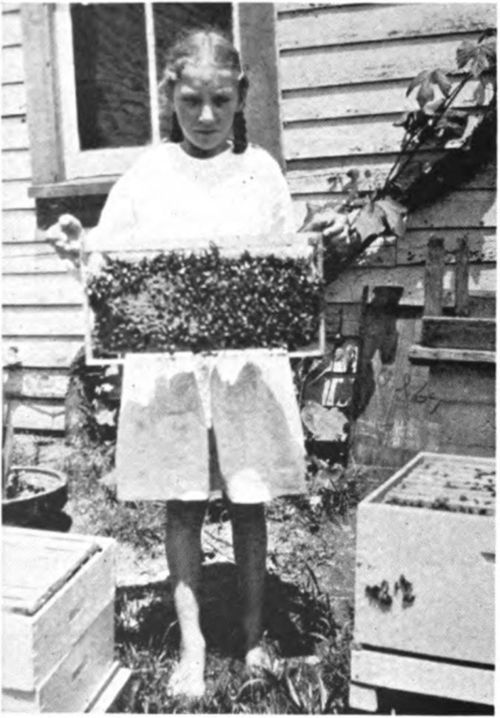
Little Girl Removing A Section From A Modern Hive
"Yes, but the usual comb is square and holds about a pound of honey. Now, the supers that are full of section boxes are placed one at a time, as needed, over the body of the hive. After the bees have filled one super, or nearly so, the beekeeper places another between the first and the body of the hive; or places a new super on top of the first one. During a good season, one hive may have as many as five or six supers of stored honey. "
"Is it better to insert the supers next to the body of the hive or on top of the partially filled super? "
"I believe that each new super should be placed next to the body of the hive. This prevents the bees from discoloring the stored combs by walking over them, and, because the empty super creates the desire for constant work, the chances of swarming are fewer. "
Our interesting study in the extracting room is interrupted by a cry from outside.
"Swarm. Swarm. "
The workmen hurry outside and we follow Ted, who says, "Now you can see how a swarm is captured. "
We walk across the orchard to a spot where several men are gathered. The men are gazing upward into the branches of a tall maple tree where the happily buzzing bees are gathered in a large cluster.
"How can they be taken down? "
"There are several ways, " answers Ted, "but we can probably reach them with a tall ladder. If this is not possible, a stream of water from a hose may force them down. "
Two men bring a long ladder and place it against a limb near the place where the cluster of bees is hanging. Ted is chosen to go up for the bees. He takes a saw and a long piece of rope under his arm, then climbs the ladder. Soon he saws through the limb on which the bees cluster. We are not afraid that the limb will come crashing down to the ground because Ted has tied the rope to the limb on each side of the swarm and has passed it over another limb higher up. From there the rope drops to the ground. The men who are helping Ted, simply grasp the rope and lower the severed limb, bees and all, to the ground.
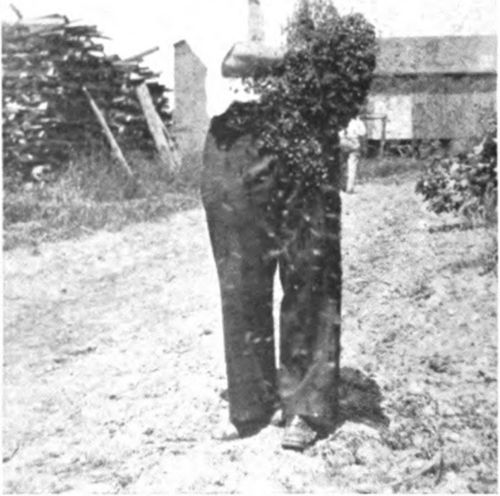
Carrying The Swarm
The limb is carried to a place where a new hive stands under a shady tree. The hive is raised slightly from the ground in front to make a larger entrance. A white sheet is spread on the ground in front of the doorway.
The bees are shaken from the limb upon the sheet. They do not seem to mind being handled in this way. We recall that bees are very gentle when filled with honey at swarming time.
The queen may lead the way into the dark entrance of the hive. Where the queen leads, the other bees follow. Soon a steady stream of the runaway bees is entering the new home. Empty combs have been placed in the hive and these furnishings make the bees feel that there is work to he done. They are contented.
Now we return to the work building to remove our protective equipment, for Ted has invited us to take lunch with the apiary workers. He promises to show us, after we have eaten, how bees are removed from box hives and placed in modern movable frame hives.
Continue to:


My Books

