


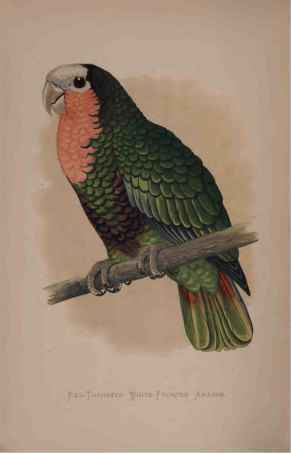
Cuban Parrot, Or Red-Throated White-Headed Amazon. Psittacus leucocephalus, Lnn. Chrysotis leucocephala, Auct.; Amazona leucocephala, Schlg
Description
This section is from the book "Parrots In Captivity", by William Thomas Greene. Also available from Amazon: Parrots in Captivity.
Cuban Parrot, Or Red-Throated White-Headed Amazon. Psittacus leucocephalus, Lnn. Chrysotis leucocephala, Auct.; Amazona leucocephala, Schlg
Psittacus leucocephalus, Lnn. Synonyms: Chrysotis leucocephala, Auct.; Amazona leucocephala, Schlg.;
Psittacus martinicus gutture rubro, Brss.; P. Paradisi, Shw., Ctbs.
German: Der weissköpfige Amazonenpapagei, Bchst.
French: Perroquet de Cuba, Bff.
THIS charming bird bears, as we have said, a considerable resemblance to its neighbour of Jamaica, from which it is principally distinguished by the black lacing on the feathers of the head and neck, and by the red throat. It is also somewhat larger than Collaria, to which it yields in no good quality, while it surpasses it in linguistic attainments.
It is probably the longest known of any of the American Parrots, having been mentioned by Aldrovandi, though first accurately described by Edwards, and named by Linnaeus. Not long since we saw a most graphic portrait of one of these birds in an old oil painting; it was represented leaning forward, with out-stretched wings, from the branch of a tree, to reach a cherry held out to it by a pretty child in the foreground, and had evidently been painted from life. We made a bid for the painting, of which the artist was unknown, but failed, to our regret, to secure it.
Catesby, from reason unknown, but probably from the combined beauty and gentleness of the creature, named this bird the Paradise Parrot; and the father of chamber bird-lore waxed unusually eloquent in its praise in his larger work; although in his Naturgeschichte der Stubenvögel, he dismissed it with the summary remark:-"This is one Referring to some old catalogues of the Crystal Palace Bird Shows, we find that a White-headed Parrot was exhibited there in 1883, in the "Any other variety of large Parrots" Class, and took a third prize; the price affixed was £4 4s. Another was shown in 1884 by Mr. Washer, under the ill-omened name of "Cat-throat Amazon", but was left unnoticed by the Judges; the price asked was £2 10s. In 1885, Miss Ada Skinner showed a very fine specimen, that took first prize in the same class, and was valued at the comparatively low figure of £3 10s. The same bird was exhibited the following year by the same owner, who then priced it at £5 10s., but it only succeeded in gaining a fourth prize; and in 1887 none were shown.
The food for this species is the same already recommended more than once for members of this sub-family, namely, hemp seed, maize, boiled and raw, and canary seed. A morsel of sweet cake, or biscuit, or a bit of stale bread, may be given now and then for a change, as well as a slice of raw carrot, or ripe apple, or a few grapes. "Sop" is not to be advised; but water, both for drinking and bathing, should always be available; while sharp grit is a sine quâ non if the bird is to retain its health and beauty. A log of soft wood will afford amusing occupation; and a fly round the room now and then will exercise the wings and the comparatively large muscles that move them.
Occasionally the claws or the beak become overgrown and must be cut; which can be done by means of a sharp pair of scissors or a nail nipper, which is perhaps the better instrument of the two for the purpose. The bird should be held in the hands of another person, and for security from bites should be wrapped in a towel or napkin, leaving exposed merely the parts that are to be operated on. After a time, or two, should it be necessary to repeat the cutting, the bird will not make nearly so much resistance as at first; and finally the cloth may bo dispensed with, as the Parrot will submit with resignation to the inevitable.
Wo recollect a short time before his lamented death, seeing a very fine specimen of this bird at the establishment of Mr. Anton Jamrach. It spoke several words with very fair distinctness, and was so tame it would allow him to take it out of its cage, and toss it about without resisting or appearing to be frightened in the least. We forget the prion he asked for it; but probably it was somewhat high, or the bird would have exchanged owners, as it was a pretty gentle creature; and being yet young, gave good promise of becoming a valuable acquisition in the near future.
It is, however, a mistake to suppose that Parrots, generally, do not require to be taught; but that they will pick up of their own accord a variety of accomplishments without any attention to them on the part of their owner. An odd one here and there may certainly do so, but as a rule, unless considerable pains are taken, a Parrot will make no progress to speak of, in a human language.
The more a Parrot is noticed and spoken to, the sooner it will become docile, and begin to repeat the words and sentences it hears. We have, it is true, known cases where one of these birds has repeated with perfect accuracy even tolerably long sentences, which had certainly only been once uttered in its presence; but such exceptional talent is, to say the least, rare; and the contrary rule may indeed be said to obtain among them.
If it is wished to teach some word or phrase to a pet Parrot of any species, that phrase, or word, must be distinctly and slowly repeated before it whenever an opportunity presents itself; and the more frequently the better. At first, very likely, the bird will take no notice; but after a longer or shorter interval, the patience of the tutor will be rewarded by hearing the pupil whisper a word, or a word or two of the phrase spoken to it, which it will do in a low key, and with a deeply meditative air, as if it were severely taxing its memory, or testing its power of articulation. By and bye the pupil gains confidence, and repeats its lesson with more boldness; but not until it is perfect in it should another trial be made, and a new word or sentence be introduced, or added to the existing repertory.
By judicious education a Parrot, of almost every known kind, from the tiny Budgerigar to the gigantic Macaw, may be converted into a talker, more or less proficient it is true, according to the species taken in hand; but we have no hesitation in saying that all the Parrots, with a very few exceptions, will learn to speak; and very likely that the few that have hitherto been looked upon as non-talkers, may with greater care than has hitherto been bestowed upon them, develop latent talents which had not been previously suspected.
Who, for instance, would have imagined a few years since that the Undulated Grass Parrakeet, generally known by its aboriginal Australian name of Budgerigar, would have developed powers of speech? but that it has done so is incontestable; for not only does Dr. Karl Russ, in his work, Die Sprechenden Papageien, give several instances of talking Budgerigars; most interesting, but too long for quotation in these pages, although we reserve some of them for our Appendix; but a well-known London amateur has recently communicated to the Bazaar newspaper an account of one of these birds, which he has himself taught to speak.
"I have at the present time", writes Mr. Joseph Groom, on March III.
2nd., 1887, "a most wonderful talker in a male Undulated Grass Parrakeet (Budgerigar); it is quite a plain speaker, and has not learnt from another bird, for I taught him myself from the first, and now he pronounces very distinctly different words he hears that suit his fancy; such as, 'Oh! you wicked boy; so you are.' I find the females will also talk fairly well."
If then this mite of a bird can be taught to imitate the human voice, what may not be expected from the more highly gifted Cuban Parrot, if taken in hand young and carefully trained? The attempt certainly is worth making, if only from a pecuniary point of view; for, say that a newly imported White-headed Parrot is worth twenty shillings in the market, the same bird capable of repeating distinctly half a dozen or so of short sentences, or even a few words, would certainly be worth double, or treble, the sum named, or even more. Let amateurs therefore persevere, for in the Cuban they have a plastic material to work with; a bird which a high authority in this connection pronounces to be teachable, good-tempered, easily tamed, and chattering all day.
The Hon. And Rev. F. G. Dutton's Account Of The White-Headed Amazon (Chrysotis Leucocephala)
I recollect the first of this species that I saw was a very tame little bird, that used to run about the kitchen floor in the house where we lived. He would say "Pretty Polly", and he loved having his poll scratched. But there his accomplishments ended. After a time his mistress, whose devotion to him was not, I think, very deep, found that he was infested with vermin, and sent him to the Zoological Gardens, from which she never, I believe, took him back.
I have written thus at length about him, because I think he was a very typical specimen of his kind. Bechstein speaks of it as "very tame and talkative." I should agree with the "very tame." I look upon it as perhaps the most easily tamed of all the Amazons, but as a decidedly indifferent talker. Other people have given it a good character for talking; and it cannot be too often repeated, that you may find clever individuals in species that learn with difficulty; and individuals absolutely incapable of learning anything of the very cleverest species. Still, as a whole, the small Amazons are not, according to my experience, good talkers; and the White-headed is not even good amongst the small Amazons.
Their price varies according to the number in the market. Unless the specimen be clever, £1 is ample at any time. They might be bought much cheaper.
Continue to:


My Books

