


Orange, Cream, Fawn, And Tortoise-Shell Cat Society. Part 5
Description
This section is from the book "The Book Of The Cat", by Frances Simpson. Also available from Amazon: The Book Of The Cat.
Orange, Cream, Fawn, And Tortoise-Shell Cat Society. Part 5
Miss Beal's male orange "Minotaur" is one of the most beautiful cats of this breed now exhibited, and has quite the best round head and face, with sweetest expression. These are qualities too often lacking in orange cats.
Miss Beal's name is, perhaps, more closely associated in the cat world with cream cats, and in my next chapter on this breed she has kindly supplied some notes.
Another fancier of both orange and cream cats is Mrs. D'Arcy-Hildyard, and to her I am indebted for the following notes on orange Persian cats : "Until comparatively lately I confined myself entirely to the breeding of creams, and my efforts were attended with considerable success, both in multiplying the number of cats of that colour - I bred thirteen one year - and in filling the classes given for cream females. I was particularly lucky in breeding many creams of the gentler sex.
"The birth of the Orange and Tortoiseshell Society fired me with ambition to start breeding oranges. I was much fascinated with the colour, though I hate their being penned beside the creams at shows, as they completely take all colour out of the lighter animals and give them a washed-out appearance. I started by crossing my cream queen 'Josephine of the Dur-hams' with Mrs. Neate's famous' The King's Own.' This proved a most satisfactory cross, the results being three rich-coloured unmarked orange kittens, one male and two females. I sold one female to Miss Scratton, of Prittlewell Priory, and it has, I hear, grown into a very handsome cat ; the other two I kept, and they won all before them at Manchester Kitten Show, 1901, and were shown at Slough after, where the male was claimed. The remaining one,
'Mehitabel of the Durhams,' I kept, and she won me many prizes last winter, and being mated this year to 'Champion Romaldkirk Admiral' has presented me with a litter of two creams and an orange. Certainly creams and oranges cross well, and often I think produce a brighter and deeper tone of colour than is obtained from other shades. I have lately purchased an orange torn, and by crossing him with'Hazeline,' one of my cream queens, have got a splendid litter of seven pure oranges. This, I think, proves that the cream and orange cross is good, and that they breed very true. Oranges bred by crossing other colours seem to me rather spasmodic, if I may use the term. When breeders try crossing an orange and a tortoiseshell they very often get blacks and blues as well as oranges ; on the other hand, from a blue and a tortoiseshell cross sometimes an orange is obtained. But they do not seem able to count exactly on the results.
"Reliability is what I claim from the cream and orange cross. I emphatically believe in mating creams to creams if you wish to get a good pale colour and few markings, and oranges and creams crossed have certainly produced good specimens of both colours for me. I speak from my own experience.
"I hope to do great things by trying a cross between my orange torn' Benjamin' and'Mehitabel.' Miss Winifred Beal's' Minotaur' was the result of a cross between a cream and a tortoiseshell. Her well-known 'Garnet' is the daughter of a cream and a blue. At present there is, to my mind, no orange female on the show bench to compare with the late'Jael,' owned by Miss Mildred Beal, whose brilliant colour and perfect head with its tiny ears made her hold her own at all the shows up to within two months of her death at quite a venerable age ; but I hope in the future, as oranges become more popular and breeders work hard at producing good specimens, we may see her like again. I was much taken at Richmond show with Mrs. Singleton's' Orange Girl,' and also with the kitten of that colour exhibited by the same lady at Manchester. Every year, I think, shows that the general world is becoming more alive to the beauties of orange and cream cats, as proved both by the large increase in entries of these colours at the principal shows and the great demand for kittens when any are offered for sale.
Undoubtedly breeders owning creams should stick to them, if they wish to produce good oranges - see the many splendid specimens sired by 'Midshipmite' and 'Admiral.'
"It is a hard matter to say decisively what tint orange kittens should be when born. 1 have known them enter the world a bad cream, and gradually grow redder till they develop into the brilliant colour we all look to see in a cat of orange hue. Personally, I prefer them born a dark shade ; they usually lighten and brighten a little, but on the whole I think that is the more satisfactory of the two. It is distinctly discouraging to see a washed-out looking kitten when you are expecting a bright orange one.

Out In The Cold (Photo: E. Landor, Ealing.)
"Fanciers differ about the eyes which are supposed to be correct in this breed. Hazel eyes are universally acknowledged to be the right thing. Personally, I admire green, or rather eau-de-nil eyes, as giving more contrast to the colour of the coat, but you do not often see them. I have always wished to breed a cream with blue eyes - I do not mean the baby blue, but the colour that Siamese have - and only the other day I sold a kitten three months old with brilliant blue eyes of this tint, and shall be anxious to know whether they change in time or not.
"I think the time is approaching when the orange and cream cats are going to be among the most attractive classes at our bigger shows. Already the classes are much better rilled than when I first joined the fancy, and you always find an admiring crowd in front of their pens. I wish, though, that a nice sprinkling of blues could always be placed between the two colours at shows. The close company of the oranges is so excessively unbecoming to the creams, while when you see the three colours together they are especially lovely. To see cream and orange cats at their best they should be at large in the country and running about on the green grass."
In 1902 an Orange and Cream Cat Club was started by a few enthusiastic breeders of these varieties over in America. The Misses Beal, Mrs. Vidal, and Miss Frances Simpson were elected as honorary members. The following is an extract from Field and Fancy, the American weekly paper : ORANGE CATS. There is very little doubt that this is a colour that has from the beginning of the fancy in America been very popular, and has had a very strong hold upon the American love for colour. But, of course, as is generally the case with the popular ones, the supply has never been too plentiful, and probably never will be as regards the queens, for they only appear once in a while, according to what seems to be one of Nature's rules, that the queens should be tortoise-shells.
The Orange and Cream Club is probably destined to do a great deal for the variety, which is one of the colours from which it takes its name. Breeding orange cats opens quite a field, for in attaining your end you can at the same time indulge in other colours, for undoubtedly a cross with a tortoiseshell will be found necessary to keep the colour sufficiently intense, and at other times it may be quite as well to throw in a little black. The tendency for the queens to be tortoiseshells may possibly be somewhat overcome in time, but these inherent traits in colours in animals and birds are often so strong that they have a knack of reappearing even after several generations. We occasionally see queens of the orange colour, and these are usually high quality ones, both in colour and type ; but the orange queens are not destined to at present make heavy classes by themselves. Though the standard calls for orange eyes, it is a curious coincidence that the most consistently successful cat of recent times has been Miss Beal's "Jael," who had green eyes ; but so good was her colour, so good her type, that she generally won when exhibited.
The struggle carried on in the British Isles for some years to breed these cats without marks has been hardly a success, and there have not been very many evolved of that colour that were really without marks, and it is a great question if in this craze for absence of marks they have not been passing by a lot of good cats. As far as we personally are concerned in the matter, we see little to be gained by the absence of marks in the orange cats. If the colour had been very prolific in numbers it might have been a good idea to try and split up the classes, but they were never too well filled, and there is room still for plenty more, though we cannot complain so much at the representation that they have had in America last season, either in numbers or quality.
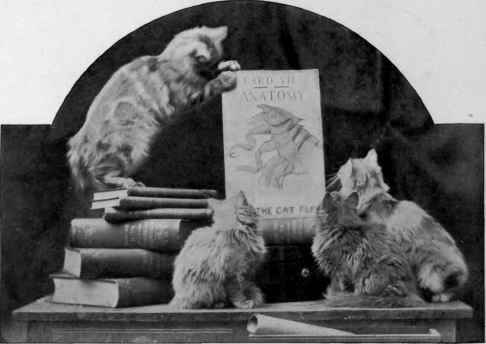
Higher Education (Photo : Mrs. S. F. Clarke.)
Continue to:


My Books

