


The Progeny Of A Tailless Cat Of The Isle Of Man. Continued
Description
This section is from the book "The Book Of The Cat", by Frances Simpson. Also available from Amazon: The Book Of The Cat.
The Progeny Of A Tailless Cat Of The Isle Of Man. Continued
"As I before remarked, colour should be considered last. I think a good black is the nicest colour for a Manx, and, of course, the eyes should be of the colour sought for in ordinary black cats. A pure blue-eyed white is very pretty, and also very scarce. Tabby-and-white I personally do not care for. Silver tabbies are uncommon and very handsome. Tortoiseshells are also pretty and quaint.
"The fur of the Manx should be just a little longer and softer than that of the ordinary short-haired cat. Now and then we see longhaired Manx advertised, but these are, of course, mongrels or abortions, and by no means Manx cats.
"What is the origin of the Manx ? That is a question which in all probability will never be answered. The theory that it originated from a cat (or cats) having lost its tail by accident I do not consider worth a moment's consideration. Such a cat might well have tailless progeny, but that would have nothing to do with the abnormal length of the hind legs, which in good specimens is patent to the most superficial observer, and which makes the gambols of a couple of Manx a comical sight calculated to excite laughter in the most mournfully disposed person.
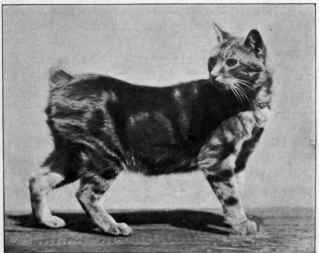
Manx Cat (Photo: Gambier Bolton, F.Z.S. [Regd.].)
" Quaint is the old versified explanation, which I remember hearing some years ago.
It ran, if I remember rightly, somewhat like this : Noah, sailing o'er the seas,
Ran high and dry on Ararat. His dog then made a spring, and took The tail from off a pussy cat. Puss through the window quick did fly,
And bravely through the waters swam, Nor ever stopped, till, high and dry,
She landed on the Isle of Man. Thus tailless puss earned Mona's thanks, And ever after was called Manx.
"The most feasible explanation, in my opinion, though of course it can be but a theory, is that these cats were originally imported from the East. Asiatic cats of domestic varieties show remarkable variety in the shape of their tails, as witness the kinks often found in the tail of the Siamese cat, and the knot tails of other varieties. This subject will be referred to again in a subsequent paper.
"It is also noticeable that many Manx, like the Siamese, are very dog-like in their habits, showing extreme affection for their owners. Poor old' Katzen jammer,' for instance, would follow me to the railway station, and many a time on my return from town have I found him sitting in the middle of a field waiting for me, and on seeing me he would accompany me home just like a dog.
"To return to the question of the Manx cat's tail, this should, of course, be like snakes in Ireland - absent. What we want is for the spinal column to come to an end high up on the back, so that on placing the finger where the tail would begin a hollow or depression is felt. This is the perfection, but it is not always obtainable in even the very best specimens. Next to be desired is when only a little tuft of gristle and hair, with at most a suggestion of a twisted and withered bone, is present. Then comes a distinct caudal vertebra, if twisted or abnormal in shape so much the better ; but in my opinion more than two joints should not be allowed in show specimens at all, though such cats, as I remarked above, may be valuable at stud for breeding from. But I see no reason, if Manx breeders would pay more attention, and incompetent judges were barred, why absolute taillessness should not be attained in ninety-nine kittens out of each hundred. I have bred many, but none have had the crooked stumps we often see in otherwise good specimens.
"I do not care for large Manx, which generally look coarse. Here, again, the all-rounder often goes astray, and unduly favours a large cat.
"I can heartily recommend the Manx as a pet, and the quaintness of his movements are certainly a recommendation. My cats are all house pets, so that I can watch them and enjoy their company; the' cattery' cat is abhorrent to me. I cannot understand why so few people go in for rationally breeding this quaint variety. I had hoped that the recent purchase by his Majesty of two couples of the breed might have given it a fillip.
"To illustrate the breed, I may perhaps be accused of egotism in giving the portrait of one of our own cats, but as he is dead it is less invidious than if living specimens were selected, and as they were awarded the very highest prizes by the very greatest authorities they may safely be taken as near perfection. The silver tabby' Champion and Premier Bonhaki' was bred by Mr. Jungbluth, one of the keepers of the monkey house at the Zoo. He made his debut at the Botanic Gardens as a kitten, when he was much admired by the then Princess of Wales, and Mr. Wain awarded him the championship. This success he followed up by winning four others under various judges,and died at the early age of twenty-seven months.
'Champion and Premier Katzenjammer' was bred at home; he did not commence his show career till late, and then he had to meet 'Bonhaki,' after whose death, however, he was unbeaten, and had earned his champion title at the time of his death from gastritis last year, which robbed me of one of the most affectionate' pals' man ever had, and I am not ashamed to own that many and bitter were the tears I shed over his grave.
"In conclusion, I would advise Manx fanciers to do their best to accustom their cats to seeing strangers, to being handled, and to the show pen ; for when a cat is nervous and crouches in a heap it is most difficult to see whether the desired shape of hind quarters and rabbity action are present. They can best be seen when the cat holds itself fearlessly and boldly; and when a judge has a large number of classes to get through in a short space of time, in very likely an ill-lighted building, he cannot spend half an hour coaxing each cat to show its action."
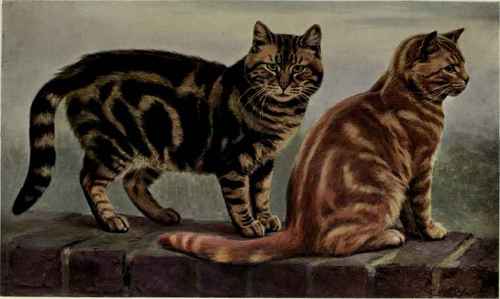
Brown Tabby And Orange Tabby Short-Haired Cats (From a Painting by W. Luker, Jun.)
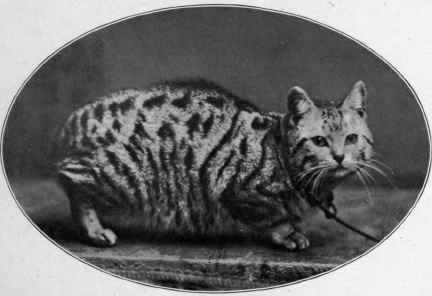
Mr. Ward's Manx "Silverwing." (Photo: H. Glacier, Longsight.)
Continue to:


My Books

