


General Management. Continued
Description
This section is from the book "British Dogs: Their Varieties, History, Characteristics, Breeding, Management, And Exhibition", by Hugh Dalziel. Also available from Amazon: British Dogs.
General Management. Continued
"Fig. 1 gives the front view of the sleeping house, the side view of which may be seen at Fig. 3. This is made to lift bodily in one piece, and is built of red pine boards one inch thick, tongued and grooved to make it weatherproof. At the front it is six feet high, falling to five at the back, so that a man can work comfortably inside. The door must open outwards, otherwise you will be troubled with straw and rubbish getting behind it, and it ought to be so let in as to exclude draughts. Two ventilators, which open and shut at pleasure, are introduced over the sleeping benches, and this proper attention to ventilation I consider of great importance. A pane of glass in the door gives what light is required, and a swinging panel, which the dogs very soon learn to use, ensures perfect protection during inclement weather. The panel must not be made of very heavy wood, and the hinges upon which it is swung must work easily. It should be cut about four inches from the bottom of the door.
Fig. 3. Side View of House and Yard.
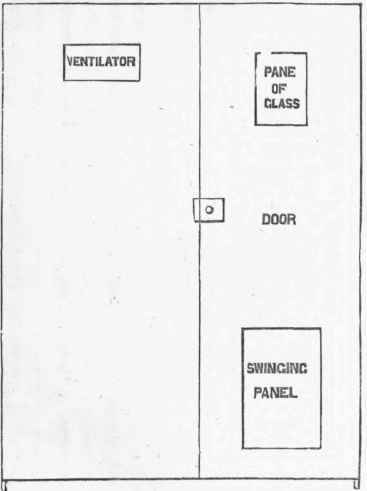
Fig. 1. Front of House.
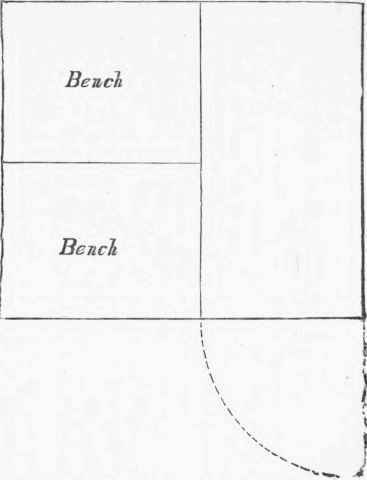
Fig. 2. Arrangement of House.
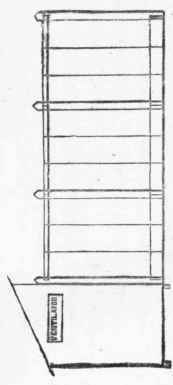
PORTABLE KENNEL FOR SEVERAL DOGS.
"Fig. 2 shows the internal arrangements, which consist of two benches placed so as to be out of the draught, and also to leave a free space for the dog to get in and out. The benches are placed one foot from the floor, and a division runs from top to bottom to prevent fighting, which will sometimes occur. The partition between the benches is movable, and when a family is expected it is taken out.
" Fig. 3 gives a side view of the kennel complete. The side of the yard is made in one piece, with a number of rafters to add strength, and it is covered with the largest wire netting.
"The doors to the yards are put at the bottom, opposite the sleeping houses, and to each of these a lock is fixed. Short supports are driven into the ground, and to them the frames forming the yard are screwed. When more than one is erected, by being placed alongside of each other a frame is saved; but the one which forms the partition, instead of being covered with wire, must be made of boards. The yards are paved with flags, which are properly laid so as to carry all surface water to a grid, and in this way the kennels are thoroughly cleaned every morning by the simple application of some water and a brush. I should have mentioned that the roof of the sleeping house is covered with felt and then tarred, the woodwork is painted outside and whitewashed in, and the latter process should be repeated once a month.
"As to cost, I have had three kennels built upon the above plan and placed side by side by a joiner in the neighbourhrood, who has finished them in first-rate style for an outlay of £25, and, I must say, I consider the money well spent."
In providing accommodation for packs of hounds and other large numbers of dogs the special circumstances of the locality must often to a considerable extent determine the particular form of the building, but in all the main objects the health and comfort of the dogs should be paramount, and this need not exclude considerations of convenience in feeding, cleaning, etc, for these really are included in the first.
Elaborate ornament might not be in keeping, but even a kennel is better when architecturally beautiful than if a mere misshapen block. The place chosen should be on rising ground, so that there may be good drainage. A light soil is always to be preferred. On wet clay soils it is almost impossible to keep dogs free from skin diseases, and such a situation induces other ailments also.
Concrete is the best flooring, and it should slope from the dormitories down to the bottom of the yard, along which there should be an open gutter running down to a grated entrance to the main sewer, so that the kennels can be readily cleansed with water, and get quickly dry. If due attention is paid to cleanliness in this way, disease will be less likely to appear and have less inducement to linger, and disinfectants need only be occasionally used as preventives.
It is generally necessary and convenient to lodge several dogs in the same dormitory, and these companions should be such as are usually on good terms with each other, for there is no large kennel in which individual dogs are not quarrelsome and spiteful against some other, whilst with those they like they are quiet and agreeable.
Sometimes there is one dog of such a mischievous tendency, and so cantankerous, that he proves a perfect nuisance, and there is nothing for it but to separate him, or he may spoil the temper of many others.
Where stud dogs at the service of the public are kept, kennels separate and secluded should be reserved for strange bitches, and these should be invariably cleansed, disinfected, and the walls limewashed on the departure of each one.
The sleeping benches in the dormitories should not be more than a foot from the ground, and with a front board to prevent a dog crawling under it. It should work on hinges, so that it may be lifted up and kept so by a hook in the wall or other simple contrivance. This enables the kennel man to get at every crevice and corner in cleaning out, which is very essential.
The doors must be big enough to admit the attendant, and if the lower part is made to swing, so as to be self-closing, cold and draughts will be avoided, and both sufficient light and ventilation can be provided for by a latticed window in the wall of the dormitory. This window should be so made as to entirely close, if necessary, in very severe weather.
Bedding
For bedding pine shavings are recommended, because the heat of the dog evaporates some of the turpentine they contain, and this is obnoxious to fleas. Pine shavings may be used in the summer, when dogs are as well without bedding, only that on bare boards they are apt to wear the hair off parts; but shavings are too cold for winter, and although they may assist in keeping fleas away, these troublesome intruders are better kept at a distance by constant attention to thorough cleanliness.
Straw in abundance is, on the whole, the best material for dogs in health, but hay is an advantage at times to dogs ill and to delicate puppies.
Cleansing The Kennel
The dogs should be taken out for exercise at a regular hour, and when out - if that is practicable, which it may not be if only one man is kept, or the dogs have not an enclosure to exercise in - the kennels should be thoroughly brushed out, and in warm dry weather swilled out thoroughly; for this purpose, if water can be laid on and used from a hose it is of great advantage, and saves time and labour. It must, however, be done before feeding - the food preparing the while. The straw should be forked off the sleeping benches, and these brushed free from dust and dirt, and the beds again made up. If they are dogs for exhibition, and require grooming, let that also be done before the morning meal is served.
Whitewashing
At regular intervals, say every month or six weeks, the walls should be whitewashed. For this purpose whiting is of no use. Get lumps of unslaked lime, and gradually slaking it, add water until it is thin enough to apply.
Disinfectants
The use of disinfectants is as preventives of disease, and to check its spread when it has entered the kennel.
Whichever is used it should be by itself, not mixed with the limewash. Disinfectants are numerous. Chloride of lime is a white powder, which must be kept very dry, as it absorbs moisture rapidly. It should be mixed with considerable quantities of water when used, and old rags dipped in the solution and hung up inside the dormitories where there is a suspicion of an infectious disease will prove a good way of distributing the free chlorine - which is the disinfecting principle - and purifying the kennel. A solution of permanganate of potash is an excellent disinfectant. There is, however, nothing better suited to kennel use, and so convenient, as "Sanitas," and of its efficacy I can speak from considerable personal experience; it is also reasonable in price, and handy, as all chemists sell it.
Carbolic acid - even granting the qualities claimed for it as a disinfectant, which I do not - is objectionable, because of the insolubility of the cheaper kinds, so that it never can be equally distributed. It is also a dangerous thing about kennels, when frequently men ignorant of the nature of poisons, and consequently careless, have the using of it therein.
It should always be strongly impressed on persons using disinfectants that throwing them down in quantities and in certain spots only is mere waste; it is the equal, regular, and constant distribution of them spread over large surfaces that purifies the contaminated air, as well as the floors, walls, etc.
Before leaving the subject of kennels, it may be well to refer to the necessary fencing for the yards ; and I would here call attention to the great improvement in this introduced by Messrs. Boulton and Paul, Norwich. They make iron fencing specially for kennels of every size and for every variety of dogs, and whether required light or strong, it is equally convenient, elegant, and durable.
Continue to:


My Books

