


The Wire-Haired Fox Terrier. Continued
Description
This section is from the book "British Dogs: Their Varieties, History, Characteristics, Breeding, Management, And Exhibition", by Hugh Dalziel. Also available from Amazon: British Dogs.
The Wire-Haired Fox Terrier. Continued
On this point "Stonehenge" says: "The Fox Terrier Club description does not sufficiently, I think, insist on the thick and soft undercoat, which should always be regarded as of great importance in resisting wet and cold. An open long coat is even worse than a thick short one for this purpose, as it admits the wet to the skin and keeps it there, whereas the short coat speedily dries." There is no doubt this undercoat is of great importance, but even when it exists in perfection, the divisions among the longer hair must allow a more ready access for rain and wet in the interstices than would be the case with a smooth dog, whose thick, dense coat lies flat and close together.
But the wire-haired terrier, from the absence of those causes that have so damaged the smooth race, has preserved in obscurity all the true working capacity of the tribe, for a very simple reason, that as a rule he has been bred solely for work.
There can be no doubt that in point of quality he is considerably behind the smooth hair; indeed, what would have happened to the race had not Kendal's Old Tip come to the rescue and got some really good-looking ones, such as Mr. Carrick's Venture, Mr. Shirley's Tip, Mr. Hay ward Field's Tussle, and others, it is impossible to say. Indeed, it is very seldom, even now, that one can find a good-looking dog of the breed without some serious fault.
The north countrymen have paid much greater attention to the breed than the south, and it was there that Kendal's Tip did good service with the Sinnington for some years. Mr. Carrick, of Carlisle has always a few good ones, which he uses with the otter-hounds, and several of them, such as Vixen and Venture, have been very successful at shows.
The late Charles Kirby, of Malton, owned some excellent terriers, chiefly from strains possessed by the Rev. C. Legard. Among these was Sam, who afterwards belonged to the writer, as game a dog as ever walked, but short of coat. He won a prize or two and was worried in the kennels. His blood proved very valuable, and may be met with in such dogs as Mr. G. Hogg's Topper, and several others, such as Sting (K.C.S.B. 5629).
Among others of Kirby's was Vic. (K.C.S.B. 6712), a beautiful bitch by Capt. Skipworth's Tartar out of Venom, by Lord Milton's Sam out of Rev. C. Legard's Miss, and there was also Tip, now called Tussle, a rare little dog, one of the few wire-haired terrier dogs of the present day that is just the right size - for be it remembered that the wire-haired terrier has for a long time been the companion of rabbit and rat catchers, so that his size has been permitted to increase in a way to unfit him for his legitimate purpose.
Mr. Colling, of Marske-by-the-Sea, is never without a good dog or bitch of the sort, and from his Patch, who hailed from the Hurworth Kennels, he bred Motley, a smooth dog, by Old Jester, who won several prizes in good company.
Mr. A. H. Easten has been very successful with several of his, of whom Tip, by Old Venture, did great things in his day; and we have the north country further strengthened now by Mr. Petler, of York, having purchased Gorse, who is without doubt the best show dog of the day - albeit., by no means perfect.
The bitches, strangely enough, seem to be considerably in advance of the dogs in show properties; and probably no one has brought out so many good ones as Mr. G. F. Richardson, who carried all before him with Bramble, Birch, and Bristles - the two last mentioned being now the property of Mr. Shirley, who should be able to breed something good from them with his well-known dog Spike.
Mr. A. Fitz Roy may be mentioned as one who has exhibited terriers of this breed with success, his Madge and Minx being very good samples. Then, of course, there has always something out of the common hailing from Nottingham, either from Mr. Wootton's, Mr. Terry's, or Mr. Hulse's kennels.
The Rev. J. Russell, who is certainly the father of fox terrier breeders, tells us that he has bred his dogs since 1815, and their pedigree has been kept quite pure, except that he once admitted an admixture of old Jock, a high compliment to the old dog.
The points of the wire-haired fox terrier are precisely the same as those of the smooth one, with the exception of the coat, which should be broken. The harder and more wiry the texture of the coat is the better. On no account should the dog look or feel woolly, and there should be no silky hair about the poll or elsewhere. The coat should not be too long, so as not to give the dog a shaggy appearance, but at the same time it should show a marked and distinct difference all over from the smooth species. This is the Fox Terrier Club's description of the coat, and I have nothing to add to it, except perhaps "Stonehenge's " remark about the necessity for plenty of undercoat.
The great thing is to get wire-haired terriers small enough, for they offend more in this respect at present than do the smooth ones. We must remember, however, that mere weight does not constitute size, and that show condition means at least l½lb. more than working condition. It must also be remembered that a somewhat oversized terrier can oftentimes be of service, while he is able to get along when the small one must be led or carried. The writer has seen a dog running with the Cleveland hounds that would certainly weigh close on 191bs., and he was generally able to do all that was required, while he could really make his way unaided either with or on the line of the hounds.
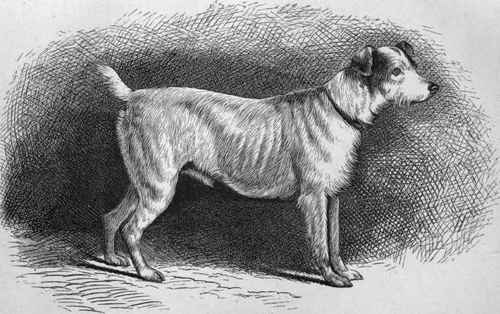
MR. A. H. EASTEN'S WIRE-HAIRED FOX TERRIER "TWISTER/' Sire Terror, by Tramp (brother to Old Jerry) out of Venom - Dam Wasp, by champion Ruler.
"The Sporting Dictionary" says: "With every established pack of foxhounds there is seldom to be seen less than a brace of terriers; and for the best of reasons, one is generally larger and stronger than the other; in a small earth where one cannot enter the other may."
So, then, it is apparent our grandfathers did not wholly discard a dog that could not always follow his fox, if they knew he would be generally able to do so; but they supplemented him with a smaller one, whose drawback would be inability to go the pace.
It must not be thought for a moment that this chapter advocates large terriers. On the contrary, there can be no doubt that the ideal dog is one who can follow his fox anywhere, and yet has size and speed enough to enable him to get over the ground; but it would be somewhat unfair to sweep the larger ones off the face of the earth, provided always, they are not like the majority of wire-haired terriers of the present day, large beyond all reason.
Measurements of -
Mr. Arthur H. Easten's wire-haired Twister: Age, 1 year and 5 months; weight, 221b.; height at shoulder, 13½in.; length from nose to set on of tail, 26½in.; length of tail, 4in.; girth of chest, 21½in.; girth of loin, 18½in.; girth of head, 13¼in.; girth of forearm, 5½in.; length of head from occiput to tip of nose, 7½in.; girth of muzzle midway between eyes and tip of nose, 6½in.
Mr. J. W. Corner's Chance: Weight, 191b.; height at shoulder, 14in.; length from nose to set on of tail, 28in.; length of tail, 4½in.; girth of chest, 20in.; girth of loin, I7in.; girth of head, 12in.; girth of arm, 4¾in.; girth of forearm, 3¾in.; length of head from occiput to tip of nose, 7½in.; girth of muzzle midway between eyes and tip of nose, 7½in.; colour, white body, lightly marked badger tan on head.
Continue to:


My Books

