


Distemper. Part 8
Description
This section is from the book "Everything About The Dogs", by Alvin George Eberhart. Also available from Amazon: Everything About Dogs.
Distemper. Part 8
Don't let a day pass without proper use of compound tablets (pepsin, bismuth and charcoal).
Don't get scared if your dog won't eat. It's better for him not to eat until he can handle his food rightly. He won't die of starvation.
Don't allow him to get his feet wet. This is likely to bring on pneumonia, which is generally fatal.
Don't wash a dog, no matter how foul he may be, when down with distemper or convalescent. Brush, comb and clean with powder (flour). Many a dog has contracted incurable chorea and its twitches from a bath too soon after distemper. Keep him away from the water for three months at least.
Don't let your dog off chain as soon as he begins to feel better. Keep him there till well, leading him for exercise only when convalescent. Relapses are common and often fatal.
When your patient is once well over distemper you can risk him anywhere, for dogs do not have the real thing but once. If your dog's system is left very much run down, blood tonics are good, according to individual needs, Scott's Emulsion being especially beneficial.
The most important safeguards to bear in mind are: (1) Absolute quiet on chain in dry quarters. (2) Tablets regularly given and constant care. (3) The seton promptly put in before the case has advanced to the fatal or acute form of the disease. Distemper in itself is not fatal, but the complications and collateral developments it leads to are. Whoever faithfully follows the suggestions given in this article need have no fear of any fatal results from distemper. The ideas herein formulated are but the result of years of practical experience of varying results with young setters. Common sense is the underlying principle of it all, which after all, if used in time, is far better than medicine. We hear of all kinds of "cures," including those who still have faith in "coffee," the pellet of "buckshot," or dose of "gunpowder," together with other harsher specifics and methods of treatment. Should we not give our priceless dogs, whose value every year is increasing with their educated usefulness and close com-panionableness, the benefit of up-to-date intelligent care, rather than the "guess at it" methods of the past?
"Modestly submitted for the benefit of somebody's faithful dog, sometime, somewhere."
The following very complete and exhaustive article on Distemper was written especially for this book by Dr. George W. Clayton:
Distemper.
History
The disease now known as canine distemper made its appearance at a very early period. According to Laosson, it was known at the time of Aristotle, and the epizootic that invaded Bohemia during the year 1028 and decimated the canine species of that country is now known to have been canine distemper. It made its appearance in England and on the Continent of Europe during the Seventeenth Century, first in Spain, and traveled from there to the other countries. It appeared in England and France about 1740, in Germany in 1748, in Italy about 1764, and in Russia in 1770. Distemper now exists all over the world wherever the dog is found. From the time of its first appearance it has been considered one of the most fatal diseases to which the dog is subject.
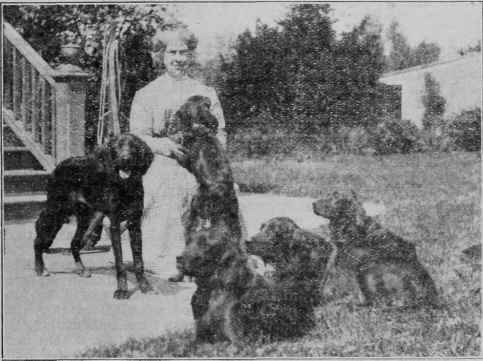
Richwoods Kennels, IRISH SETTERS. One of the largest Irish Setter Kennels in this country. Have b r ed many champions, and one International Champion. Tup-pies usually for sale, from prize winning stock.
CHAMPION RICHWOODS GLENROY, (182911), at Stud. A son of the Famous Ch. PAT LAW.
WALTER McROBERTS, Peoria, 111. Member Irish Setter Club of America. Al. G. Eberhart is my agent at A. R. C. shows.
Definition
Distemper is an acute contagious disease, caused by the introduction of a specific poison into the system. It has been known under various names. Opinions differ as to its nature. Some authors have compared it to typhoid or typhus in man, others to variola. A number of different authors describe it as a catarrhal fever, as it affects all the membranes of the body. The nervous system is generally if not always involved, and there is also a characteristic skin eruption.
Causes
That a germ constitutes the exciting cause of distemper we . are convinced by recent investigations. Some authorities believe there may be several germs or different forms of the same germ. As the disease is very highly contagious, clearly defined, and well characterized, the existence of a specific germ must be conceded. According to this theory the spontaneous origin of distemper is not tenable, and that the disease may be perpetuated and continued in existence, there must be a continued propagation of the poison, and a continual transmission of this poison.
"The poison exists in the air in a fixed and volatile state, and enters the system by the nose and mouth.
"The virus can be communicated from one animal to another, and transmission by cohabitation is more easily effected than by inoculation.
"The germ has great vitality and great power of resistance. It may undergo dessication in the air and still retain its virulence. It can exist a long time outside the body without destruction, and communicate the disease when brought into contact with susceptible individuals.
"It has been found that the virulent properties of the germs are not lost in any degree when dried at a normal temperature, or when exposed to a temperature of 20 degrees Centigrade, but does lose some of its power if preserved in a dray state and kept for any length of time.
"Under proper conditions the poison of distemper can reproduce itself without limit.
"The blood of the affected animal has been found to be contagious; also the secretions from the eyes and nose.
"Vaccination of young animals by means of the secretory fluid from animals affected with the disease has been tried and has produced the disease artificially. The disease when produced from vaccination generally runs a mild course. The liability of dogs to contract distemper is not the same at all ages, and under all circumstances and conditions. Old dogs have a greater chance of escape, this being more a disease of youth. Young animals generally contract the disease in the course of their first year. Sometimes whole litters of puppies being carried off by it. Some animals seem to possess immunity from the malady, and one attack successfully overcome produces immunity from another. In very rare cases there are exceptions to this rule. Distemper is found in all localities, and at all seasons, in the country it may be more rife at some seasons than others, but in large cities it exists permanently.
Continue to:


My Books

