


Ringworm Of The Horse
Description
This section is from the book "The Horse - Its Treatment In Health And Disease", by J. Wortley Axe. Also available from Amazon: The Horse. Its Treatment In Health And Disease.
Ringworm Of The Horse
It may be observed at the commencement that ringworm in the horse is a comparatively rare affection. In cattle it is constantly found in young animals; very rarely, however, is it seen in an animal after the age of one year. In the horse age does not appear to afford any protection from the disease.
Symptoms
In consequence of the common occurrence of a form of eczema, in which the eruption is distinctly circular, the term ringworm is frequently applied to that disease, which is not associated with the presence of a fungus and is not contagious in its character. In eczema the round patch which characterizes the eruption is developed at once, hut in ringworm it commences as a small pimple and spreads day by day in widening circles until a rounded patch is produced. True ringworm is in all cases due to the growth of the fungus (Trichophyton) in the hair follicles, and frequently in the interior of the hair, and the diagnosis of the disease implies the detection of the fungus under the microscope. For this purpose a few hairs and a certain small proportion of scab should be removed from one of the spots of the skin, placed in a little solution of potash, with a few drops of glycerine added, in order to render the opaque scabs transparent. If the disease is ringworm the appearance presented will be that which is indicated in Plate XXXVI, figs. 9 and 10.
Another method of diagnosis has been suggested, which, taken in connection with the clinical symptoms, i.e. itching and the appearance of gray scabs along the back, the sides of the withers, and, in bad cases, on the neck and head, may lead to a correct conclusion; hut absolute proof of the nature of the disease can only be obtained by microscopic inspection. The method proposed is as follows: - A few drops of chloroform are allowed to drop on one of the suspected spots; if, after the evaporation of the fluid, some of the hairs present a white or pale-yellow colour, it is concluded that the disease is ringworm.
Two varieties of ringworm have been distinguished by writers - the common kind, in which the scab is gray and the hairs are inclined to break off short at the mouth of the follicle, owing to their brittle condition; and another form, in which the scabs are yellow, and the hairs, instead of breaking off, fall out and leave perfectly bare patches of skin. This variety of the disease does not appear to have been recognized in England.
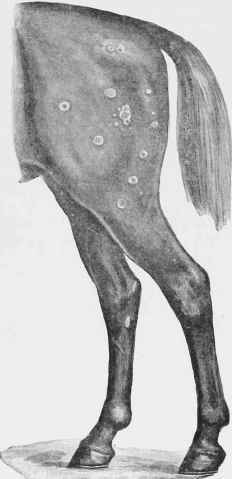
Fig. 272. - Ringworm.
Treatment
It is a somewhat remarkable character of this disease that while the eruption extends from the centre of the scab by constant distribution of the spores there is a well-defined limit to its progress, and at a certain point the disease undergoes a spontaneous cure. This has been noted particularly in ringworm of calves, and there is no doubt that the continuance of the affection in many cases is largely dependent on the general weakness and poor condition of the subject. The average duration of ringworm in the horse is said to be forty to fifty days, but it must be understood to mean that in regard to a certain spot or a certain number of spots a cure will be evident by the growth of new and healthy hair. Meanwhile, however, any advantage from this spontaneous cessation of the affection is often neutralized by the constant conveyance of the spores (seeds) of the fungus to the other parts of the skin. Consequently it happens that as fast as the affection is cured in one place it breaks out in another; hence the necessity for the prompt use of remedies which will destroy the vitality of the fungus as quickly as possible.
Various agents are employed in the treatment of ringworm, and it may be said of nearly all of them that they are perfectly successful, for, unlike the ringworm of the human subject, ringworm in the lower animals is not difficult to cure. Among the agents which are recommended arc a solution of corrosive sublimate, 1 to 300 of water, to which a little spirit has been added, or a mixture of 1 part carbolic acid with 10 parts of glycerine. These preparations are to be applied by means of a brush to the spots of ringworm wherever they are found. Of the ointments which are commonly employed, blue mercurial ointment, and red biniodide of mercury, each diluted with six times its bulk of lard or vaseline, are most effective. The treatment in any case will have to be continued until a healthy state of the skin is indicated by the growth of new hair in all parts of the diseased skin.
Transmission of ringworm to other horses, probably also to other animals, and certainly to human beings, is likely to take place unless proper precautions are used. Care therefore should be taken to cleanse and disinfect thoroughly the stable and its fittings, destroy the litter, and disinfect or destroy all the stable apparatus used about the diseased animals.
For the protection of the helper who dresses the animal the shirt-sleeves should be kept down instead of being turned up, as is usually done, as experience proves that the arms are the parts most likely to be attacked.
Continue to:


My Books

