


Fossil Ancestors Of The Horse
Description
This section is from the book "The Horse - Its Treatment In Health And Disease", by J. Wortley Axe. Also available from Amazon: The Horse. Its Treatment In Health And Disease.
Fossil Ancestors Of The Horse
The preceding remarks on the special characters of some portions of the horse's structure, and on the presence of organs and parts which have now no obvious use or function, have cleared the way for a brief enquiry into the evolution of the horse. Organs which are now gradually becoming rudimentary and useless must have once formed essential parts of the animal's structure; and in their present state it may be said of them that their existence cannot be satisfactorily accounted for except on the assumption that they were transmitted from remote ancestors in gradually modified forms, becoming less and less definite in character as they became either obstructive or unnecessary to the animal in its different surroundings and new mode of life.
The doctrine of evolution has already been illustrated by reference to the process of generation in the higher and lower forms of life. Changes in the small mass of "undifferentiated (that is, formless and jelly-like) protoplasm" in the human ovum (egg) have been seen to result in the development of a mature human form; and almost identical changes in a microscopic cell in the ovum of other animals have also been referred to.
No hesitation is permissible in respect to the facts of evolution which have been described. Wonderful in truth they are, unbelievable, perhaps, to many, but nevertheless commonplace facts to the man of science, who has had the faculty of wonder obscured and dimmed by incessant repetition of the marvellous in his daily work, and who can no longer take refuge in doubt, because the evidence forces him altogether out of the region of doubt.
Continuing the investigation in the direction of the previous remarks, evidence has now to be produced from the discoveries of geology to justify the assertion that the modern horse had its origin in the remote past in ancestors the history of which can be traced from the earliest beds of the Tertiary formation up to deposits of a comparatively recent date.
In dealing with this part of the subject two courses are open, either to trace the horse from its present condition backwards to the first-discovered hoofed mammal in the lower Eocene, or to begin at the beginning and follow the changes in size and arrangement of his various organs in successive generations of horse-like animals, each series becoming more and more like the horse, until, in the recent deposits, the differences are almost obscured by similarities, and finally vanish altogether. The latter course will pro-bably be the more interesting and intelligible.
It has been well said that the horse is an animal the evolution of which from the Eocene to the Pleistocene may be compared to a chain in which there is scarcely a missing link.
Starting with the earliest hoofed mammal yet discovered, which, though not a direct ancestor of the horse, has certain special characteristics in common with it - the animal known as the Phenacodus deserves notice. 'The first specimen was dug up by Professor Cope from the Eocene marl on Bear River, Wyoming, and the restored skeleton of the animal is represented in Plate LXX.
The lighter shaded portions of the figure indicate the places where missing portions of bones have necessitated restorations. No important bones are absent, although, as necessarily happens in fossil specimens, some displacement of parts has occurred.
A glance at the skeleton of the Phenacodus will show that it belongs to the perissodactyle or odd-toed mammals, and that the third digit is distinctly larger than the rest. It is not to be understood that the animal here shown is to be taken for the primeval horse, but it has several characteristics in common not only with the horse but also with the rhinoceros and tapir, which lead us to conclude that these animals are all descended from nearly allied ancestors, of which the Phenacodus may be taken as a representative.
In the later Eocene and the formations overlying it the remains of hoofed mammals are found exhibiting remarkable changes in their teeth and in the arrangement of the bones of that part of the extremities which is rightly called the foot, the bones below the joints called the carpus or wrist and tarsus or ankle in man, the knee and hock of the horse (see Plate LXXI). From the five-toed Phenacodus the change to four, three, and then one (with rudimentary splint bones) is seen to have gone on with remarkable regularity, as indicated in the illustrations.
In the Plate the extremities of the limbs have all been drawn to the same scale, so as to show their relative sizes, fig. 1 representing the fore- and hind-feet of the Phenacodus already mentioned - an animal about as large as a fox - whilst fig. 7 represents those of the horse of the present day.
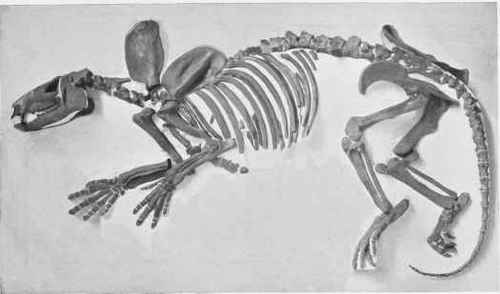
PLATE LXX. SKELETON OF PHENACODUS.

PLATE LXX. SKELETON OF PROTOROHIPPUS.
The worn or exposed surfaces of the upper molar teeth of five of these fossil animals and of the horse are represented in fig. 667; in order that the development from the comparatively simple structure of the tooth of the Hyra-cotherium to the complicated details of the teeth of the Hipparion and horse may be more readily followed, those figures are drawn of the same size, although in nature there is a gradual increase in size as well as in complexity. Of these examples the first three belong to the brachydont or short-crowned class, of which a side view is given at a, fig. 668, whilst the teeth of the Protohippus and Hipparion show an advance towards the state of hypsodont or high-crowned teeth (b, fig. 668) which culminates in the horse (c, in the same figure).
Next in chronological order to the Phenacodus mention must be made of the Hyracotherium and the Eohippus, also from the Eocene, which are, so far as is at present known, the earliest direct ancestors of the horse, the former in the Old, the latter in the New World. They may, indeed, be varieties of the same animal, and they are described as being about the size of a fox. In the fore-feet there were four well-developed toes and the rudiment of another, the hind-feet had three toes, as represented in the Protorohippus (fig. 2, Plate LXXI), which marks the next step in the order of development. The change which has taken place in the latter animal, as will be seen by reference to the figure, consists only in the loss of the rudiment of the first digit, leaving second, third, fourth, and fifth digits. It will be observed that the third or middle digit is the largest of the four, representing in fact what has previously been termed the one big digit of the horse.
Continue to:


My Books

