


Chapter 5. Horse Show Jumping
Description
This section is from the book "Training Young Horses To Jump", by Geoffrey Brooke. Also available from Amazon: Training Young Horses To Jump.
Chapter 5. Horse Show Jumping
In my opinion there is little to add with regard to the training of show jumpers. I believe on the Continent they keep horses especially for show jumping and this class of animal is never hunted. Personally I can see little use or amusement in keeping a horse solely for this purpose, and I would be very sorry to do so.
A horse schooled on the lines that I have suggested will probably not only be a good hunter but also a good show jumper. One often hears people say that a horse trained for show jumping is spoiled as a hunter. If this is the case it must be due to some very exceptional training that it has undergone.
In the early training we were careful to teach our youngster to jump fast and extend himself. Now this is not essential for an Olympia jumper; he can go up in the air, dwell there, and land almost on the same spot. Needless to say this class of show jumper is neither a pleasant nor reliable fencer.
As a rule I have found the more highly-trained jumper is the more brilliant fencer, and surely it is a pleasure both to horse and rider, if he sometimes does jump a bit too big. You feel that you have a bit in hand, as you can always go the shortest way. You certainly have a better chance when you come to a really big fence than the rider on a horse that barely jumps big enough. This is probably contrary to the opinion of most men, but I find it gives me more pleasure to ride a bold young horse, that feels like jumping the National Course, than a safe old stager, that has lost the elasticity of youth.
A horse that is to perform at Olympia naturally must be schooled in a Riding School, if possible over solid fences, and the more peculiar the fences are in appearance the better.
It is ridiculous to expect the ordinary hunter to show his best performance in a school if he has not been used to it. In fact, if he is to be successful he must in all probability start at the beginning and work up gradually like a young horse. He will then learn to jump quietly and go through the monotony of school jumping as a matter of course. He has to learn to jump slowly and with only a short run, to balance himself, to get his weight forward when required, and to raise his hindquarters.
A standing martingale may often be found useful in training a show jumper that is inclined to jump with his head too high. He will soon learn to correct this fault, if the rider assists him by getting his own weight forward and giving complete liberty of rein when the horse is actually jumping. The rider will often find it necessary to exaggerate both these actions with a horse that appears to jump with his weight too far back, as the whole of show jumping for man and horse is an exaggerated effort.
The horse that rides with too much of his weight in front is more likely to raise his hind-quarters, but perhaps not his forehand, sufficiently. If he can be given one or two falls free he will soon learn that solid fences are not to be trifled with. If this treatment has little effect on him, and he continues to knock the fences with his fore-legs, the chances are that he is not worth training as a show jumper, provided always, of course, that he has had a fair chance, starting over small obstacles at slow paces at the commencement. Remember that a jerk on the horse's mouth when in mid-air will raise the horse's head and down will go his hindquarters, and down will come the railway gates or sleepers, etc.
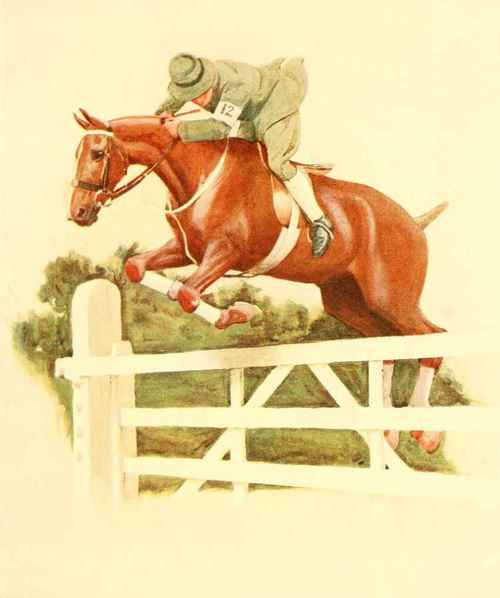
The Exaggerated Seat - Show Jumping: The Gate
In riding show jumping it is necessary to, always ride the horse in the same way, otherwise he cannot consistently show his true form. I found this out from experience lately, when, owing to an injured leg, I was unable to ride the horses in the manner they were accustomed to. Consequently they lost confidence and failed.
For this same reason it is inadvisable to put strange riders on to horses when they are show jumping. No matter how good the rider may be, he and the horse will probably take some days to know each other's ways, and, until they do, the horse cannot be expected to jump in his best form.
Horses trained for show jumping may roughly be divided into two classes.
1 - Horses that perform on their own, and the rider is merely a passenger. Such horses are trained by incessant jumping, and generally take several years before they reach the top of their form.
2 - Horses that are carefully trained to obey the rider's hand and leg. They can then be taught to jump in a comparatively short time,
The rider can lengthen or shorten the horse's stride as he wishes, consequently he watches where the horse is putting his feet, and keeps him on his hocks, and makes him take off when he wishes. This helps the horse to measure the fence, and he will seldom make a bad blunder. Personally I prefer the latter class of horse. In this country, where most officers play polo, they cannot be expected to keep up hunters throughout the summer for show jumping, and most soldiers' horses require a well-earned rest after hunting. The only horses I have ever jumped at Olympia have been troop-horses. No doubt in every regiment there are a considerable number of horses that could be trained successfully for Olympia. The training entails very little time and trouble, and is in no way detrimental to the horse's military career.
Continue to:


My Books

