


Kinds Of Stairs
Description
This section is from the "Practical Building Construction" book, by John Parnell Allen. Also see Amazon: Practical Building Construction.
Kinds Of Stairs
A straight stair is that on which the person ascending moves up in the same forward direction from bottom to top, as Figs. 798, 799, and 800, in plan, section, and elevation. This is a very common form of stair, though it takes a considerable length of space in proportion to the height to be attained; and on the other hand, it only takes up half the width. It is a very tiring and inconvenient stair when there is a considerable distance to ascend.
Fig. 801.

Sectional Elevation.
Fig. 802.
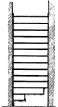
Front Elevation Fig. 803.
Figs. 801, 802, and 803 represent the same class of stair with winders at the bottom, which create a saving in the length of the staircase, and, when at either bottom or top, necessitate the starting place or landing being almost at right angles to the stair itself.
Winders, though of common occurrence, are an inconvenient defect in a stair, and should always be avoided as much as possible. Straight stairs may have a landing in their length, to break the flight, and as a resting place; but it seriously increases the length of the staircase.
Dog-kgged stairs are the first improvement on the latter, inasmuch as by them the distance to be ascended is divided into two flights with a half-space, or two quarters connected by one riser, between each flight, as Figs. 804, 805, 806, 807, 808/and 809. It will be seen that the length of the staircase is considerably reduced, while its width is increased; also that the outer string, carrying the outer ends of the steps of one flight, is exactly above that of the other flight, leaving no opening or well hole, as it is called, between them. It is in this kind of stair that the newel is first used, its object here being to receive the top end of the string and handrail of the one flight, and the bottom ends of the other, or top flight The newels are generally square pieces of wood, but sometimes turned or otherwise ornamented. Figs. 810 and 811 represent the common square newel (used in Figs. 807, 808, and 809), which receives the strings of both flights, one over the other, on the first side, the risers of the bottom and top step of the alternate flights on the second and fourth sides, and the riser (X, Fig. 811) on the third side, when there are two quarter-spaces in lieu of the half-space landing. The newel reaches in length from the floor below to a little above, where it receives and supports the handrail of the top flight.
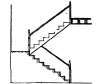
Sectional Elevation Fig. 805.

Front Elevation Fig. 806.

Sectional elevation Fig. 808.

Front Elevation Fig. 809.
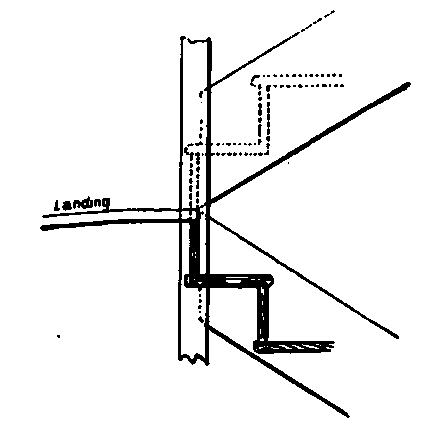
Fig. 810.
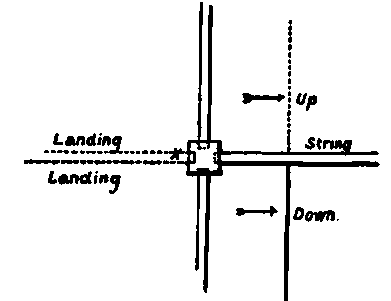
Plan.
Fig. 811.
Sometimes, in dog-legged stairs, the quarter and half-spaces are completely taken up by winders; but this should always be shunned as a most serious defect and danger.
The open newel stair differs from the foregoing, in that it has a well hole between the strings of the two flights, necessitating the use of two newels in lieu of the one at the junction; while it allows of one tread and two risers between the two quarter-spaces, as in Figs. 812, 813, and 814.
This is a convenient form of stair, though it takes a wider staircase than the last; but this is more than counterbalanced by its utility, for which reason it is most generally used in decent work. Still, its principles can be misused by the addition of winders in the quarter-spaces, as in the last.
A geometrical or wreathed stair is one which has no newels. It requires about the same length of staircase as a"dog-legged" or "open newel" stair, but is perhaps a little wider than the latter. The principle of the stair is the continuous string, stretching, or inclining, as it does, from bottom to top, around a well hole, with a half-round comer (still on the incline), where the newels of the open newel stair have been dispensed with.

Fig. 812.

Fig. 813.
It has no landings or quarter-spaces, but is one continuous, convenient, and comfortable ascent, the winders converging to points inside the well hole, and thus giving a wide tread, at a very short distance from the wreathed string and handrail. Figs. 815, 816, and 817 give plan, section, and elevation of such a stair.

Fig. 814.
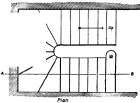
Fig. 815.
Having explained the different kinds of stairs, it now only remains to explain the details which may be said to be applicable to all the foregoing kinds, although there are extra members, and different forms and details of them, peculiar to the more elaborate kind of stair.
Continue to:


My Books

