


Mouldings
Description
This section is from the "Practical Building Construction" book, by John Parnell Allen. Also see Amazon: Practical Building Construction.
Mouldings
Mouldings are a series of sinkings and projections of various forms - mostly parts of circles, ellipses, etc. - worked on the edges of the wood to produce light and shade by shadows, and give it an ornamental and showy appearance. They are of two kinds - stuck and planted, or laid in; the former denoting that the moulding has been worked on the solid edges of the stuff, as in Fig. 560; and the latter that it is a separate slip, moulded and attached to the side of the framing by brads and glue, as Fig. 561.

Fig. 558.

Fig. 559.

Fig. 560.

Fig. 561.

Fig. 562.
The chief parts of moulding are as follows: -
The bead (Fig.. 562) is the most useful, being often utilised for covering joints, etc., and as a nosing to round off edges, when it is called a "rounded nosing."
The quirked bead has a sinking ton one side, as Fig. 563, and the double quirked has one on each side (see Fig. 564). They are required to give a limit produced by the shadow.
Fig. 563.
Fig. 564.
Fig. 583.
The return or staff head - "return" being the joiner's term, and "staff" the carpenter's term - Fig. 565, is used for exposed angles, where arrises would soon be knocked off.

Fig. 566.

Fig. 567.
The cocked bead - named after its projection from the face line - is as Fig. 566.
Cocked bead and fillet is as rig. 567.

Fig. 568.
Where several beads are placed together they are called reeding (Fig. 568).

Fig. 569.

Fig. 570.
The Torus is a bead with an extra fillet (Fig. 569).
The Ovolo is a quarter of a circle with a fillet on either side, as Fig. 570.
It can also be a part of an ellipse or any other circular Figure. A sash bar is formed by a "double ovolo," as Fig. 571.
The Cavetto is the reverse to the ovolo (Fig. 572), hollow in form.

Fig. 571.

Fig. 572.
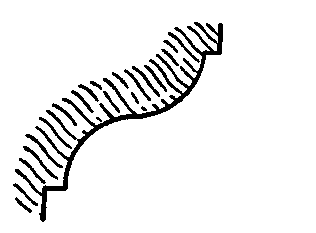
Fig. 573.
Ogee, or the "Cyma recta" mouldings, are made up of parts of two circles which touch one another, as Fig. 574.
Cyma reversa, or the reverse ogee, as Fig. 573, explains itself.
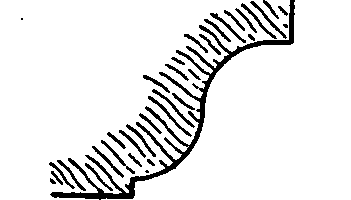
Fig. 574.

Fig. 575.
The Scotia, a moulding chiefly used for bases, is similar to Fig. 575.
Mouldings are often made up of two or more of the above forms grouped together, when they are known or distinguished by the combined name. Thus Fig. 576, consisting of a quirk ovolo (any moulding can be quirked by the addition of the sinking on one side) and a bead, is called a quirk ovolo and bead moulding.
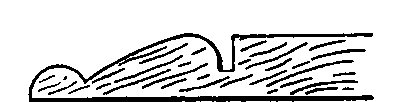
Fig. 576.

Fig. 577.
Median mouldings are those which are rebated out at the side, and project above the face of the panelling it is intended to ornament (Fig. 577).
Chamfering is the taking off of the arris or sharp edge of any angle, as Fig. 578, the angular groove formed by the meeting of two chamfered angles (Fig. 579) being called a V joint.

Fig. 578.

Fig. 579.

Fig. 580.
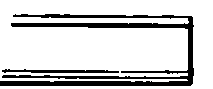
Fig. 581.
Mouldings, etc, are united at internal angles, as in Fig. 580, stopped at ends (Fig. 581), and returned at extreme angles (Fig. 582), when the contour of the mould is exposed to view.
Match Boarding
This is an arrangement of boards matched and put together with grooved and tongued joints, and their edges "shot" or planed truly, so that a fine joint can be made. Match boarding, otherwise called deciding, is of several kinds, the chief of which are: -
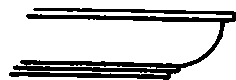
Fig. 582.

Fig. 583.
Plain matched boards (Fig. 583).
Beaded-one-side match boarding (Fig. 584).
Beaded-both-sides match boarding (Fig. 585).
V-jointed match boarding (Fig. 586).

Fig. 584.

Fig. 585.

Fig. 586.
Affixing Of Joinery Work
Joinery work is fixed to either plugs, grounds, or backings.
Plugging is done by means of wood wedge-shaped plugs, which are driven into the vertical joints of the bricks, and cut off to a level face, to which the other woodwork is secured by nailing (Fig. 587).
Grounds are used in better work, being wrought and splayed to form a key for the plaster. They are nailed to plugs in the cross-joints, as Fig. 588; or to wood or breeze bricks, Fig. 589; or to elm pads, Fig. 590; which the bricklayer builds in the cross-joints for the carpenter to fix to.
The grounds are " framed" (that is, dovetailed) at external, and tongued at internal angles, in the very best work. To doors and windows they are splayed to receive and "key" in the plastering, being fixed perfectly "plumb" or perpendicular to the plugs, bricks, or palettes encircling the door or window, except at the floor line. Fig. 591 represents an enlarged plan of a door-jamb, and Fig. 592 an elevation to a smaller scale.
1" Scale.
I" Scale.
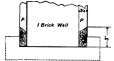
Fig. 591.

Fig. 592.

Fig. 593.

The doited line on Fig. 591 represents the gauge to fix by. The angles at X on Fig. 592 are joined by a bevelled haunching, as Fig. 593, in the elevation, drawn to a larger scale.
Backings are pieces of wood framed in between the grounds to form a backing and fixing for linings, window boards, and other wide joinery, requiring to be fixed against anything, as Fig. 594.
Shaped backings are those which are cut and notched to receive irregular framing or different members, as skirtings, etc., in best work. (See Fig. 595.)
For ordinary skirtings a fillet is run along the walls, on the floor, to receive the bottom of the skirting, as X, Fig. 590.
All first-class work should be fixed to grounds in lieu of plugs, which are only fit for inferior common work; and when the grounds are fixed perfectly true vertically and horizontally, there is no difficulty in affixing the joinery without fitting, cutting, and scribing; and moreover the plasterer finishes his work with greater truth in his surfaces, as he has perfectly true substantial grounds to straighten from.
Continue to:


My Books

