


Apparatus For Photo-Micrography. Part 5
Description
This section is from the book "Complete Self-Instructing Library Of Practical Photography", by J. B. Schriever. Also available from Amazon: Complete Self-Instructing Library Of Practical Photography.
Apparatus For Photo-Micrography. Part 5
714. Use Of The Hand Focusing Glass
Use Of The Hand Focusing Glass. For some high-power work the hand focusing glass may need to be employed. With it you obtain a sharp focus on the central part of the image. Place an ordinary focusing glass, similar to the one shown in Fig. 3, of Illustration No. 126, on the center of the ground-glass and look through it the same as you would when focusing with the eye-piece on the microscope. The focusing glass may be moved about over different portions of the field until a sharp focus is obtained.
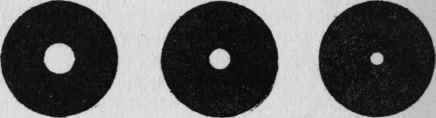
Illustration No. 128 Interchangeable Diaphragms for Microscope See Paragraph 715
715. Diaphragms
Diaphragms. For the cheaper instruments which are not fitted with the Abbe condenser diaphragms, a little more depth of focus can be obtained by applying an interchangeable diaphragm in the tube of the microscope. These diaphragms may be made of black paper and can be supplied with different size openings. (See Illustration No. 128.) To insert these diaphragms, remove the eyepiece and inner tube from the microscope and slip the diaphragm down in the tube, resting on a metal diaphragm, which is present in this outer tube. These diaphragms are easily made. In order to obtain the actual measurements, place a piece of black paper on the top of the outer tube, and with the finger crease the outline of the tube; then, with a pair of shears, cut to the outline. Next, perforate the center, being careful that the hole is perfectly round. Illustration No. 128 will give you an idea of the size opening required. It is needless to state, that the smaller the opening the sharper the image, requiring a correspondingly longer exposure. When the high-grade instruments fitted with an Iris diaphragm in the Abbe condenser are used, the interchangeable diaphragms are not necessary. For all ordinary work, the diaphragms are really unnecessary, but where great precision is required in the focusing, they are almost indispensable.
716. Photo-Micrographic Camera For Laboratory Use
Photo-Micrographic Camera For Laboratory Use. In Illustration No. 127 we present one of the latest photo-micrographic cameras, made by the Bausch & Lomb Optical Company. This is a very practical instrument, and is designed to meet the requirements of medium-power work in any laboratory. The strength, simplicity, serviceability and convenience of manipulation are at once apparent, and attention is directed to the fact that but one vertical bed is employed, thus giving a much greater latitude for work, as compared with those models using two upright rods.
717. The camera consists of a heavy metal base 9 4-5 x 13 inches, upon which a movable plate 8x6 inches is mounted and secured with a clamp. This plate has a movement of 4 3/4 inches, thus allowing the microscope, which is clamped to it, to be removed from the axis for examining a slide and then quickly returned to the proper position. An adjustable clamp is mounted on the plate, and by this means any microscope may be secured in place and accurately centered, the clamp and the plate permitting movement in two directions.
718. The vertical bed, 25 3-5 inches long, is graduated throughout its length and is mounted on the base with a joint having its bearing surface in the shape of an arc. A clamp secures the vertical bed at any angle between the horizontal and vertical positions. This camera can, therefore, be used in a vertical position to photograph objects which must be held in a horizontal position, such as specimens in solution, or may be inclined at will to meet any conditions.
719. Upon the vertical bed two frames are supported by standards held in a T-shaped slot by clamps. The first frame carries either the front board with tube adapter for the microscope or a shutter and this adapter. The bellows, which have a cross section of 4 3/4 x 6 1/3 inches, are attached to the rear of this frame and extend to the rear frame. They are long enough to accommodate work at any distance along the bed.
720. The rear frame carries a camera box of unique design. At the back a hinged cover with two springs permits the plate-holder to be laid into place, and then gently but firmly pressed into exact position, bringing the plate into focus without jarring the apparatus. This is most essential in high-power work where the focus must be exact. The focusing screen of ground-glass, with clear center, slides in two grooves in the camera box, and is, therefore, always used in the same position.
721. The finish throughout is dull black, excepting the bearing surfaces, thus preventing reflections as far as possible. A double plate-holder for two 4x5 plates, with kits for 3 1/4 x 4 1/4 plates, is included in the outfit.
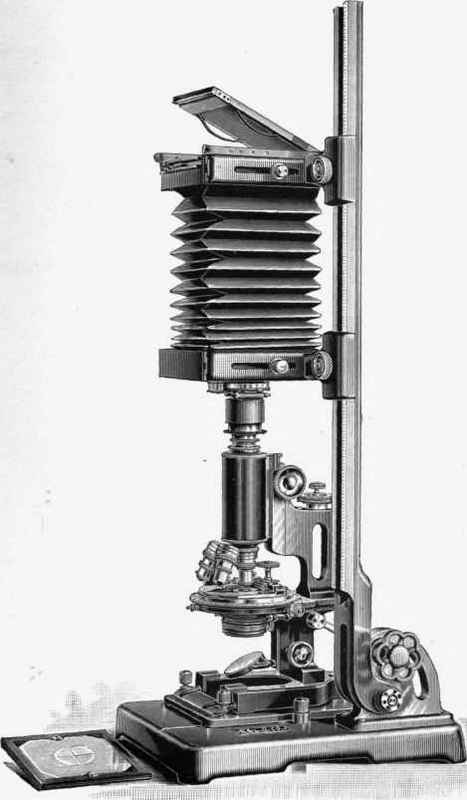
Illustration No. 127 Bausch & Lomb Photo-micrographic Camera for Laboratory Use
See Paragraph 711
Continue to:


My Books

