


How To Make A Reminder Board. A Papier-Mache Bowl. Wooden Belt Buckle
Description
This section is from the book "Craft Projects For Camp And Playground", by National Recreation Association. Also available from Amazon: Craft Projects For Camp And Playground.
How To Make A Reminder Board. A Papier-Mache Bowl. Wooden Belt Buckle
A Reminder Board
This BOARD may be made as a present for some member of the child's family, or to hang in his room at home or cabin in camp. The small child can make it from strong, heavy cardboard or beaverboard; the more skilled craftsman will probably prefer plywood.

Figure 9
The board (Figure 9) is cut to the desired size and shape, and if wood is used it is sanded smooth. It might be decorated very simply with a plain colored band to match the room in which it is to hang, or have colored cut-outs in the corners, made waterproof with clear shellac. The possibilities for a more advanced group are many- designs may be carved, printed, pasted or burned on. The part of the board used for mounting should be left in a neutral color to form a background for anything that may be attached to it. Four small rings should be fastened to the top, and the board can then be hung on the wall with glass picture tacks.
If the project is to be a gift, assemble materials that the recipient would especially like-a picture, a clever cartoon, a bit of verse-and mount them on the board with thumb tacks before it is wrapped for presentation.
A Papier-Mache Bowl
The description of this project is taken from a bulletin issued by the Recreation Division of the Board of Park Commissioners, Minneapolis, Minnesota, and is reproduced by permission.
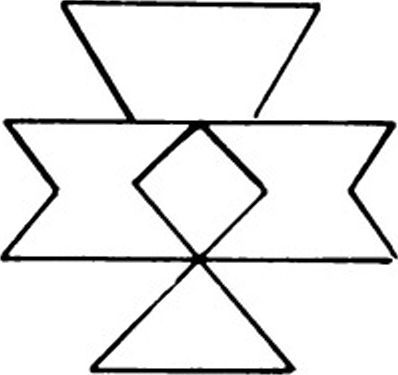
BUTTERFLY Everlasting life
Figure 10

THUNDERBIRD Sacred bearer of happiness unlimited

EAGLE FEATHERS Chief
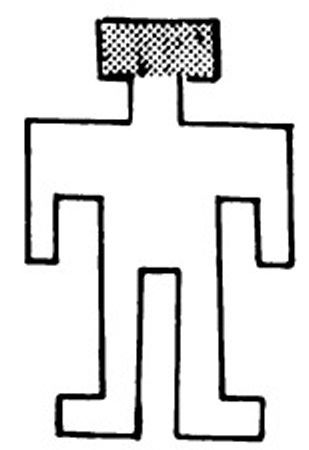
MAN Human life
Figure 11

RAIN CLOUDS Good prospects
Figure 12
The American Indians used clay for their pottery work, but a fair approximation of an Indian bowl can be made with papier-mache. Any bowl can be used as a mould, or a mould of the desired shape and size can be cut from wood. When the mould has been selected, it is rubbed with lard or oil and covered with a smooth layer of cheesecloth. A layer of paste is applied and strips of newspaper are crisscrossed over the paste. Alternate layers of paste and paper applied until the papier-mache coating is at least a half inch thick. After this shell has dried thoroughly, it is removed from the mould and the inside is coated with paste and lined with paper. The bowl can then be sandpapered and painted the color of red clay. If an assortment of Indian symbols, such as those shown (Figures 10, 11, 12 and 13) are painted on the surface, the finished bowl will resemble real Indian handcraft.

SUN SYMBOLS Happiness

THUNDERBIRD TRACK Bright prospects
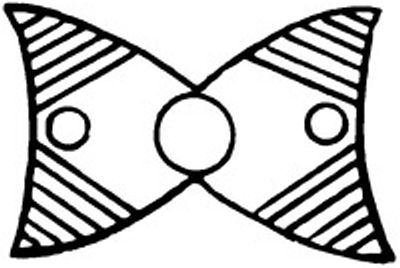
SADDLE BAGS Journey
Figure 13
Wooden Belt Buckle
The buckle (Figure 15) may be made of any hard wood, such as walnut, maple or birch. Its size will be determined by the width of the belt with which it is to be worn. It may be made in almost any desired shape, but a plain ring is probably the easiest to make and therefore the best for a first attempt.
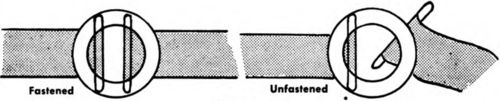
Figure 15

Figure 16
The ring may be whittled out with a knife or cut out with a coping saw; it should not be made too thin, or it will be likely to break easily. The back is left flat and the front is shaped to a rounded contour-the top and side views of the ring are shown (Figure 16). Two wooden pegs are cut and the ends are shaped to fit the contour of the ring (Figure 17). These pegs are also sanded smooth when they have been whittled to the desired shape. Both the ring and the pegs may be stained or painted in any color to match the costume with which they are to be worn.

Figure 17
When the pegs are dry, the ends of the belt are sewn or stapled to them and the buckle is ready for use.
Some of the variations that may be used in designing the buckle (Figure 18) and the ends of the pegs (Figure 19) are shown.

Figure 18

Figure 19
Continue to:


My Books

