


Chapter Twenty-One. Classroom Decorations
Description
This section is from the book "Arts And Crafts In The Elementary School", by Joan Dean. Also available from Amazon: Arts And Crafts In The Elementary School.
Chapter Twenty-One. Classroom Decorations
There are very few Primary schools where the children do not decorate the classrooms for Christmas. There is, I think, a tendency among teachers to feel that this work is not really a legitimate part of art and craft work, and that to some extent it is time wasted, justified only by the pleasure it gives the children. This is true only if the opportunities offered by the work are not properly used. It can be of great value if opportunities are given for individual creation and if children are encouraged to exercise critical judgement about the appearance of the room.
Children, and teachers, too, for that matter, need constant encouragement at all times of the year to look round the room and to ask themselves questions about it. "Are the pictures as well arranged as they might be?" "Is there enough good colour in the room?" "Are there too many things on show?" If more teachers asked themselves these questions more often, we might have fewer dreary classrooms. Small dark rooms painted in uninteresting colours are no excuse for covering the walls with dull pictures. Something can be done with the dullest classroom, as many teachers working in poor surroundings can show. If more children were encouraged to look critically at their surroundings, we might eventually see a great step forward in good taste in the decoration of the individual home. One sees the classroom afresh at Christmas when it takes on a new look with decorations. There is no reason why we should not create similar shocks to the eye at other times of the year, so that we become increasingly conscious of our surroundings. Any wall display is in effect an exercise in composition. It provides opportunities which should be used to the full both by teacher and children.
We have seen that there are certain basic things which we hope children will get out of their art and craft work. We hope that they will develop certain skills and we hope also that they will develop their creative abilities and critical faculties. There are a number of activities which have been popular in schools which do develop certain skills, but leave little scope for developing creative ability. Drawing round templates, for example, is good training in control, but not much else. If the children had made their own templates, the activity would give equally good training in control, but at the same time offer far greater scope for training creative ability—not to mention the additional skill needed to cut out the templates. In the same way, making the traditional kind of paper chains is quite a valuable training in skill for the first year in school, but it has little to offer Junior children. There are many ways of making decorations which offer similar training in skill, but which also give scope for individual creative ideas.
Mobiles of various kinds, for example, give scope to children of all ages to develop skill and individual ideas. They can be suspended in various ways, according to the opportunities the classroom offers. Individual motifs can be suspended from various forms of wire frame (see p. 163) or from covered hoops, from lights or beams or from strings going across the room. The motifs themselves need a good supply of colourful scrap material for their making. Silver paper, aluminium foil, shiny wrappings from soap and biscuit packets, scraps of Christmas ribbon and string, cellophane of various colours, straws, pieces of wire—in fact, any kinds of scrap material which are attractive to look at, are suitable material. The children then use these materials to make any motif they wish and these are suspended from the framework by pieces of cotton. In a school where children are used to carrying out their own ideas, the response will be varied and immediate. (I think it is a sign of good art and craft teaching in a school when children respond quickly and with many ideas to an opportunity for individual creation.) Where children are used to more formal teaching, however, they may need some guidance, and there are, in any case, usually some children who reach a point of needing fresh ideas. For these, the following may serve as starting points:
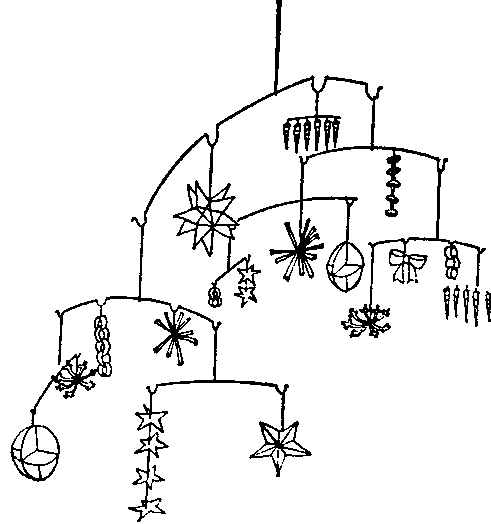
Mobiles suspended from wire framework.

Mobiles suspended from hoop

Wire star.
1. Stars and other shapes. These can be of many kinds. Some simple ones can be made by bending wire to a star shape and covering it with silver or metal paper. Stars can also be made by folding a square piece of paper into four and drawing part of a star on it and cutting it out. Stars made in this way will need backing, because these mobiles will be seen from all sides. Stars can also be made by tying bunches of straws together, and painting them.
2. Snowflakes can be made by folding paper and cutting it to a snowflake pattern. (Fig. 1.)
3. Flowers can be made by folding and cutting sheets of paper and fastening several together (see Fig. 2.)
4. Short lengths of paper chains—both the orthodox kind and variations on them—can be used.

Fig. 1.

Fig. 2.
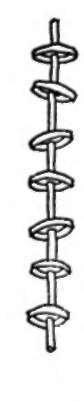
Fig. 3. Milk tops and paper beads. Trie beads are made by rolling coloured paper round a pencil and sticking it to form a roll.

Fig. 4.
Cardboard box motif with rolls of coloured paper and foil stuck on to its sides
5- A hanging decoration may be made by threading milk-tops and paper beads alternately. (Page 165, Fig. 3.)
6. Motifs can be made from small boxes and pieces of cardboard tubing. (Fig. 4.) These can be covered and decorated in various ways. All sorts of solid shapes, such as octohedrons and tetrahedrons, can be made from cut-out shapes of thin card stuck together with Sellotape and decorated with coloured papers or patterns. They can also be made from straws joined with thread, or pipe cleaners, and some of the areas between can be filled in with coloured cellophane. One can go on endlessly, but these should be sufficient to start children producing ideas of their own.
Continue to:


My Books

