


The Teacher's Task. Continued
Description
This section is from the book "Arts And Crafts In The Elementary School", by Joan Dean. Also available from Amazon: Arts And Crafts In The Elementary School.
The Teacher's Task. Continued
Children's work in art and craft is also influenced by their mental characteristics. The particular type of imagery which a child most commonly uses will affect the appeal of varying kinds of work.
Children who by temperament are orderly-minded will prefer to work neatly rather than vigorously, small rather than large. Children who avoid detail in other work will generally prefer to work broadly in art and craft. Teaching should allow scope and offer encouragement for broad work and small neat work. Both have their place. The teacher should try to help children to develop their work in many directions, but at the same time, she should recognize that they are most likely to produce good work and to develop confidence when they are working in the ways which are mentally and physically most natural to them. On the other hand, while a child who is uncontrolled in movement is most likely to achieve success in large vigorous pictures, he has much to gain from the discipline of small-scale, careful work. In the same way the neat careful child will gain from doing some work on a large scale. It must be recognized, however, that it is less satisfying to work in a way which is unnatural to you. A change of medium will often help both kinds of work—paint, for example, used with a fair-sized brush, gives little opportunity for niggling drawing. Pen drawing, on the other hand, with its hard, precise line, forces children to draw in detail. These two types of drawing are, at their extreme, representative of two distinct types of adult work. The teacher must endeavour to sympathize with and to understand both groups, even though she herself will probably belong, quite definitely, to one or the other.
Environment must, of necessity, play a large part in establishing individual ways of expression. Subject-matter will be drawn from the world round about from the early stages, sometimes directly and sometimes symbolically. It is for this reason among others that the school should do everything in its power to make the child's environment as wide as possible. This is especially important at the Junior stages. Children should be taken to visit places outside school as much as possible and their imagination stimulated by pictures when actual visits are not possible. A background rich in experience is a real need in creative work.
A child's idea of pleasing shape, colour, pattern and texture will be very much affected by what he sees at school and at home, and by the comments of those around him. In some cases he will see and hear of things which are good to look at, and will learn from the good taste of his parents. It is, unfortunately, more likely that the adults around him, having themselves been denied opportunity to see good things and to create and experiment in childhood, will be little in advance of him in their ideas. In either case his taste must grow from his own experience as well as his background if its basis is to be sound. School must, therefore, provide much that is good to look at, much that is satisfying in shape, colour and texture, and much that is stimulating to handle. Children should be actively encouraged to consider the appearance of things, to think about and to discuss how they feel to the touch, so that their taste grows from a full experience. A child's work will be affected by the attitude of those at home and at school to his creative efforts and by the opportunities for creative expression he is given. Lack of encouragement and a setting up of the photograph as the perfect picture will eventually, at adolescence usually, prevent him from attempting any form of graphic expression. This is one of the major problems of art teachers in Secondary schools, and one which the Primary schools can help to solve. Much of the teaching in the Primary school is given through the medium of praising one thing rather than another.
All these factors—mental and physical characteristics and environment—influence the way in which a child draws and paints. Since the characteristics are different in each individual, so drawing and painting and craft work are different in each individual. Although a group may get ideas from each other, or from the teacher, each child's work should be easily distinguishable from that of his contemporaries, hall-marked, as it were, with his particular characteristics. It is for this reason that a teacher should not attempt to help a child by adding to his drawing or painting. The teacher's personal way of working must of necessity differ from that of the children she teaches.
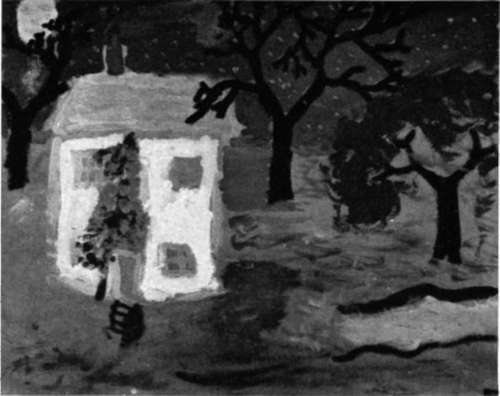
11-year-old. The haunted house. This painting was done as an illustration to "The Listeners", by Walter de la Mare (Chapter 2).

Development of children's painting 5-year-old. Exploring the use of paint (Chapter 3).
We must forget the idea that some are born artists and that there is no hope for the rest. Every child can produce good pictures if he is given the right sort of help and encouragement, although some will do it more easily than others. In any class lesson, at least 80 per cent of the work ought to be good enough for display.
There is a very real danger of art and craft being regarded as a useful adjunct to other subjects and no more. One hears students and teachers say, "They can spend their art lesson drawing or modelling from the work they are doing in history or from the book they are reading." This sort of work is valuable and necessary, but it may perhaps be worth giving some consideration to the relationship of art and craft with work in other aspects of the curriculum. As I see it, there are two quite distinct ways in which art and craft work may be used to link up with other work. Drawing, painting or modelling may be used to establish particular pieces of information in children's minds. Thus they may be helped to understand more about the people who lived at a particular time in history by drawing or making models of the houses they lived in, the furniture they used and the clothes they wore. In doing this, they may learn much that is valuable, both from the point of view of art and craft and from the historical point of view, but in this work the art and craft aspect of the work is second to the historical aspect. Accuracy in detail of costume or architecture comes before colour scheme or composition or whether the picture looks right, although one hopes that it will be possible to combine the two aspects of the work satisfactorily.
On another occasion an exciting story in scripture or history may stimulate children to paint or model. Here the important thing would seem to be the picture or model and the fact that children garnish Palestinian houses with television aerials would seem to be of little importance compared with the emotion aroused by the story and expressed in the picture. There are many aspects of Primary school work which provide this kind of stimulus and we should make the most of them.
Primary school timetables become increasingly fluid as time goes on and subject divisions become less and less important, but there is still a place also for an art and craft lesson as such, a time when children explore specific aspects of art and craft, and learn to deal with some of the problems which arise.
Ideally a teacher of art and craft should be able to see from her own experience what a child is trying to do in a picture or design, and from this experience offer such advice as will help on the work, but help it on in the personal language of the child who is producing it. In any piece of work, turning-points will arise. A child, lacking experience, may as easily spoil a picture as enhance it. True, if he spoils it, he will be able to note that this was the wrong turning, but the possible combinations are endless, and he may go down any number of blind alleys without arriving anywhere. Some experience of this is valuable. A great deal of it is depressing and discouraging and a very slow way of learning. It is the teacher's task to step in from time to time, and in the light of her own experience and her knowledge of the child to help him find the best path. Unfortunately she may not have this experience and so cannot offer advice. She may also be at a loss to know why the work of a particular group of children falls short. Only by extending her own knowledge can she hope to advise adequately. This is an ideal, however. There are, fortunately, many paths which teacher and children can explore together. In this book, I am attempting to suggest some of the paths and to tell of some of the things which one may hope to discover.
Continue to:


My Books

