


Locomotive Flue Welder
Description
This section is from the book "Welding Theory, Practice, Apparatus And Tests Electric, Thermit And Hot-Flame Processes", by Richard N. Hart. Also available from Amazon: Welding: Theory, Practice, Apparatus And Tests, Electric, Thermit And Hot-Flame Processes.
Locomotive Flue Welder
The Warren Electric Manufacturing Company has furnished the following description of their flue welder, which is especially adapted to the work:
"The flue welder (Fig. 30) operates from an alternating source of electromotive force, and steps the voltage from any convenient line voltage down to from 5 to 10 volts on the weld by means of a transformer enclosed in the body of the welder. The secondary leads from the transformer are connected to two copper contact shoes, which hold the ends of the flues to be welded. These contact shoes have a copper top clamping piece, operated by cam levers, which clamp the flue very securely. The top and bottom members of this clamp are cooled by means of running water. One of these pipe clamps which holds the shorter end of the flue is operated longitudinally by means of a lever, so as to bring the ends of the flues into contact under heavy pressure. One of the foot treadles operates a switch in the primary circuit for controlling the heating of the joint. The second treadle operates a die which is brought up so as to surround the joint at the time at which compression takes place and prevent an external upset around the pipe at the joint. This die is also water-cooled.
1 Special information furnished by the company.
"Owing to the circular form of the pipe, the compression at the joint produces a pressure on the interior portion of the pipe, which increases the density of the metal. This increased density resists the tendency to expand internally, as the metal naturally expands in the. direction of the least resistance. It has been found experimentally that there is no tendency whatever to an upset on the inside of the pipe. When the flues are welded without the clamp die, the free flow of the metal is all outward, which produces an exterior upset only.
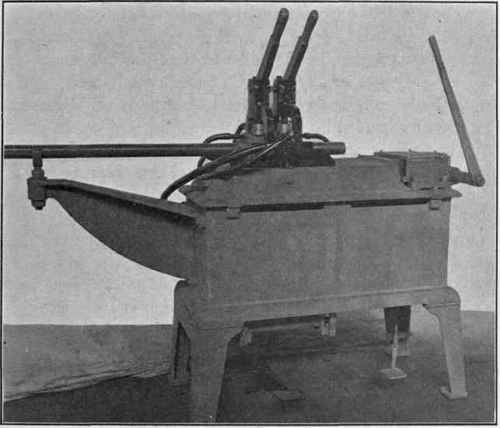
Fig. 30. - Locomotive flue welder.
"The operation of the welder is as follows:
"The two ends of the flue are clamped in place, and then brought into contact by means of the horizontal hand lever. The current is thrown on, and the metal at the joint gradually brought up to welding heat. Immediately upon reaching the welding heat, the current is thrown off, and the dies for controlling the form of the weld are brought up into contact with the work by means of the second treadle. A further movement of the horizontal lever is then made so as to produce a very heavy compression of the joint inside of the die. After compression the die is then released, and also the top clamps, so as to relieve the pipe of strains during the cooling of the joint.
"The advantage of this form of welder is a practically smooth joint on the outside of the pipe, which permits the flues after welding to be placed in the end sheets of the boiler without reducing the upset usually met with on butt-welds made by the electrical process. In welding flues electrically, this exterior upset is accompanied by an expansion of the pipe at the joint, so as to produce an annular groove inside the pipe, which is objectionable in boiler flues on account of the accumulation of scale therein. This annular groove is of course entirely eliminated in the flues as welded by this machine."
Continue to:


My Books

