


Esteve's Automatic Pile
Description
This section is from "Scientific American Supplement". Also available from Amazon: Scientific American Reference Book.
Esteve's Automatic Pile
Mr. Esteve has recently devised a generator of electricity which he claims to be energetic, constant, and always ready to operate. The apparatus is designed for the production of light and for actuating electric motors, large induction bobbins, etc.
We give a description of it herewith from data communicated by its inventor.
The accompanying cut represents a battery of 6 elements, with a reservoir, R, for the liquid, provided at its lower part with a cock for allowing the liquid to enter the pile. The vessels of the different elements are of rectangular form. At the upper part, and in the wider surfaces of each, there are two tubes. The first tube of the first vessel receives the extremity of a safety-tube, A, whose other extremity enters the upper part of the reservoir, R. This tube is designed for regulating the flow of the liquid into the pile. When the cock, r, is too widely open, the liquid might have a tendency to flow over the edges of the vessel; but this would close the orifice of the tube, A, and, as the air would then no longer enter the reservoir, R, the flow would be stopped automatically. The second tube of the first vessel is connected with a lead tube, 1, one of the extremities of which enters the second vessel. The other tubes are arranged in the same way in the other vessels. The renewal of the liquids is effected by displacement, in flowing upward from one element over into another; and the liquids make their exit from the pile at D, after having served six times.
The electrodes of the two first elements are represented as renewed in the cut, in order to show the arrangement of the tubes.
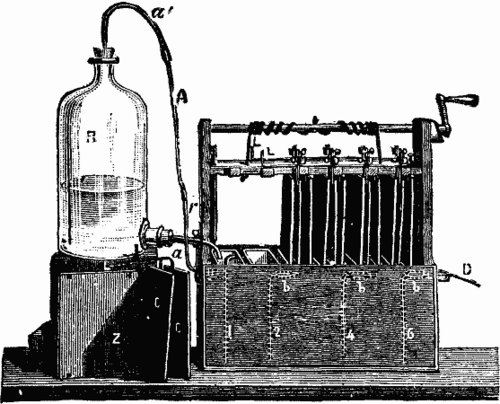
ESTEVE'S AUTOMATIC PILE.
Dimensions
The zinc, 2, has a superficies of 15×20 centimeters, and is cut out of the ordinary commercial sheet metal. It may be turned upside down when one end has become worn away, thus permitting of its being entirely utilized. The negative electrode is formed of four carbons, which have, each of them, a superficies of 8×21 centimeters. These four carbons are less fragile and are more easily handled than two having the same surface. Their arrangement is shown at the left of the figure. They are fixed to a strip of copper, a, to which is soldered another strip, L, bent at right angles. There are thus two pairs of carbon per element, and these are simply suspended from a piece of wood, as shown in the figure. Upon this wooden holder will be seen the two strips, LL, that are designed to be put in contact with the zinc of the succeeding element by means of pinchers that connect the electrodes with one another. This arrangement permits the pile to be taken apart very quickly.
Charging, Work, And Duration Of The Pile
The inventor has made a large number of experiments with solutions of bichromate of potash of various degrees of saturation, and has found the following to give the best results:
| Bichromate of potash. | 1 | kilogramme. |
| Sulphuric acid | 2 | liters. |
| Water | 8 | " |
When a larger quantity of the salt is used, crystallization occurs in the pile.
| Constants and work of an element having a zinc of 16×20 cm. | Constants and work of a round Bunsen element, 20×30 cm. | |
| Volts. | 1.9 | 1.8 |
| Resistance. | 0.05 | 0.24 |
| Work disposable in the external circuit. | 1.839 k. | 0.344 k. |
The work disposable in the external circuit is deduced from the formula:
| T = | E² (4R × 9.81) |
It will be seen that an element thus charged gives as much energy as 5.3 large Bunsen elements.
The battery is charged with 10 liters of solution, and is capable of furnishing for 5 hours a current of 7 amperes with a difference of potential of 9 volts at the pile terminals. The work, according to the formula (EI)/g, equals 6.422 kilogram-meters; with a feebler resistance in the external circuit it is capable of producing a current of 19 amperes for an hour and an half. In this case the resistance of the external circuit equals the interior resistance of the pile. Upon immersing the electrodes in new liquid, and with no resistance in the external circuit, the current may reach 100 amperes. On renewing the liquids during the operation of the pile, a current of 7 amperes is kept up if about a liter of saturation per hour be allowed to pass into the battery. For five hours, then, only 5 liters are used instead of the 10 that are necessary when the liquid is not renewed while the pile is in action. - La Nature.
Continue to:


My Books

