


The Meteorological Station On Mt. Santis
Description
This section is from "Scientific American Supplement". Also available from Amazon: Scientific American Reference Book.
The Meteorological Station On Mt. Santis
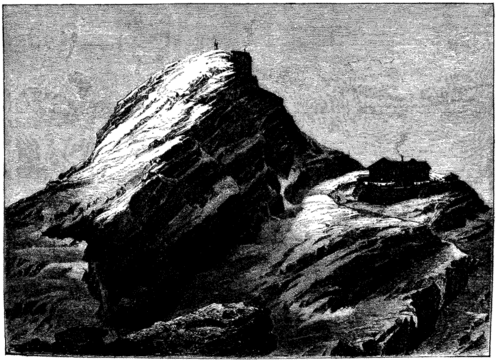 THE METEOROLOGICAL STATION ON MT. SANTIS.
At the second International Meteorological Congress, in 1879, the erection of an observatory on the top of a high mountain was considered. The Swiss Meteorological Commission undertook to carry out the project, and sent out circulars to different associations, governments, and private individuals requesting single or yearly contributions to aid in defraying the expense of the station. In December, 1881, an extra credit of about $1,000 was granted by the Bundesversammlung for the initial work on the station, which was temporarily placed in the Santis Hotel, and a telegraph was put up between that place and Weisbad in August, 1882, so that on September 1 of the same year the meteorological observations were begun.
At the end of August, 1885, this temporary arrangement expired, and the enterprise could not be carried on unless the support of the same was undertaken by the Union. On March 27, 1885, the Bundesversammlung decided to take the necessary steps. Mr. Fritz Brunner, who died May 1, 1885, left a large legacy for the enterprise, making it possible to build a special observatory.
For this purpose the northeast corner of the highest rocky peak was blasted out and the building was so placed that the wall of rock at the rear formed an excellent protection from the high west winds. By the first of October, last year, the building was ready for occupancy, and there was a quiet opening at which Mr. Potch, director of the Blue Hill Observatory, near Boston, and others were present.
The building is 26 feet long, 19 feet deep, and 30 feet high, and is very solid and massive, having been built of the limestone blasted from the rock. It consists of a ground floor containing the telegraph office, the observers' work room, and the kitchen and store rooms; the first story, in which are the living and sleeping rooms for the observers and their assistants; and the second story, living and sleeping rooms for visiting scientists who come to make special observations, and a reserve room. The barometer and barograph are placed in the second story, at a height of about 8,202 feet above the level of the sea, whereas in the hotel they were only about 8,093 feet above the sea level. The flat roof, of wood and cement, which extends very little above the plateau of the mountain top, is admirably adapted for making observations in the open air. All the rooms in the house are ceiled with wood, and the walls and floors of the ground floor and first story and the ceilings of the second story are covered with insulating material.
The cost of the building, including the equipments, amounted to about $11,200.
The fact that since the erection of the Santis station there has been a still higher station constructed on Sonnblick (10,137 feet high) does not decrease the value of the former, for the greater the number of such elevated stations, the better will be the meteorological investigations of the upper air currents. The present observer at Santis is Mr. C. Saxer, who has endured the hardships and privations of a long winter at the station.
The anemometer house, which is shown in our illustration, is connected with the main house by a tunnel. Several times during the day records are taken of the barometer, the thermometer, the weather vane, as well as notes in regard to the condition of the weather, the clouds, fall of rain or snow, etc. A registering aneroid barometer marks the pressure of the atmosphere hourly, and two turning thermometers register the temperature at midnight and at four o'clock in the morning. - Illustrirte Zeitung.
Continue to:


My Books

