


2. Claytonia [Gronov.] L. Sp. Pl. 204. 1753
Description
This section is from the book "An Illustrated Flora Of The Northern United States, Canada And The British Possessions Vol2", by Nathaniel Lord Britton, Addison Brown. Also available from Amazon: An Illustrated Flora of the Northern United States, Canada and the British Possessions. 3 Volume Set..
2. Claytonia [Gronov.] L. Sp. Pl. 204. 1753
Perennial succulent glabrous herbs, with corms, or thick rootstocks, petioled basal leaves, and opposite or alternate cauline ones. Flowers terminal, racemose. Sepals 2, ovate, persistent. Petals 5, hypogynous, distinct. Stamens 5, inserted on the bases of the petals. Ovary few-ovuled; style 3-lobed or 3-cleft. Capsule ovoid or globose, 3-valved, 3-6-seeded. Seeds compressed, orbicular or reniform. [In honor of John Clayton, 1686?-1773, American botanist.]
About 10 species, natives of northern North America. Type species: Claytonia virginica L.
Leaves linear-lanceolate, 3'-7' long. | 1. | C. virginica. |
Leaves ovate-lanceolate or ovate, 2'-3' long. | 2. | C. caroliniana. |

I. Claytonia Virginica L. Spring Beauty. May- Or Grass-Flower
Fig. 1740
Claytonia virginica L. Sp. Pl. 204. 1753.
Ascending or decumbent, perennial from a deep tuberous root, stem 6'-12' long, simple or rarely with a few branches. Leaves elongated, linear or linear-lanceolate, obtuse or acute, narrowed into a petiole, the basal 3'-7' long, 1"-6" wide, the cauline shorter and opposite; raceme terminal, loose, at length 3'-5' long, somewhat secund; flowers white or pink, with darker pink veins, 6"-10" broad; pedicels slender, at length l'-1 1/2' long and recurved; petals emarginate; capsule shorter than the sepals.
In moist woods, Nova Scotia to Saskatchewan, south to Georgia, Montana and Texas. Very variable in the breadth of leaves. Ascends to 2400 ft. in Virginia. Good-morning-spring. Wild potatoes. March-May.
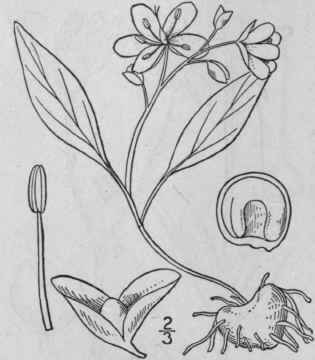
2. Claytonia Caroliniana Michx. Carolina Or White-Leaved Spring Beauty
Fig. 1741
Claytonia caroliniana Michx. Fl. Bor. Am. I: 160. 1803.
Similar to the preceding species but sometimes more nearly erect. Basal leaves ovate-lanceolate or oblong, 1 1/2" - 3' long, 6"-9" wide, obtuse; stem-leaves on petioles 3"-6" long; flowers fewer.
In damp woods, Nova Scotia to Saskatchewan, Connecticut, south to North Carolina along the Alleghanies, and to Ohio and Missouri. Rare or absent near the coast in the Middle States. Ascends to 5000 ft. in Virginia. March-May.
Claytonia lanceolàta Pursh, a related species, with sessile shorter stem-leaves, occurs from the Rocky Mountain region to the Pacific Coast, and perhaps in the extreme western portion of our territory.
Continue to:


My Books

