
![previous page: 26. Astragalus [Tourn.] L. Sp. Pl. 755. 1753. Part 7](../../../images/nav/page_prev.gif)


27. Phaca L. Sp. Pl. 755. 1753
Description
This section is from the book "An Illustrated Flora Of The Northern United States, Canada And The British Possessions Vol2", by Nathaniel Lord Britton, Addison Brown. Also available from Amazon: An Illustrated Flora of the Northern United States, Canada and the British Possessions. 3 Volume Set..
27. Phaca L. Sp. Pl. 755. 1753
Perennial herbs, similar to Astragalus, mostly with pinnate leaves, and racemed or spicate, purplish or purple flowers. Pod much inflated, membranous in texture, strictly I-celled, neither of the sutures intruded. [Greek, Lentils.]
A large genus, mainly of the north temperate zone. Besides the following, numerous other species occur in the western parts of North America. Type species: Phaca baetica L.
Leaflets 7-21, oblong, elliptic or ovate. | ||
Pod stalked; flowers slender-pedicelled. | 1. | P. americana. |
Pod sessile; flowers short-pedicelled. | 2. | P. neglecta. |
Leaflets only 1, or sometimes 3-5, very narrowly linear. | 3. | P. longifolia. |
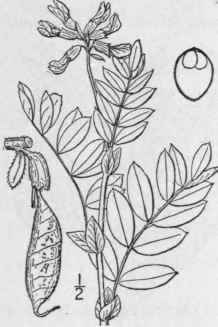
1. Phaca Americàna (Hook.) Rydb. Arctic Milk Vetch
Fig. 2553
P. frigida var. americana Hook. Fl. Bor. Am. 1: 140. 1830. Astragalus frigidus var. americanus S. Wats. Bibl. Index, 1:
193. 1878. Phaca americana Rydb.; Britt. & Brown, 111. Fl. 2: 304. 1897.
Erect, nearly simple, glabrous, 1°-2° high. Stipules folia-ceous, ovate-oblong, 2"-6" long; leaflets 7-17, oval or ovate-lanceolate, 9" - 18" long; peduncles generally exceeding the leaves; flowers white, 8"-9" long, in loose racemes; pedicels filiform, V long in fruit; pod I-celled, stipitate, inflated, membranous, 10"-12" long, acute at each end, oblong, dehiscent at maturity, glabrous, shining.
In wet rocky places, Quebec to British Columbia and Alaska, south to South Dakota and in the Rocky Mountains to Wyoming. June-July.
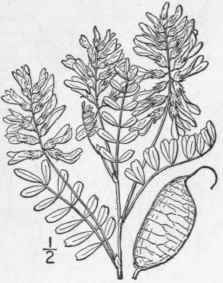
2. Phaca Neglécta T. & G. Cooper's Milk Vetch. Fig- 2554
Phaca neglecta T. & G. Fl. N. A. 1: 344. 1838. Astragalus Cooperi A. Gray, Man. Ed. 2, 98. 1856. Astragalus neglectus Sheldon, Bull. Geol. Surv. Minn. 9: 59. 1894.
Glabrous or nearly so, erect, 1°-2° high. Stipules ovate, acute, 1"-2" long; leaflets 9-21, thin, oblong or elliptic, often minutely pubescent beneath, 8"-12" long, obtuse or emarginate at the apex, narrowed at the base; peduncles shorter than or equalling the leaves; flowers white, 5"-7" long, in rather loose spikes; calyx pubescent with blackish hairs, its teeth subulate; pod 1-celled, sessile, the ventral suture somewhat intruded, inflated, coriaceous, ovoid, acute, glabrous, slightly furrowed along both sutures, 6"-10" long, 5"-6" thick.
. On banks and shores, Quebec to Niagara, west to Minnesota and Iowa. June-July.
3. Phaca Longifólia (Pursh) Nutt. Long-Leaved Milk Vetch
Fig. 2555
Psoralea longifolia Pursh, Fl. Am. Sept. 741. 1814. Phaca longifolia Nutt.; T. & G. Fl. N. A. 1: 346. 1838. Astragalus pictus var. filifolins A. Gray, Proc. Am. Acad. 6:
215. 1864. A. filifolins Smyth, Trans. Kans. Acad. 15: 61. 1895.
Erect, very slender, branching, finely canescent, 6'-18' high. Stipules subulate, rigid, those of the lower part of the stem connate; leaflet usually 1, narrowly linear, nearly terete, 1'-4' long, 1/2"-1" wide, sometimes 3 or 5; leaves persistent; flowers few, pink, 3"-5" long, in short loose racemes; peduncles much shorter than the leaves; pod I-celled, short-stalked, much-inflated, membranous, spotted, glabrous, ovoid, short-pointed, not furrowed, about 1' long, i' thick.
In sandy soil, South Dakota to Nebraska, Wyoming, Idaho and New Mexico. Bird-egg pea. May-June.
Phaca Bodini (Sheldon) Rydb., a decumbent species with small blackish pubescent pods and purple flowers, common in Wyoming and Colorado, enters our area in western Nebraska.

Continue to:


My Books

