


5. Ligústrum [Tourn.] L. Sp. Pl. 7. 1753
Description
This section is from the book "An Illustrated Flora Of The Northern United States, Canada And The British Possessions Vol2", by Nathaniel Lord Britton, Addison Brown. Also available from Amazon: An Illustrated Flora of the Northern United States, Canada and the British Possessions. 3 Volume Set..
5. Ligústrum [Tourn.] L. Sp. Pl. 7. 1753
Shrubs or small trees, with opposite entire simple leaves, and small white complete flowers in terminal thyrses or panicles. Calyx small, truncate or 4-toothed, inferior. Corolla gamopetalous, funnelform, its tube mostly short, the limb 4-lobed, the lobes induplicate-valvate in the bud. Stamens 2, inserted on the tube of the corolla; filaments short. Ovary 2-celled; ovules 2 in each cavity, pendulous; style short or slender; stigma thickened. Fruit a 1-3-seeded mostly globose berry. [The classical Latin name.]
About 35 species, natives of the Old World, the following typical.
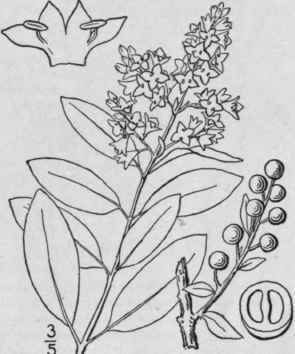
1. Ligustrum Vulgare L. Privet. Prim
Fig. 3325
Ligustrum vulgare L. Sp. Pl. 7. 1753.
A shrub, 6°-10° high, the branches long and slender. Leaves firm, tardily deciduous, glabrous, lanceolate or oblong, acute or obtuse at the apex, narrowed at the base, short-petioled, 9"-2 long, 3"-7" wide, obscurely veined; panicles dense, short, minutely pubescent; flowers white, about 3" broad; pedicels very short; stamens included; berries globose, black, 2"-3" in diameter.
In thickets and along roadsides, escaped from cultivation, Maine and Massachusetts to Ontario, western New York, Pennsylvania and North Carolina. Native of Europe and Asia. Used for hedges. June-July. Old English names, primwort, print, skedge, skedgwith.
Continue to:


My Books

