


Honeysuckle Family - Capri Foliaceae - Twinflower; Deer Vine - Linnaea Americana Forbes - Plate 213a
Description
This section is from the book "Wild Flowers Of New York", by Homer D. House. Also available from Amazon: Wild Flowers Of New York.
Honeysuckle Family - Capri Foliaceae - Twinflower; Deer Vine - Linnaea Americana Forbes - Plate 213a
A creeping and trailing, slender, vinelike plant, with scarcely woody, perennial stems, 6 to 24 inches long, slightly pubescent. Leaf blades evergreen, opposite, rounded or obovate, obscurely crenate on the margins, one-fourth to three-fourths of an inch wide and rather thick in texture on petioles one-twelfth to one-sixth of an inch long. Flowers fragrant, pink, borne in pairs at the summit of elongated terminal stalks. Calyx five-lobed. Corolla funnelform, nodding, one-third to one-half of an inch long and fivelobed at the end. Stamens four, attached at the base of the corolla tube within. Ovary three-celled, two of the cavities filled with abortive ovules, the other with one perfect, pendulous ovule. Fruit a nearly globose, three-celled capsule, two of the cells empty, the other with a single, oblong seed. In cold woods throughout the north, common in the Adirondack and Catskill mountains, otherwise rather local, ranging south to Maryland, west to the mountains of Colorado, California, British America, and eastward to Newfoundland. Flowering from June to August.
Memoir 15 N. Y. State Museum
Plate 213
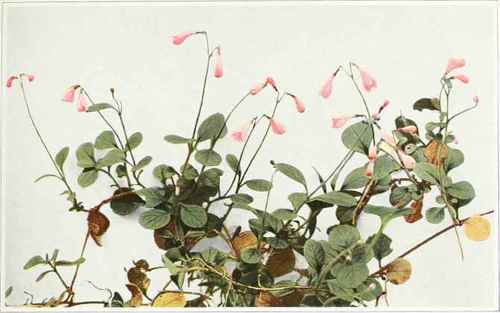
A. twinflower; deer vine - Linnaea americana
Continue to:


My Books

