


Medical. How To Render First Aid
Description
This section is from "Every Woman's Encyclopaedia". Also available from Amazon: Every Woman's Encyclopaedia.
Medical. How To Render First Aid
By Mary Westaway (Associate of the National Health Society)
The Subject of Haemorrhage - In cases of Accidents, the Flow of Blood must be Stopped - The various Kinds of Bleeding and How to Treat Each - Pressure Points and How to Find Them
Many personal injuries occasion loss of blood, and certain diseased conditions are characterised by the same symptom. The most important part of the study of first aid concerns itself with the control of haemorrhage, for " the blood is the life." and if blood is allowed to flow without check, life ebbs with it. Thus, in the treatment; of all accidental injuries, haemorrhage, when present, must receive the first attention.
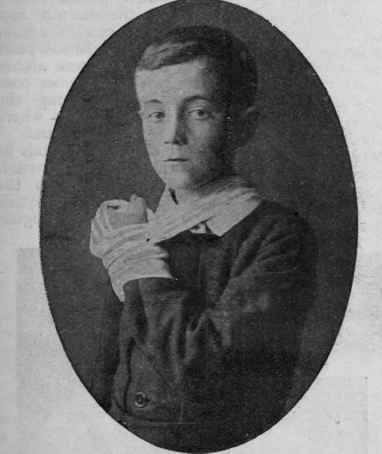
How to place a bandage to check bleeding from the palm of the hand
The Circulatory System In the first place it must be understood that pure blood is pumped by the heart from its left side through the arteries of the body, which, branching in their course, become smaller the farther they are away from the heart, until they are so minutely divided that they merge into a network of small blood-vessels, known as capillaries. These permeate the tissues, and, while supplying them with nourishment, carry off their waste products, which are conveyed by the blood through other and larger vessels known as veins. The veins pour the impure blood into the right side of the heart, whence it is sent to the lungs to be purified before finding its way back again to the left side of the heart ready to repeat its course through the body.
Varieties of Haemorrhage Thus blood may flow from injured arteries, capillaries, or veins. It is not difficult to recog-nise the source of blood in haemorrhage, and to apply treatment according to the kind of bloodvessel which is discharging.
1. Blood which flows from capillaries is of a dull red colour and oozes from the injured part in small quantities.
2. Blood which flows from veins is of a dark purple colour. It issues freely with a steady flow, and will be found to come chiefly from that side of the injury which is farther from the heart.
3. Arterial blood may be recognised by the bright scarlet colour and by the way in which it leaves the injured vessel in spurts, or jets, which correspond with the beating of the heart. Such blood issues chiefly from that side of the wound which is nearer the heart.
All external haemorrhage can be controlled by pressure, provided it is exerted at the right place. Pressure, in the first place, should be made on the wound itself without the loss of a single moment. The thumb seems to be specially designed by Nature for pressure, and therefore should be brought into action at once, and kept in use until other remedies or substitutes can be arranged. With trifling accidents, thumb pressure is all that is needed, and Nature soon provides a clot of blood which hermetically seals the wound.
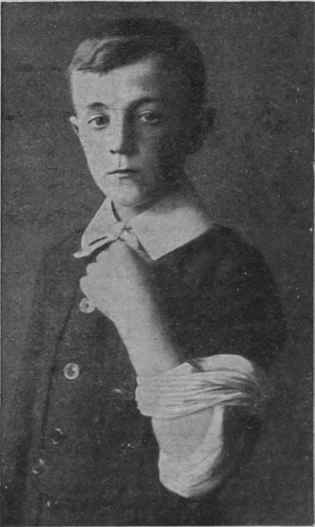
Arm flexed on rolled coat'sleeve to control arterial bleeding below the elbow
If bleeding does not stop quickly with pressure from the thumb, a substitute can be arranged in the form of a clean pad, such as a roll of lint or a tightly folded handkerchief firmly fixed by means of a bandage, such as the triangular bandage described in the first article of this series (page 62).
If the bleeding is recognised as arterial, it should be controlled by pressure on some part of the injured artery between the wound and the heart - that is to say, at one of the special places known as pressure points. This will be described later. ,
Styptics are often of service. They are substances which check the flow of blood by causing it to cover the injury with a clot. Most styptics must be regarded as within the province of the doctor, but there are certain homely ones available. Such are fresh air, cold water, ice, cold tea, tobacco leaf, ravellings of clean linen or flannel, etc. A clot once formed must never be washed away. It is Nature's dressing, which guards the wound against the intrusion of harmful germs.
Position is of great importance in cases of haemorrhage. Exertion makes the heart beat rapidly. When one is sitting still the heart movement is slower than when standing erect, and when the body is reclining it is slower still. The flow of blood from a wound varies in severity according to the pulsation of the heart. Patients, therefore, should be placed so as to retard the circulation. When the injured blood-vessel belongs to an arm or leg, keep the limb in an elevated position until the bleeding has ceased.
Arterial Haemorrhage
The course of the main arteries through the body must be understood, so that pressure may be exerted at the proper pressure points.
The blood-vessel through which blood first passes from the heart is known as the aorta. The first part is arched like a shepherd's crook, and from the top of this three smaller vessels spring. These are known as the left subclavian, left common carotid, and innominate respectively. The innominate soon divides again into the right subclavian and right common carotid, which correspond with those of similar name on the other side.
Tracing the course of these vessels, we find that the right and left subclavians pass up to the root of the neck, lying between the collarbone and the first rib. When the head is turned aside and the thumb inserted in the hollow or "salt cellar," thus made, the pulse can be felt, and when the artery is pressed against the bone behind it, the circulation between this point and the finger-tips is arrested (see illustration).
Continue to:


My Books

