


A Birth in a Japanese Family. Part 2
Description
This section is from "Every Woman's Encyclopaedia". Also available from Amazon: Every Woman's Encyclopaedia.
A Birth in a Japanese Family. Part 2
Babies learn to talk earlier in Japan than in England, for the Japanese language lends itself to the expressions of very young children; and long before their European brothers and sisters would be asking for things, the Japanese baby begins to chatter in soft, easily spoken words which have a definite meaning. Some of these are very much like the baby-talk of our own land, only they signify something quite different. Papa means tobacco, for example ; o mam-ma means boiled rice ; be-be does not mean baby, but dress, or kimono ; ta-ta, instead of meaning good-bye, denotes sandals or other footgear.
School Days In Japan
The boy baby is soon sent to school, and afterwards drifts into or is placed in some trade or profession, according to the position in life his father wishes him to occupy, his personal aptitude, or, in some cases, the custom of his ancestors.
When the little girl leaves babyhood behind, she finds the life into which she emerges bright and happy to a degree, but set about with many rules and much etiquette which it is her duty to master as soon as she can.
One thing she is speedily taught - namely, that her position in life and the respect paid to her will depend very greatly upon her own cheerful obedience, pleasing manners, and personal neatness and cleanliness.
Girls' education has been much improved during the last decade, but till quite recently there was no career or vocation especially open to girls, and her duties had always to be household ones, or, if she belonged to the peasant classes, the work of the fields. Nowadays, however, there are some excellent schools at which Japanese girls are being educated in nearly, all the subjects which form the school training of their English sisters.
Teaching Little Girls
For lessons the little girls generally sit down on their knees and heels on mats, at a low table, and for a writing-lesson prepare the Indian ink that they use with water, rubbing the black stick of ink on a stone. Large sheets of soft paper are then placed before them, and, the teacher having written one hieroglyphic (as the Japanese letters or words are best described) on one sheet, the pupil, with a soft camel-hair brush dipped into the ink, instead of a pen or pencil, with her hand and arm supported by the table, writes it over and over again until the teacher is satisfied.
At first she is taught the easy Japanese phonetic alphabet, invented in the eighth and ninth centuries ; then she learns to write the very complicated though often beautiful Chinese hieroglyphics which, in Japan, take the place of our letters and words.
Handwriting is held in Japan to be a criterion of a woman's ability, education, and personality, and some of the writing of their complicated alphabet by the women and girls of Japan is indeed beautiful. Most Japanese girls, too, are taught, in addition to geography, history, arithmetic, and the usual subjects, to write poetry, for poetry has been a very popular art among the women of Japan for many ages.
Schools for Arranging Flowers
The art of flower arrangement is taught almost every Japanese girl, and everyone of good family certainly takes lessons in this art. At one time there were no fewer than a hundred schools or methods of flower arrangement existing in Japan, of which about ten are taught nowadays. To learn to arrange flowers according to the Japanese method is not easy for any girl, and, indeed, we are told that five years is needed for a thorough course in this art, even if one takes a lesson regularly every week !
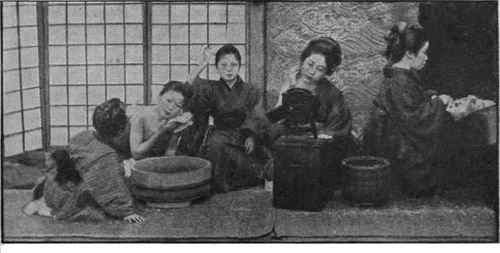
Little Japanese girls at their toilette. In every rank of life, both children and adults attach the greatest importance to personal cleanliness and neatness. Girls and boys are trained from infancy to be punctilious in this matter
The art of ceremonial tea, which is always taught to all girls of good family, dates in its present form, like that of floral arrangement, from the fifteenth century. It is a very solemn and elaborate ritual, and constitutes the most formal and punctilious of social observances, and is quite different from the ordinary serving and drinking of tea.
Music is considered one of the most necessary accomplishments for the upper-class Japanese girl. And thus, if it be intended that a girl should study music, she begins at a very early age, often before she is six years old.
Musical Training In Japan
There are three stringed instruments which are considered suitable for girls - the koto, a horizontal sounding-board, with thirteen strings stretched from the head to the foot, and something like a harp ; the samisen, which resembles a guitar, but is square, and not round in shape, and usually made of quince-wood, or red sandal-wood ; and the kokiu, which is a kind of two-stringed violin supposed to have had the same origin, and to have been brought to Japan by the Portuguese three centuries ago.
To the Western mind, the most curious customs in a Japanese household are the formalities that are universal even between brothers and sisters, and the great respect paid by all younger members of the family to the older. A younger sister, for example, must always pay due deference to the elder, even in so small a matter as the entering of a room. And throughout the family the comfort of the older members is always consulted before that of the younger.
Happy Japanese Girls
The little Japanese girl has, however, a very happy place in the family circle, for she is almost invariably the pet and plaything of her father and elder brothers, and is never addressed by anyone in the family, except her parents, without the title of respect to which she is entitled. By the servants she is always addressed as O Jo Sama, or, literally, the Young Lady.
Continue to:


My Books

