


Children. Dancing The One-Step. Continued
Description
This section is from "Every Woman's Encyclopaedia". Also available from Amazon: Every Woman's Encyclopaedia.
Children. Dancing The One-Step. Continued
This popular dance appeals to children quite as much as to grown-ups, and I find that it is a great help in teaching children to give them two simple exercises to practise, which are used later in the dance itself. First of all, the easiest way to make a child realise the one-step is to compare it to a running march. Say to the little pupil, " You know how to mark time, don't you ? " Then make her do it; and afterwards say " Now start running and keep on doing that same movement." The running movement gives the necessary spring which differentiates the one-step from " marking time." The first exercise is to help a child understand the dotted one-step. Stand the pupils in rows facing the teacher, and tell every girl to point her left foot and raise her right hand, and the boys to do the opposite. Beat 1, spring on left foot ; beat 2, spring on right foot; beat 3, spring on left foot ; beat 4 (dotted step), spring on right foot and quickly back on to the left, doing two steps in the time usually occupied by one. Thus five steps are taken to the left with the right hand raised ; and the right foot is now ready to take the same steps back again, starting on the right foot, with the hand down this time. This step should be carefully practised before attempting the dotted one-step.
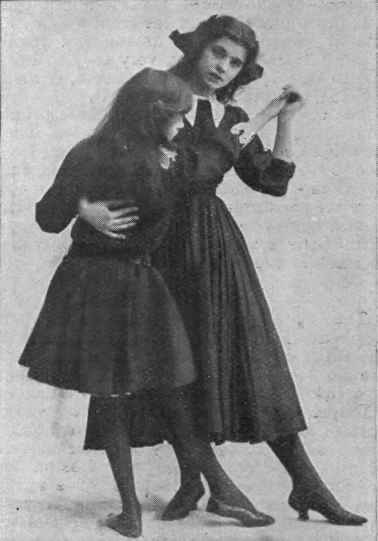
Fig. 3. The Dotted One-step. Three steps to centre of room. Lady moves forward all the time ; hands raised
The second exercise is to help a child understand the crab step. Turn two children, or teacher and pupil, face to face, and sideways to the instructor. Make them join both hands, and tell the girl to lift her right foot and place it across her left (beat 1), lifting the left foot from behind and pointing it sharply to the left (beat 2). The same step is then repeated, placing the left foot across the right, and pointing the right foot. The gentleman starts with the opposite foot, and does precisely the same step. The feet pass over and in front of each other.
The One-step Proper
Holding his partner exactly as in the two-step, hip to hip, the gentleman places her so that she travels backwards down the room. Four steps on alternate feet are then taken, the lady starting backwards with her right, and the gentleman forward with his left foot (see Fig. 1). The direction of the steps is then reversed, the gentleman travelling four steps back, and the lady four steps forward, covering the ground they have just passed over. A rock is then made, the gentleman taking a decided step forward on his left foot, bending the left knee, and the lady going backwards on her right foot, also bending the knee. The movement is then repeated by each dancer stepping backwards and forward respectively on their opposite feet (see Fig. 2, in which the gentleman is stepping back and the lady forward). The whole step (two movements) is then repeated, giving a rocking effect, and the first half of the dance ends with four steps taken straight forward, as at the beginning.
The Dotted One-step
In the dotted one-step dance the lady goes forward all the time, and starts with her left foot, and the gentleman steers backwards, towards centre of room, and outwards, at an acute angle, making a zig-zag progress. Raising their hands the dancers take three steps towards the centre (see Fig. 3), making the dotted step described in the second exercise on beat 4, and changing the position of their hands. Standing rather far apart they repeat the same steps, and the dotted step moving outwards, with their hands low down (see Fig. 4). After beat 4 they swing their hands up and travel inwards again, moving gradually round the room.
Now the crab step movement starts with four steps straight forward and back, as in the one-step first described. Then the dancers turn, taking one step on each foot, and describing a complete circle in two steps. The lady starts by placing her right foot between her partner's feet, and when the gentleman uses his right foot he does the same thing (see Fig. 5), the dancers keeping very close together as they turn. They describe two complete circles, stopping so that the gentleman faces the wall, and the lady the centre of the room, and start the crab step. In this the dancers move along sideways, continuing the original springing
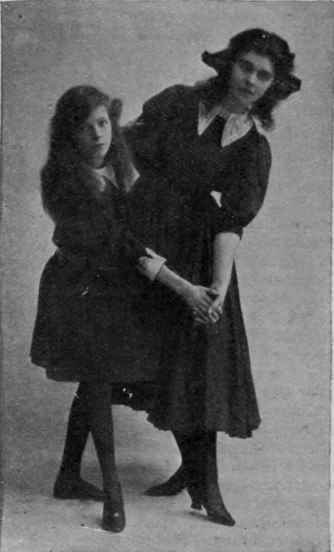
Fig. 4. The Dotted One-step. Three steps to edge of room Lady still moves forward, hands lowered
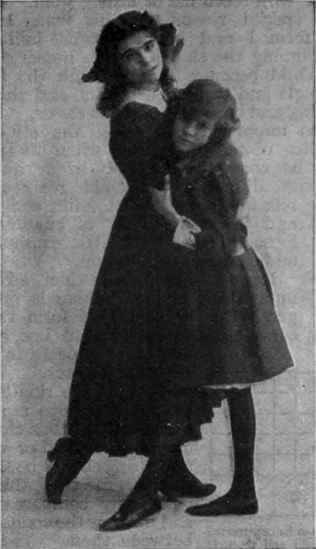
Fig. 5. The Crab Step. Turning in the crab step. The feet pass in between each other. The gentleman is just putting left foot between lady's feet, having described one circle front)
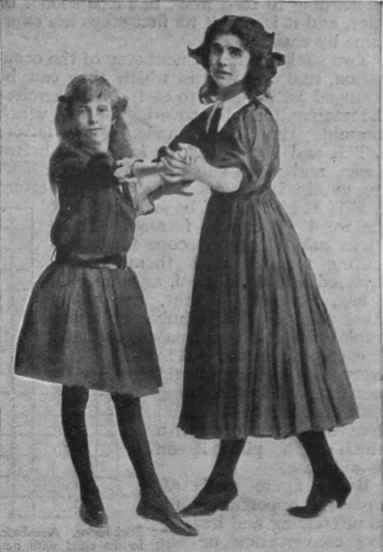
Fig. 6. The Crab Step (sideways). Moving away from the camera, lady's right foot behind, gentleman's left foot over (in step, the lady placing her right foot in front of her left at the first beat, and the gentleman doing the reverse. On beat 2 the lady places her foot behind, and the gentleman puts his in front (see Fig. 6). This backwards and forward step continues for eight bars of music, and then the entire dance is repeated. The three one-steps described have a definite form and arrangement, but there are many other so-called one-steps to be seen at any dance which are simply the invention of the dancers.
Continue to:


My Books

