


Home-Made Candle-Shades
Description
This section is from "Every Woman's Encyclopaedia". Also available from Amazon: Every Woman's Encyclopaedia.
Home-Made Candle-Shades
An Easily Made Shade for Candles - Choice of Materials and Colours - The Combination of
Colours - Lantern and Lamp Shades
It is not always the most costly things that lend an artistic effect to the house, and those whose means are limited may welcome the idea of the artistic and inexpensive candle-shades here illustrated.
Anyone with a little knowledge of drawing will find endless possibilities in design and decorative work, while those who do not feel competent to produce an original design should adopt the use of transfers, which can be bought at any fancy-work shop for a few pence.
First obtain some thin sheets of carton paper in a pale grey or fawn colour. These may be bought from any art dealer, or in the stationery department of the big shops. Some pieces of thin pongee or glace silk will be needed, a bottle of glue, and a camel-hair brush.
With a pair of compasses mark out a circle forty inches in circumference on the carton paper. Mark the half circle at each side, and cut the circle exactly in halves. This will give two semicircles, which will form the pair of candle-shades.
Having obtained the semicircles in the rough, proceed to trim the edges of the carton paper. This is best done by means of a very cheap penknife on a drawing board. Fix the cardboard to the drawing board very firmly by means of drawing pins, and, taking a firm hold of the knife, cut the card all round the pencil line, lifting the hands as little as possible to ensure a clean cut. Remove the pins, and set the semicircles aside while the design is prepared.
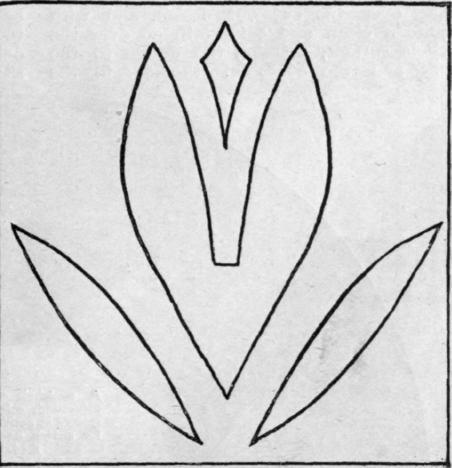
When this design has been traced on to a piece of cardboard, it can be cut out with sharp scissors and used as a stencil plate
It is best to start with some quite simple design, such as a shamrock leaf or a small conventional pattern. Take a piece of thin box cardboard and very carefully draw the selected design on this. Then carefully cut the design out to use it as a stencil plate. The design given on this page can be traced on to a sheet of tracing paper and transferred to the small piece of cardboard by means of carbon paper. A pair of manicure scissors will be found the best with which to cut the more delicate parts of the design.
When it is cut out, and the edges neatly and smartly trimmed, lay the design on the semicircle for the shade, marking with a pencil the position in which it should be placed.
Care must be taken to see that an equal distance is arranged for between each design. Lastly, cut out the design in the places indicated, and make each outline as bold and characteristic as possible.
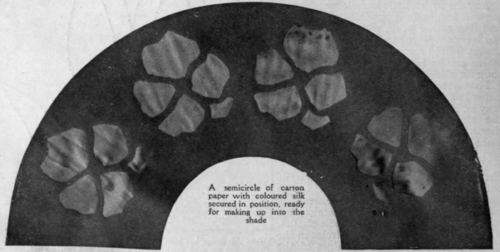
Cut some small pieces of silk of any colour which will suit the design you have selected, and, after having glued well the back of the shade, stretch each piece of silk over the cut out design, and with quite a clean and soft cloth go over the whole surface, pressing the design to the silk and the edges of the silk to the candle-shade until there is no danger of sagging. The shades must then be placed under a heavy book to make them perfectly flat. The shade may then be lined with the thinnest white kitchen paper, and joined neatly by means of glue. After joining, it will be found a good plan to place it over a candle-shade already made to ensure its drying a good shape.
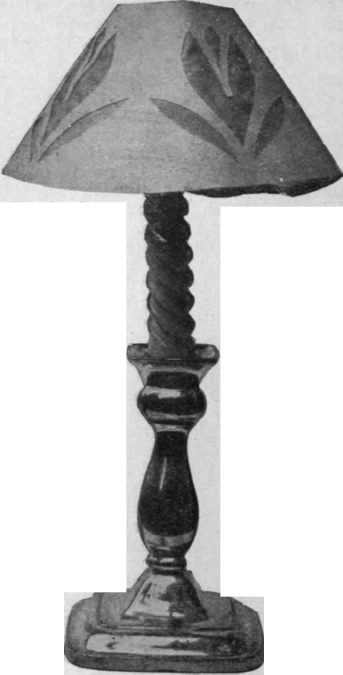
The candle-shade when finished.
A very pretty effect is obtained when the candle is alight
As a means of raising money for charitable enterprises the sale of these little shades will be most successful. They invariably attract the attention of buyers, and their novelty assures a great demand for them. They offer a good opportunity for the exercise of artistic talent, not only in design, but in the variety of the colour schemes. Exquisite combinations of white and green, of yellow and brown, mauve and purple, grey and orange, can be worked out by the clever girl who can make deft use of her fingers.
Those who desire to carry out a more elaborate scheme will find that a study of leaded-glass shades and stained-glass windows will help them greatly, and will result in beautiful productions, in which the colour schemes may be quite as lovely as any carried out in stained glass.
Lamp shades and screens can be fashioned successfully in this work, and lanterns offer scope for novel designs in which large flowers or quaint figures should be chosen. These lanterns may be used in halls and on porches. In rooms where a Japanese scheme of decoration prevails lanterns set on pedestals or hung from the ceilings give a finishing touch that is charming, but, in this case, only designs of strictly Japanese style should be used.
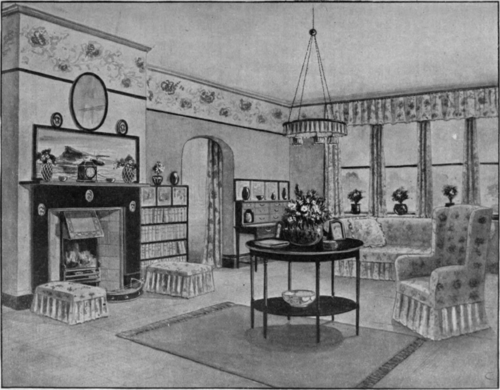
A chintz drawing-room is one of the most charming and restful of rooms. The walls should be hung with self-coloured paper, the frieze finished with a black beading, and the mantelpiece painted black to introduce the note of black which is a distinctive asset in the scheme. All woodwork should be black and all furniture covered in rose-covered chintz. The floor is laid with Indian matting on which are rose-coloured rugs one of the greatest delights of a drawing-room should be its cosiness and its homeliness.
Continue to:


My Books

