


Modern Parisian Etiquette. Continued
Description
This section is from "Every Woman's Encyclopaedia". Also available from Amazon: Every Woman's Encyclopaedia.
Modern Parisian Etiquette. Continued
One of the earliest lions forms also almost the earliest example of a " punning coat," as he represents the ancient kingdom of Leon, which ceased to exist as a separate regality in the early part of the twelfth century, when it was absorbed into Castile by the saintly King Ferdinand. The lion of Leon was the plainest and simplest of lions, thereby displaying his antiquity. He ramped red upon silver without accessories of any sort. Later lions forked their tails, and assumed crowns and sceptres, and other regal paraphernalia.
The parti-coloured lion of Thuringia is very ancient, for Thuringia as a separate State has long been merged. I do not think it ever boasted of an actual crowned king, except during the brief period when it formed part of the mushroom kingdom of Westphalia under Jerome Bonaparte, but it was among the first of the great European principalities. It is now represented by Hesse, and the Hessian lion is very like his
Thunngian predecessor, but more complicated.
The silver lion of Bohemia has a forked tail and a golden crown. The kingdom of Bohemia passed to the spindle side almost oftener than any other State in Europe. It is an interesting but not generally known fact that the King of Bohemia best known to readers of English history, that "John of Bohemia, blind and old," who was the original bearer of the device of the Three Feathers and the motto ' Ich Dien," was only King of Bohemia in right of his wife. Finally, with the wife of Ferdinand I., King of the Romans, Bohemia became an integral part of the Empire. But if the old-time custom still held good, the next Austrian emperor would not be its king, for the Archduchess Elizabeth, daughter of the ill-fated Crown Prince Rudolf, is the rightful heir. Bohemia, old as it is, had a brief existence as a separate State, and that troublous. Its sovereigns were usually members of other ruling Houses, and all it really had of its own was its arms.
Some Heraldic Lions
The lion of Luxemburg is another old coat. He has been crowned with the Imperial crown since the early fourteenth century, when the saintly Henry of Luxemburg was elected emperor.
The Norse lion holds the battle-axe, the characteristic weapon of the Vikings, in his paw.

The lion couchant, or lying down, figures frequently upon coatsof'arms
The Dutch lion, which is evolved from the more ancient lion of Nassau, the cognisance of the ruling House of Holland, holds a sheaf of arrows, typifying the united provinces.
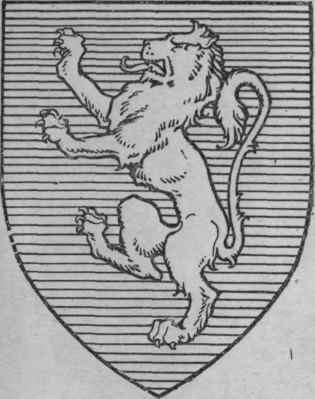
The lion rampant is a favourite device; he is thus represented in the arms of Scotland
Belgium and Bavaria are two modern kingdoms that bear lions in their arms. Bavaria's is another lion of the forked tail variety, silver upon red. Belgium's royal beast is blue, and ramps on a background of bars. The lion of Zaehringen presides over Baden ; and Schleswig and Brunswick are minor principalities, once kingdoms, which have lost their identity, but retain their armorial lions. There are black lions passant in the arms of Wurtemberg, a red lion rampant in the quarterings of the shield on the breast of the Austrian eagle, and a blue lion ramping among the hearts of Lunenburg.
The Romance of a Device
In the arms of Denmark three lions pass across the shield among nine hearts.
" ' That is the most beautiful coat-of-arms in the world,' said the old man. ' The lions represent strength, and the hearts gentleness and love.' And as he gazed upon the uppermost lion he thought of King Canute, who chained great England to Denmark's throne ; and he looked on the second lion, and thought of Waldemar, who-united Denmark and conquered the Vandals. • The third lion reminded him of Margaret, who united Sweden, Denmark and Norway. But when he gazed at the red hearts, their colours glowed more deeply, even as flames, and his memory followed each in turn. The first led him to a dark, narrow prison, in which sat a prisoner, a beautiful woman, daughter of Christian IV., Eleanor Ulfeld, and the flame became a rose on her bosom, and its blossoms were not more pure than the heart of this noblest and best of Danish women.
" ' Ah, yes, that is indeed a noble heart in the Danish arms! ' said the grandfather. And his spirit followed the second flame, which carried him out to sea, where cannons roared and the ships lay shrouded in smoke, and the flaming heart attached itself to the breast of Hvitfeldt in the form of an order as he blew himself and his ship into the air to save the fleet. And the third flame led him to Greenland's wretched huts, where the preacher Hans Egede ruled with love in every word and action. The flame was as a star on his breast, and added another heart to the Danish arms. In a peasant woman's humble room stood Frederick VI., writing his name with chalk on the beam. The flame trembled on his breast and in his heart . . ."
I have quoted in full this passage from the prince of Danish story-tellers, because it is a very good illustration of the romance underlying a coat-of-arms for those who have eyes to see.
Leopards As Lions
To come to our most familiar heraldic lions, the Scottish lion is as old as heraldry in Scotland. It is only since the time of Bruce that he has been surrounded with his now characteristic " tressure flory counterflory." But the so-called lions of England are really leopards; and it is only quite by a misapprehension that they now figure as the nobler beasts.
As the cognisance of persons who are not kings, the Percy lion with the straight tail is perhaps the best known, but lions are also borne by such great names as, in England, Talbot, Russell, Herbert, Mowbray, Fitzalan, Egerton, Pierrepont, Paget; in Scotland, Abernethy, Lyon, Crichton, Wemyss, Dundas, Gray, Ross, Ogilvie ; in Ireland, O'brien, O'grady. This is to give only a few of the coats in which the royal beast occurs. There is a list, too long to be given here, of families entitled to bear the lions of England and Scotland.

A lion passant and guardant. This device in its simplest form is one of great antiquity
Continue to:


My Books

