


The Art Of Skating On Ice. No. 4. The Back Inside Eight. Continued
Description
This section is from "Every Woman's Encyclopaedia". Also available from Amazon: Every Woman's Encyclopaedia.
The Art Of Skating On Ice. No. 4. The Back Inside Eight. Continued
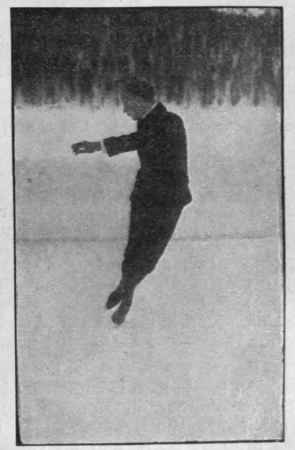
No. 5. The back inside change. The free foot is swung behind the tracing leg.
Just before going into the loop the body is inclined strongly, with the left shoulder advanced, with deeply bent tracing leg.
The body swing will take you into this loop, and all the others. Hold the free leg back as long as possible, and, when you are just about to come out of the loop, swing it boldly and freely to the front. This will give impetus and open out the curve to correspond to that which preceded the loop; left shoulder back. In all loops the free foot describes in the air the same loop that the skate describes on the ice.
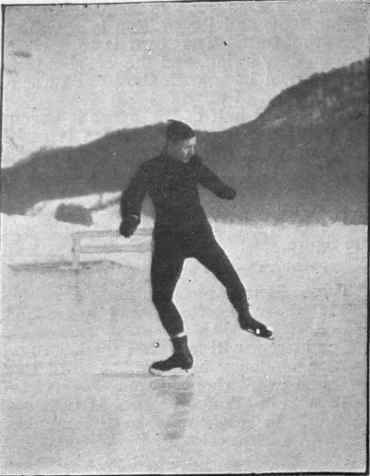
No. 6. Back outside bracket after the turn
Loops should be about fourteen inches long and shaped as in the diagrams of the school figures.
No. 15. The Forward Inside Loop
Commence with the left shoulder in front When going into the loop, bring the right shoulder forward.
When coming out of the loop, the free foot is swung powerfully to the front, and held a little across the tracing leg, to counteract the tendency to fall inwards.
No. 16. The Back Outside Loop
This is commenced in the position of photograph No. 3. Very strong bending of the knee is necessary when going into the loop ; twist the right shoulder forward as far as possible, keeping the left foot in front until the loop is nearly finished : then swing it back and keep it there until it makes the stroke for the second half of the figure.
No. 17. The Back inside Loop
The back inside loop is commenced in the position of photograph No. 4 when going into the loop; the right shoulder is still farther brought back, and on coming out the free foot is swung back and held there ready for the next stroke.
Nos. 18a and 18b. The Forward Outside and Back Inside Brackets
A bracket is composed of two curves in the same direction on different edges.
This figure is commenced with the right shoulder in front and with the body and legs held as much as possible sideways to the direction of progress, the free foot behind when nearing the turn. The tracing foot must be kept well under the body, the turn must be made very quickly, the position of the free foot being maintained, the right shoulder being well thrown back.
When commencing the second half of the figure, the free foot is immediately swung back, the body held sideways to the direction of progress, and the turn made by swinging the free foot in front of, and at once behind, the tracing foot, the right shoulder leading, body bent forward.
Nos. 19a and 19b. The Forward Inside and Back Outside Brackets
For the first turn the body must be sideways to the direction of progress, with the left shoulder leading and the free foot in front. The bracket is made by rotating the shoulders against the hips and swinging the free foot into the position of No. 3.
The back outside bracket is commenced with the free foot behind; when preparing for the turn it is swung forward and the bracket is made by a flick of the tracing foot, the position after the turn being as shown in photograph No. 6.
Nos. 20a and 20b. The Forward Outside and Back Outside Rockers
The forward outside rocker is a most difficult figure to skate with accuracy.
The difficulty is not in the first edge or the turn itself, but in holding the subsequent curve on a true edge without change.
The figure is commenced with the free leg behind. It is almost immediately brought forward into the position shown in photograph No. 7. It will be seen that the skater is here very hard on the edge, with the body strongly rotated. The skater was taken at the moment when he had lifted the free foot preparatory to making the turn and dropping it behind the tracing foot. The turn must be made very rapidly, and the left shoulder forced back as far as possible.
At the take-off for the outside back rocker, the free foot is in front. It is then swung behind, with the right shoulder pressed well back. At the turn the free foot is swung forward and immediately back; the right shoulder must then be brought well forward in order to obtain a true curve, and the free foot held behind.
Nos. 21a and 21b. The Forward Inside and Back Inside Rockers
The figure is commenced with the left shoulder leading, the free foot behind. Just before the turn the position is reversed - the right shoulder is brought well forward with the free foot in front. At the turn the free foot is swung back and immediately forward, and the right shoulder held in the direction of progress. At the finish of the curve the free foot is brought back to be in position for the take off of the back rocker.
For the first curve of the second half of the figure, the free foot is in front, with the left shoulder leading. Immediately before the turn, the free foot is swung behind and across the tracing foot, the body strongly rotated, with the left shoulder still leading. The turn is made with a very sharp movement of the tracing foot, while the free foot is swung far behind and the left shoulder in front.
N05. 22a and 22b. The Forward Outside and Back Outside Counters
The figure is commenced with the right shoulder leading, the free foot behind. At the turn the free foot is in front, with the body strongly rotated, the free foot is swung back and immediately forward. The left shoulder must then be pressed well back in order to get hard on the edge. For the second half of the figure, the right shoulder must lead with the free foot behind. At the turn the body is rotated, with the left shoulder leading; the free foot is brought forward, and back, and the curve is finished in the first position of forward outside.
Nos. 23a and 23b.. The Forward Inside and Back Inside Counters
The figure is commenced with the left shoulder leading and the free foot behind. Just before the turn the shoulders are strongly rotated, with the free foot in front of and in a line with the tracing foot.
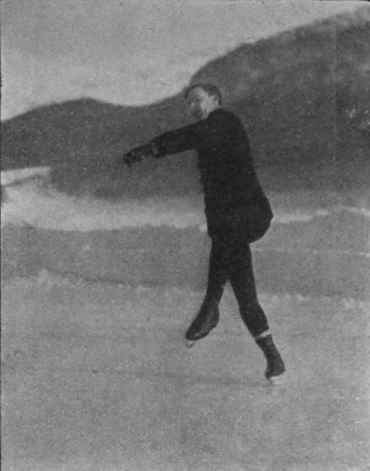
No. 7. The forward outside rocker
At the turn the free foot is swung back and immediately forward again, with the left shoulder pressed back in the direction of progress.
The second half of the figure is commenced with the left shoulder leading, the free foot in front. It is then swung back, and the right shoulder leads. At the turn the free foot is swung forward and back again, the body rotated, with the right shoulder leading.
Continue to:


My Books

