


Milk Products, Junket With Fruit, Home Recipes, Pasteurized Milk, Whipped Cream, Sour Milk Cheese Or Cottage Cheese
Description
This section is from the "Cooking" book, by Lilla Frich. Also see Amazon: Cooking.
Milk Products, Junket With Fruit, Home Recipes, Pasteurized Milk, Whipped Cream, Sour Milk Cheese Or Cottage Cheese
Milk Products
When milk stands, the fat globules rise to the top in the form of CREAM. Cream is put into a churn and shaken, and the globules of cream gather together as butter, and the liquid left is called BUTTERMILK.
An acid added to milk coagulates the casein, forming a CURD, separating it from the liquid then called WHEY. The CURD is then made into CHEESE, which contains condensed nourishment (casein and fat of milk).
CONDENSED MILK is prepared by evaporating milk to about 1/2 to 1/4 of its volume.
MILK is preserved by STERILIZATION, PASTEURIZATION and EVAPORATION.
Working Directions To Be Followed By All Odd Numbered Girls
In today's lesson you are to prepare the Junket, while your partner prepares the Cottage Cheese.
Follow each paragraph closely.
See Recipe on Front Page.
Measure the milk and heat it until lukewarm (so that it is neither hot nor cold to the touch).
Measure and add the sugar, salt and flavoring; stir until the sugar is dissolved.
Dissolve the 1/6 junket tablet in 1/2 teaspoonful of water. See FIGURE 1.
Add the junket and water to the milk mixture. See FIGURE 2.
Pour mixture into your custard cup.
Let stand in a cool place until it becomes about the consistency of a baked custard.
Serve your partner and yourself.
You are to WIPE the dishes today according to directions already learned.
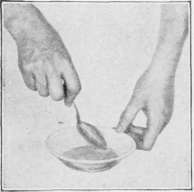
FIGURE 1.
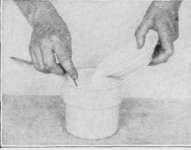
FIGURE 2.
Note Book Work
MATERIALS:
1 Qt. Milk.
4 Tablespoonfuls Sugar.
1 Teaspoonful Vanilla.
1 Tablespoonful Liquid Rennet, or 1 Junket Tablet dissolved in 1 Tablespoonful Water. 1/4 Teaspoonful Salt.
Heat the milk until lukewarm; add the sugar, salt and flavoring; stir until the sugar is dissolved. Add the junket and water mixture and pour into the serving dish. Let stand in a cool place until firm like a baked custard. Serve with plain or whipped cream or sliced fruit.

Junket With Fruit
Cost of preparing Home Recipe of Junket:
Ingredients: | Cost. |
1 Qt. Milk................................................ | cts. |
4 Tablespoonfulls Sugar.. | cts. |
1 Teaspoonful Vanilla ................................... | cts. |
1 Junket Tablet ............................................ | cts. |
1/4 Teaspoonful Salt ....................................... | cts. |
Working Directions To Be Followed By All Even Numbered Girls
In today's lesson you are to prepare the Cottage Cheese, while your partner prepares the Junket.
Follow each paragraph closely.
See Recipe on Front Page.
Heat the milk slowly in a double boiler (see FIGURE 1) until the curd separates from the whey.
Strain through a piece of cheesecloth. Squeeze curd until quite dry.
Put curd into your bowl and with a spoon or fork mix it with salt, butter and cream. Divide in two parts. See FIGURE 2.
Form into two balls, serving one to your partner and one to yourself.
You are to WASH the dishes today according to directions already learned.
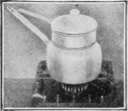
FIGURE 1.

FIGURE 2.
Home Recipes
Pasteurized Milk
Sterilize bottles by putting them edgewise into cold water; bring slowly to boiling point and boil 20 minutes. Fill the sterilized bottles 3/4 full of milk and cork with cotton which has been baked in the oven, or with sterilized rubber corks. Place bottles on a rest or on several thicknesses of paper in a pan. Fill pan with enough cold water to reach as high as the milk in the bottles. Heat gradually to 160 deg., or until small bubbles appear in the milk next the glass. Keep at this temperature 40 minutes. Cork the bottles quickly and keep in a cold place. Do not remove corks until ready to use the milk.
Whipped Cream
1 Cup Thick Cream. 3 Tablespoonfuls Sugar. 1/2 Teaspoonful Vanilla.
Pour the cream into a bowl and set in a pan of ice water. Whip with a wire whisk or Dover egg beater until stiff enough to hold its shape. Add sugar and vanilla. Do not beat the cream too long.
Sour Milk Cheese Or Cottage Cheese
1 Qt. Sour Milk.
1 Tablespoonful Butter.
1/4 Teaspoonful Salt. 2 or 3 Tablespoonfuls Cream.
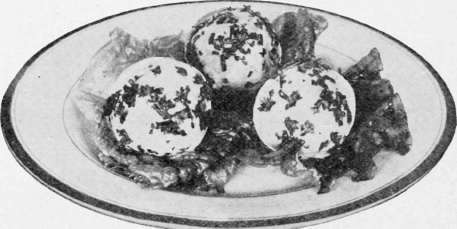
Heat the milk slowly until the curd separates from the whey. Strain through a piece of cheesecloth. Squeeze curd until quite dry. Put curd in a bowl and with a spoon or fork mix it with salt, butter and cream. Form into balls. These may be rolled in chopped parsley. The curd may be separated from the whey by adding 1 Junket Tablet to a quart of milk heated to 100 deg. F., then beaten until the curd separates from the whey.
Cottage Cheese may be mixed with finely chopped Pimento. Served between slices of bread as sandwiches or shaped into cheese balls and served on lettuce leaves as a salad or with fruit and other salads. It may be mixed with chopped olives or pickles or green pepper and used in the same way.
Questions
1. For whom is milk a perfect Food?
2. What does milk contain?
3. At what temperature is milk most easily digested?
4. How should it be drunk? Why?
5. Name three different dishes containing milk in large proportions.
6. How would you prepare Cottage Cheese?
7. How would you prepare Junket?
8. How can you make butter?
9. How much water is there in milk?
10. How much protein is there in milk?
11. How much fat is there in milk .?
12. How much mineral matter is there in milk?
13. How is milk pasteurized?
14. How is milk sterilized?
Suggestions For Home Application
Fifty sanitary rules adopted from dairy rules recommended by the U. S. Government Department of Agriculture, Dairy Division, by City Boards of Health in several cities in the United States.
The Owner and His Helper.
1. Read current dairy literature and keep posted on new ideas.
2. Observe and enforce the utmost cleanliness about the cattle, their attendants, the stable, the dairy and all utensils.
3. A person suffering from any disease or who has been exposed to a contagious disease must remain away from the cows and the milk.
4. Keep dairy cattle in a room or building by themselves. It is preferable to have no cellar below and no storage loft above.
5. Stables should be well ventilated, lighted, and drained; should have tight floors and walls and be plainly constructed.
6. Never use musty or dirty litter.
7. Allow no strong smelling material in the stable for any length of time. Store the manure under cover outside the cow stable and remove it to a distance as often as practicable.
8. Whitewash the stable once or twice a year; use landplaster in the manure gutters daily.
9. Use no dry or dusty feed just previous to milking; if fodder is dusty, sprinkle before it is fed.
10. Clean and thoroughly air the stable before milking; in hot weather sprinkle the floor.
11. Keep the stable and dairy room in good condition and then insist that the dairy, factory or place where the milk goes is kept equally well.
The Cows.
12. Have the herd examined at least twice a year by skilled veterinarians.
13. Promptly remove from the herd any animal suspected of being in bad health and reject her milk. Never add an animal to the herd until certain it is free from disease, especially tuberculosis.
14. Do not move cows faster than a comfortable walk while on the way to place of milking or feeding.
15. Never allow the cows to be excited by hard driving, abuse, loud talking, or unnecessary disturbances; do not expose them to cold or storms.
16. Do not change the feed suddenly.
17. Feed liberally, and use only fresh, palatable feed stuffs; in no case should decomposed or moldy material be used.
18. Provide water in abundance, easy to access and always pure; fresh, but not too cold.
19. Salt should always be accessible.
20. Do not allow any strong flavored food, like garlic, cabbage and turnips, to be eaten, except immediately after milking.
21. Clean the entire body of the cow daily. If the hair in the region of the udder is not easily kept clean it should be clipped.
22. Do not use the milk within 20 days before calving, nor for 3 to 5 days afterward.
Milking.
23. The milker should be clean in all respects; he should not use tobacco; he should wash and dry his hands just before milking.
24. The milker should wear a clean outer garment, used only when milking, and kept in a clean place at other times.
25. Brush the udder and surrounding parts just before milking, and wipe them with a clean, damp cloth or sponge.
26. Milk quietly, quickly, cleanly and thoroughly. Cows do not like unnecessary noise or delay. Commence milking at exactly the same hour every morning and evening, and milk the cows in the same order.
27. Throw away (but not on the floor - better in the gutter) the first few streams from each teat; this milk is very watery and of little value, but it may injure the rest.
28. If in milking a part of the milk is bloody or stringy or unnatural in appearance, the whole mess should be rejected.
29. Milk with dry hands; never allow the hands to come in contact with the milk.
30. Do not allow dogs, cats or loafers to be around at milking time.
31. If any accident occurs by which a pail full or partly full of milk becomes dirty, do not try to remedy this by straining, but reject all this milk and rinse the pail.
32. Weigh and record the milk given by each cow, and take a sample morning and night, at least once a week, for testing by the fat test.
Care of Milk.
33. Remove the milk of every cow at once from the stable to a clean, dry room, where the air is pure and sweet. Do not allow cans to remain in stables while they are being filled.
34. Strain the milk through a metal gauze and a flannel cloth or layer of cotton, as soon as it is drawn.
35. Aerate and cool the milk as soon as strained. If an apparatus for airing and cooling at the same time is not at hand, the milk should be aired first. This must be done in pure air, and it should then be cooled to 45 degrees if the milk is for shipment, or to 60 degrees if for home use or delivery to a factory.
36. Never close a can containing warm milk which has not been aerated.
37. If cover is left off the can, a piece of cloth or mosquito netting should be used to keep out the insects.
38. If milk is stored it should be held in tanks of fresh, cold water (renewed daily), in a clean, dry, cold room. Unless it is desired to remove cream, it should be stirred with a tin stirrer often enough to prevent forming a thick cream layer.
39. Keep the night milk under shelter so rain cannot get into the cans. In warm weather, hold it in a tank of fresh cold water.
40. Never mix fresh, warm milk with that which has been cooled.
41. Do not allow milk to freeze.
42. Under no circumstances should anything be added to milk to prevent its souring. Cleanliness and cold are the only preventatives needed.
43. All milk should be in good condition when delivered. This may make it necessary to deliver twice a day during the hottest weather.
44. When cans are hauled far they should be full, and carried in a spring wagon.
45. In hot weather cover the cans, when moved in a wagon, with a clean, wet blanket or canvas.
The Utensils.
46. Milk utensils for farm use should be made of metal and have all joints smooth soldered. Never allow them to become rusty or rough inside.
47. Do not haul waste products back to the farm in the same cans used for delivering milk. When this is unavoidable, insist that the skim milk or whey tank be kept clean.
48. Cans used for the return of skim milk or whey should be emptied and cleaned as soon as they arrive at the farm.
49. Clean all dairy utensils by first thoroughly rinsing them in warm water; then clean inside and out with a brush and hot water in which a cleaning material is dissolved; then rinse and, lastly, sterilize by boiling water or steam. Use pure water only.
50. After cleaning, keep utensils inverted in pure air, and sun if possible, until wanted for use.
Continue to:


My Books

