


Decorated Cakes
Description
This section is from the book "Cooking For Profit", by Jessup Whitehead. Also available from Amazon: Cooking for Profit.
Decorated Cakes
There is evidently a laborious effort to discover something marvelous to put upon a cake when a resort is had to flexible glass, satin sashes, panel paintings and various sorts of millinery in addition to the plaster of paris and gum paste figures and structures which are perennial as cake ornaments. These things come high but they must have them at the London Exhibitions and they do not interest pastry cooks and bakers much because all such methods are outside of their trade. When a cake has to be carried to the glass-blower's, the landscape gardener's, the upholsterer's, the milliner's, the image maker's, and the painter's places, the baker may throw his slipper after it for luck but he need not go with it. It is none of his work to do.
There were prize medals offered for the best decorated Christmas cake and best wedding cake, and Messrs. Newton & Eskell, proprietors of the Caterer offered a special prize in that department. This was awarded to a firm of "country caterers," from Leamington, who came to the great city and took the premium with a cake that was remarkable for its elaborate piping in sugar icing, which is true pastry cook's and confectioner's work; and the gem of the exhibition in bride cakes is said
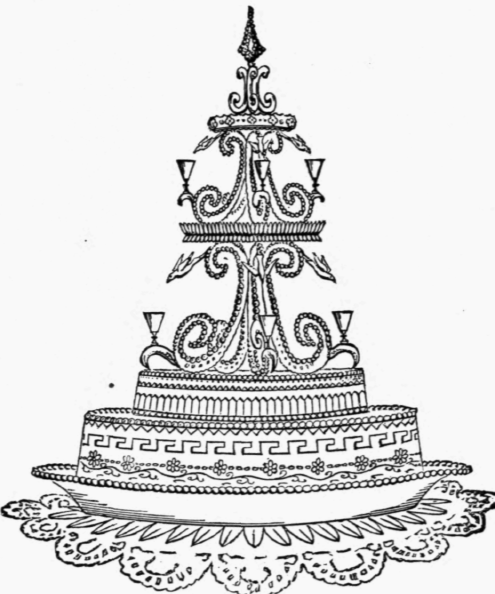
Cake Decoration In White Icing
By Jessup Whitehead.
(From a Photograph.) to have been one decorated with real hot-house flowers relieved by delicate green ferns, and if the cake itself was already ornamented in icing it must have been a beautiful object and not too far removed from common ideas of edibility, and not beyond the sphere of the workman who makes the cake to carry it to such a completion. It is a trade to itself to make the gum paste structures with altars and leaves and flowers which we see exhibited for sale under glass cases at the confectioners in every large city. Pastry cooks can make a few flowers on the spur of necessity, but very few can make them as perfectly as those do who never do any other work but make flowers.
The instructions here to be given are for designs in pure sugar icing, practice in which will lead the learner on to a trial of all the additional branches.
The engraving on the preceding page shows the design of cake decorated in the Grecian style that once came under the powerful protection of no less a person than General Grant, whose interference prolonged its existence at least two days. The hand that was extended to make a breach in the upper works was Mrs. Grant's. That serene lady would have broken off one of the white birds which were hovering in the act of sipping the crimson jelly in the glasses. The general put his hand on hers and pushed it aside saying: "Don't break that." "I want to try the con-fectionery,"said the lady.
"There is plenty without - don't break it - ," said he again; and it was saved to appear again next day with sections cut out of both the lower cake and the upper one on two sides, the cake sliced and part of the slices replaced, and all was done without breaking the ornamentation, which requires but a small foundation to stand upon. The lower cake was made by the recipe No. 836, the upper was a white citron cake.
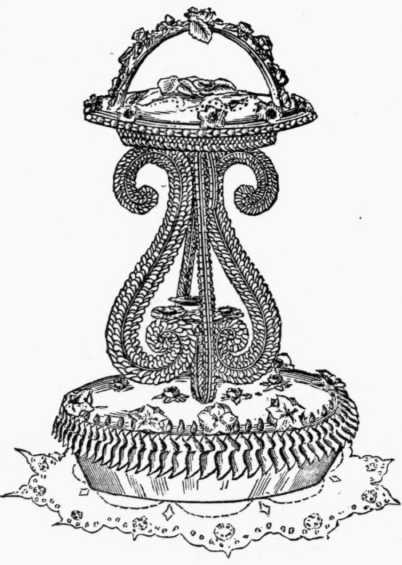
Over the top of the pyramid, which was all pure white and lace-like, was thrown a long and slender vine of Virginia creeper, much handsomer than smilax because of the finely tapering gradations of the leaf sizes, and these were just turned to vivid colors by the touch of the first October frost.*)
This is a picture of the cake that was made and ornamented in haste and under difficulties for the wedding of the banker's daughter, as hurriedly sketched at No. 941. It took about four hours of a summer night to put up those ornaments in sugar icing. There were, of course, more people concerned in that wedding than it was business of mine to mention at such a hard-working time, and among them was the young lady's father, the banker himself; and when the table was set and the time was right to bring along the wedding presents he walked up and took out of his breast pocket the title deed to a forty-thousand-dollar house and lot in Lakeport, made out in his daughter's name; he rolled up the document and placed it under the lid of the basket and left it there. The hostess put into the basket on top a silver thimble and the host put in a gold pencil case, then the children climbed on chairs and filled the basket and all the spaces with white flowers which they had been out at sunrise to all the neighbours' gardens to gather. When the bride came to cut the cake she shed tears on the flowers, hung the pencil case on her watch-chain, put the thimble on her finger and tucked the title deed down in the bosom of her dress. And the children ate both the basket and the pedestal because it was all sugar and flavored with lemon.
* [That was perhaps the happiest period of General Grant's life. He was spending a week with his family and officers of his staff and their wives at the Manitou House, Manitou Springs, Colorado. He loved that locality, this was his third visit to it; it was in the third year of his first term as President, an office of which he was wearv and he delighted the people of Manitou village by declaring his intention of returning and making- his home there when his term was ended. He went around the world after that and after all he visited Manitou once more, though only for a day, when on his way to Leadville, where he had thought of investing in the mines.]

Decorated Cake Center-Piece on a Silver Dish. Height about 3 1/2 ft.
Served at a private supper tendered to General U. S. Grant by Governor Tabor at Leadvilie, Colo. The baskets and spaces filled up with a various assortment of the lightest Italian cakes, macaroons, meringues, and bon-bons and the whole festooned with smilax.
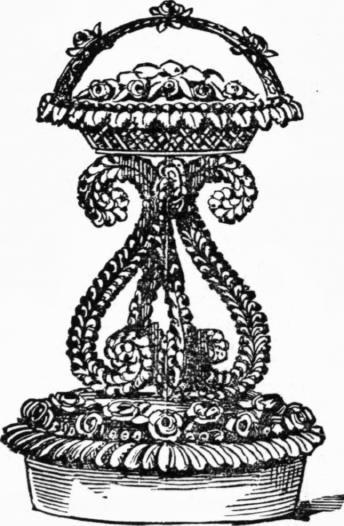
Cake Decoration in White Icing.
By Jessup Whitehead.
From, a Photograph.
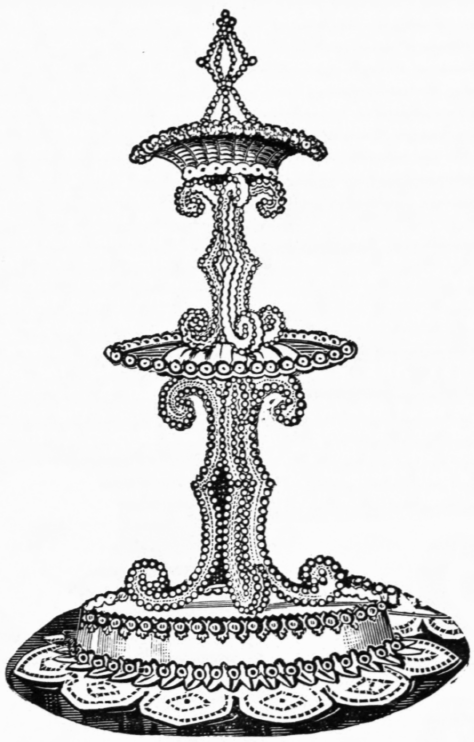
Height about 3 feet.
Cake Decoration in White Icing.
By Jessup Whitehead.
Cake Center Piece, Stand for Small Sweets, to go with Floral Decorations. Served at a terrapin supper given by Mrs. R. J. Lowry, Atlanta, Georgia.
This pattern has been redrawn large and distinct to show the details plainly for the purpose of this article. The photographer remarked that "it was a daisy," and he squared himself three or four different ways to get the best expression of it. The pure white and fragile structure was ornamented with bright colored sugar flowers set upon it and around the edges and in the spaces. It was an ornamented cake made to serve as a center piece among some elaborate floral decorations at a party supper given by a lady of Atlanta, Georgia. The design was finished for the purpose by having the stands and baskets filled up with bonbons, maca-roons, hisses, and the lightest kinds of fancy small cakes, and was hung with trailing sprays of smilax. In such positions these tall pieces harmonize most perfectly with floral decorations, the effect of which they highten without being too obtrusive and without the least suggestion of children's play-house figures such as attaches to the gum paste temples and pavilions of the ordinary style.
Continue to:


My Books

