


(3407). How To Make Bread (La Fabrication Du Pain)
Description
This section is from the book "The Epicurean", by Charles Ranhofer. Also available from Amazon: The Epicurean, a Complete Treatise of Analytical and Practical Studies on the Culinary Art.
(3407). How To Make Bread (La Fabrication Du Pain)
Bread making is divided into the following operations: The preparation of the stock yeast, the yeast, the ferment, the leaven, the dough, the molding and the baking.
(3408). Stock Yeast (Fond De Levain) Boil Five Quarts Of Water)
Put in a stone jar five ounces of flour; dilute it with a part of this boiling water, sufficient to obtain a very firm paste; put into the remainder of the water one ounce of hops; let boil for ten minutes, then remove the liquid from the fire and run it through a fine sieve into the stone jar and over the paste. Set this jar in a cool place until the liquid is only lukewarm. Then dissolve the paste with the water, and add to it four ounces of malt; cover the pot, and leave it in a rather warm temperature for forty-eight hours, where it cannot be disturbed; when this time has expired strain the liquid through a sieve into another stone jar. The stock yeast is now ready to be used.
(3409). Yeast (Levure)
All the utensils used for making yeast and leaven should be kept scrupulously clean, as also the tubs. Put fifteen quarts of water into a large pot: set it on the fire and remove it at the first boil. Lay two pounds of flour in the bottom of a tub, dilute it with a pint of boiling water and make a sufficiently hard paste. Put into the rest of the water in the pot three ounces of hops and let boil for ten minutes, then remove from the fire and strain the boiling liquid at once through a fine sieve into the tub and over the paste; set this tub in a cool place and leave it till the liquid is only lukewarm, then with the hands work the paste well into the water; add immediately one quart of barley malt and a quart of stock yeast, mixing all well together. Set the tub in a moderate temperature and leave without disturbing it while fermenting, which process will take place in eighteen to twenty hours. By attending to these elementary details with care a perfect baking will ensue. Strain the yeast through a fine sieve into another tub and set this in the icebox, or any cool place, to use as needed for the preparation of the ferment.
This yeast will keep perfectly good for four days.
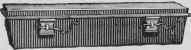
Fig. 610.
(3410). Ferment (Ferment)
Wash seventeen quarts of small potatoes, put them into an enameled iron pot, pouring over sufficient cold water to cover; place the pot on the fire, and let them boil uninterruptedly until well done, then remove. Throw the potatoes into a large tub, add two and a half pounds of flour, mash well together with a pestle to reduce the whole to a smooth paste, then dilute this paste gradually with twenty-two quarts of water, either cold or barely lukewarm, according to the temperature and season; afterward add five quarts of yeast, and mix the whole well together. Cover the tub with a cloth, and set it in a moderately warm place where there is no danger of its being disturbed and leave it until fermentation takes place, which means until it rises to double its height and falls again to its normal state. The fermentation should take place in from seven to eight hours. With this quantity of ferment a barrel of flour can be used.
(3411). Leaven (Levain)
Sift a barrel of flour into one end of the kneading trough; into the other end strain thirty-one quarts of ferment through a colander, and work enough of the flour into it to form a dough, not too consistent: gather up this dough into a small space in the trough and keep it in position with a movable board which answers for a partition; dredge it over with flour, and cover with the lid of the trough, then leave it to rise for three hours; at the end of that time the sponge should be double its size and ready to fall again; it is then ready for the dough.
(3412). The Dough (La Pate)
Remove the supporting board and let the sponge cover a larger space in the trough; pour over it twenty-nine quarts of water and three pounds of salt dissolved in a part of the water, then mix the whole together until the sponge is well blended; then dredge over the half of the remaining flour and knead well together with the hands, giving them a vertical rotary movement, going and coming from one end to the other of the dough; it should now be rather soft and begin to acquire body. Pour the remainder of the flour in one layer over all the paste and knead it once more, but this time cutting it into small pieces with the hands and superposing these pieces at once, one on top of the other; as soon as all the flour is absorbed, then push all of the dough to one end of the trough. • Cut from the whole of it a piece weighing twenty-five pounds; knead it strongly, blowing and beating it forcibly against the sides of the trough, which means to take the piece of dough by the two lateral ends, raise them to the height of the chest, stretching out the dough and bringing it down heavily against the sides of the trough in such a way as to imprison all the air possible, and give it consistency; repeat the same operation with the remainder of the paste.
Superpose the pieces of dough as quickly as they are done, one on top of the other, at the other end of the trough; repeat this operation a second time, then a third and even a fourth time, until the dough has acquired the desired body, then gather it together into a small space in the trough, holding it up with the well-floured board wedged against it. Dredge over lightly with flour, cover and leave it to rise for one hour. The dough is then ready to mold.
Continue to:


My Books

