


Recipes For Beef (Boeuf). Continued
Description
This section is from the book "The Epicurean", by Charles Ranhofer. Also available from Amazon: The Epicurean, a Complete Treatise of Analytical and Practical Studies on the Culinary Art.
Recipes For Beef (Boeuf). Continued
Beef French Cuts (Boeuf Coupe A La Francaise)
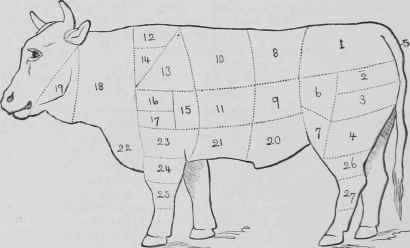
(Fig, 303.).
1. Calotte.
2. Tranches petit os.
3 Milieu du gitea la noix.
4. Derriere du gite a la noix.
5. Tendre de tranches inte-rieure.
6. Tranche grasse interieure.
7. Piece ronde partic interieure. 8. Aloyau avec filet.
9. Bavette d'Aloyau.
10. Cotes Couvertes, a la noix.
11. Plat de Cotes.
12. Surlonge partie interieure.
13. Derriere de paleron.
14. Talon de Collier.
15. Bande de Macreuse.
16. Milieu de Maereuse dans le paleron. 17. Boite a molele. 18. Collier.
19. Plat de joue.
20. Flanchet.
21. Milien de poitriue.
22. Cros bout 23. Queue degite.
24. Gite de devant.
25. Cros du gite de devant.
26. Gite de derriere.
27. Cros du gite de derriere.
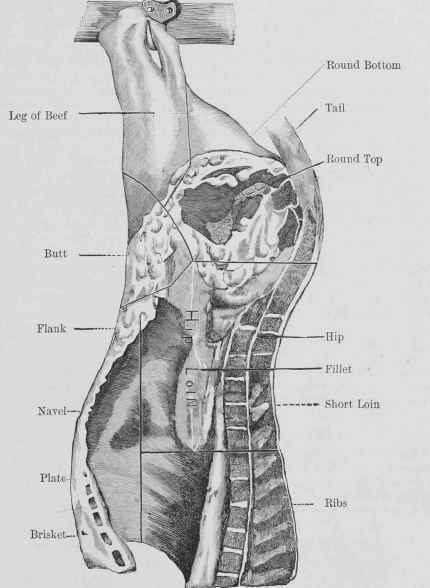
Fig. 304.
(1316). Corned Round Bottom, Top, English Style (Noix De Boeuf Salle Ecarlate A L'Anglaise)
, Bone and prick the meat with a larding needle, rub it over with pulverized saltpetre, salt, and brown sugar, then put it in an earthern vessel or a wooden tub, pouring over a brine prepared as follows: Throw a potato into salted water; when it rises to the surface it is an indication that the brine is sufficiently strong; pour enough of this over the meat to cover entirely and set it in a cool place where the thermometer does not register above forty degrees, leaving it for fifteen days, and carefully turning the meat over at various intervals. When ready to be used, drain the corned beef, wash, then boil in plenty of water. For a six-pound piece it will take about two hours and a half. After cooking for one hour, add to it a pudding made of flour and beef suet, also cabbage, onions, and pared carrots and turnips. Three-quarters of an hour before serving, throw in some medium sized peeled potatoes; range the corned meat on a dish, garnish around with the cabbage, carrots, turnips, and onions arranged in clusters, and at the ends place the pudding cut into slices.
Pour into the bottom of the dish a clear gravy (No. 404.). The quantity of water requisite to cook the corned beef depends entirely upon the quantity of salt used, and the length of time the beef was in the brine; if the beef is very salty, it will require more water than otherwise, and it is even advisable to change it after the first boil.
(1317). Edgebone Or Aitchbone, Boiled Cream Horseradish Sauce (Quasi De Boeuf Bouilli Sauce Raifort A La Creme)
Edgebone or aitchbone, is a bone of the rump which in dressed beef presents itself in view edgewise; it is also called aitchbone.
Have a piece of the edgebone weighing twelve pounds; put it in a soup pot capable of holding twice the quantity the size of the meat. Cover with some good broth (No. 194a), place it on the hot fire to bring to a boil, salt to taste, skim well, and add two pounds of carrots, or four medium sized ones, two fine turnips, a four ounce onion stuck with two cloves, six leeks, half a medium sized parsnip, a small handful of celery and one cabbage. Simmer slowly for three or four hours, and when the meat is cooked, drain and dish it up, laying the carrots and turnips cut into pieces, also the cabbage nicely trimmed, around the sides, and green sprigs of parsley at the ends. Serve separately a cream horseradish sauce (No. 478).
(1318). Kulash A La Finnoise (Guylas A La Einnoise)
Cut a pound of trimmed tenderloin of beef in inch squares, 'also two ounces of one-eighth of an inch squares of onions. Put four ounces of butter into a saute-pan, and when hot, add first the onions and then the beef; season with salt and paprika (a Hungarian pepper), moisten with a little good gravy (No. 404), and cook for one hour and a half, adding a little espagnole sauce (No. 414).
.1 wither way is to use a pound of lean tenderloin, cut in inch squares, half a pound of the breast of bacon cut in half inch squares, a pound of potatoes cut in half inch squares, a quarter of a pound of onions in one-eighth of an inch squares, frying them in half a pound of butter. Put in first the beef, then the potatoes, salt, pepper, and spice, add a pint of good gravy (No. 404), cover hermetically, and cook slowly for one hour and a half.
(1319). Marrow Bones On Toast (Moelle Sur Croutes Grillees)
Scrape and clean well some marrow bones (the best marrow bones are found in the round, the second best in the hind legs). Saw them off in three and a half inch length pieces; wrap them in a cloth, and plunge them in boiling broth; let it continue to boil for twenty minutes, then drain and serve the bones containing the marrow on a folded napkin, and slices of toasted bread separately, or take out the marrow, and serve it on slices of toast without the bones.
Continue to:


My Books

