


Recipes For Confectionery (Confiserie). Center Pieces. Part 2
Description
This section is from the book "The Epicurean", by Charles Ranhofer. Also available from Amazon: The Epicurean, a Complete Treatise of Analytical and Practical Studies on the Culinary Art.
Recipes For Confectionery (Confiserie). Center Pieces. Part 2
(3615). Center Pieces; Explanation Of Various Figures (Pieces Montees; Explication Des Differents Sujets)
These figures as far as the letter I can be used for all pyramids, either of cooked, poured or spun sugar or of gum paste; adjust four to six pieces equally distant, and fasten them together; fill the intersections with arabesques, as in G and H, and surmount the whole with an ornament or bunch of flowers made of web sugar, the same as shown on piece K. On the projections of piece K, LLL rings of poured sugar can be placed, filling the centers with iced fruits; in the empty spaces can also be ranged sticks of poured sugar covered with fruits or small cakes, bonbons, almond paste, etc. The figures F and A show the effect that can be produced by using simpler methods. A is merely decorated with small arabesques, shown in I, in half their natural size; on F small sticks are fastened one to the other. Fig. 728 is made of nougat; the frog to be of green pistachio nougat molded in a varnished and oiled plaster mold; the rushes are green and brown. Fig. 730 represents a cactus on a two-shelved socle made of Parisian nougat; the flower pot is of nougat containing chopped almonds and chocolate; the plant is of green pistachio nougat to imitate the cactus.
The lighthouse (Fig. 731) is of gum paste; the chimney on top of the house, from whence arises the smoke, is imitated in wadding; the branches of the tree of very fine wire covered with finely cut paper to represent the leaves, and the trunk to be of gum paste or fine wire covered with silk. The staircase and the boat are of gum paste; the boat lies on a piece of looking glass. The J and M are meant for forming socles for raising the low pieces, such as the frog, etc. J is made in three pieces that can be used independently, so as to make the socle either higher or lower.

Fig. ?29 I, F.

Fig. 728.

Fig. 729 H, G.
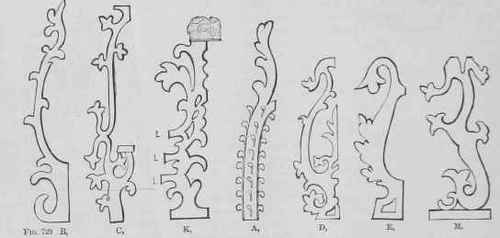

Fig. 730.
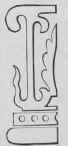
Fig. 729 J.

Fig. 781.
(3616). Center Pieces Of Cooked Sugar (Pieces Montees En Sucre Cuit)
For cooked sugar see Elementary Methods (No. 171). It is always necessary to have sugar cooked in advance so that each time some is wanted it will not have to be prepared, especially when only a little is to be used at a time. Have some sugar cooked to " large crack" (No. 171); when it reaches three hundred and thirty degrees add to it the juice of a quarter of a lemon and leave cook to three hundred and fifty degrees, then pour it hastily on a thick marble sufficiently large to allow it to cool, then detach and set it away in hermetically closed tin boxes. To make web or spun sugar, first melt it slowly in a small copper pan, a little at a time, being careful it does not change color. This sugar is used for spinning sultanas, for making ornaments in spun sugar, or it can be used for Parisian nougat and even for candying fruits, reducing its degree by introducing a little syrup at thirty-two degrees or else some glucose. For spun sugar pieces lightly trace with a pencil on an unpolished and very lightly oiled marble the outlines of the design needed for reproduction; cover this tracing with a thread of firm royal icing, either large or small according to the size of the piece.
Fill in between these threads of icing with melted sugar, white or colored; defach the piece from the marble before it is thoroughly cold, as then they are apt to break easily. Instead of using royal icing the tracing can be outlined with a thread of spinning sugar of a different color from that used in the inside; put all the pieces together, attaching them in four, six, or eight, and ornament them here and there when fastened, according to taste, with candied fruits, bonbons or else small cakes, almond paste, etc.; decorate with flowers or leaves made of sugar molded in oiled tin molds, dipped in sugar cooked to ••crack," lightly cooled in its pan, then hung by a wire to hooks slightly apart so they cannot touch one another. Unmold as soon as they begin to cool and place on grates until ready for use. sheaves can also be made (an imitation of sheaves of rye or wheat) in very finely drawn sugar, fastened with an imitation Viand prepared with the same sugar. These sheaves may be colored or white, according to the taste; the sugar should be cooked to three hundred and thirty-five degrees.
Pieces may also be decorated with pulled sugar flowers.

Fig. 732.

Fig 733.
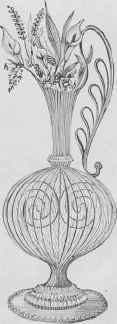
Fig. 734.
Continue to:


My Books

