


Recipes For Fiori Di Latte
Description
This section is from the book "The Epicurean", by Charles Ranhofer. Also available from Amazon: The Epicurean, a Complete Treatise of Analytical and Practical Studies on the Culinary Art.
Recipes For Fiori Di Latte
(3467). Fiori Di Latte A La Bellini (Fiori Di Latte A La Bellini)
The fiori di latte is a light preparation composed of Italian meringue with hot syrup cooked to thirty-five degrees; add flavorings, also as much whipped, well-drained cream, sweetened when drained with a quarter of a pound of sugar for each quart of cream. The meringue and cream are to be well but lightly combined. This cream is used for filling molds the same shape as shown in Fig. 628.
Fiori Di Latte A La Bellini
Whip firmly one pint of cream and pour it on a wire sieve to drain for two hours. Cut in quarter-inch squares eight ounces of fruits, such as pineapple, cherries, orange and lemon peel, also a few shredded pistachios; lay these in a vessel, pour maraschino over and let macerate for one hour, then drain. Prepare an Italian meringue with four egg-whites beaten to a stiff froth, and a pint of hot thirty-five degree syrup; allow to cool, then mix it in with the whipped cream and well-drained fruits. Pack a two-quart mold in salted ice; cover the insides with a quarter-inch thick coating of uncooked strawberry ice cream (No. 3451); place the preparation into the empty space, letting the mold be quite full; press the cover on forcibly, imbed and freeze for one hour. Unmold by dipping it into warm water, the same as for all other ices, and invert it on a folded napkin, as shown in the drawing.
(3468). Fiori Di Latte A La Orlandini (Fiori Di Latte A La Orlandini)
Whip a pint of cream, then drain on a sieve; grate the peel of a good orange on lump sugar, and scrape off the part impregnated with the peel. Make an Italian meringue preparation with five eggs (No. 140), add the sugar flavored with the peel to the sugar used for making the meringue; leave stand till cold, then incorporate gently the whipped cream without beating, and add candied citron peel cut up finely, and a little powdered vanilla. Fill a fiori di latte mold (Fig. 628), with a coating of chocolate a quarter of an inch thick, pour in the preparation, and finish the same as a la Bellini (So. 3467).
(3469). Fiori Di Latte With Vanilla Or Other Flavorings (Fiori Di Latte A La Vanille Ou Autres Parfums)
Beat up a pint of whipped cream; drain on a sieve. Whip five egg-whites quite stiff; cook eight ounces of sugar with half a vanilla bean to thirty-five degrees; suppress the vanilla and mix the sugar with the egg-whites, a little at a time, while stirring the meringue constantly; leave to cool on ice. Coat a fiori di latte mold with pistachio ice cream (No. 3454); pack in ice (have the coating only a quarter-inch thick); fill the center of this shell quite full, pressing down the preparation with the cover and imbed in ice, allowing one hour's freezing for each quart. Unmold on a folded napkin and serve. This ice may be prepared and finished the same way, only putting in the eighth part of a vanilla stick instead of half a one, and after the preparation is quite firm adding either maraschino, kirsch, prunelle, Curacoa, almond milk, or concentrated orange flower water, just enough to have the preparation nicely flavored.
(3470). Fiori Di Latte With Violets, Burnt Almonds And Pistachios (Fiori Di Latte A La Fleur De Violette, Aux Pralines Et Aux Pistaches)
Cook two ounces of violet leaves in two ounces of sugar, and when this has reached " crack" (No. 171), pour it on a marble to cool, then pound and run it through a sieve. Whip a pint of cream till very firm, and drain it on a sieve. Beat five egg-whites to a stiff froth, mix into them three gills of hot thirty-five degree syrup, and cool this meringue by standing the basin on ice; mix together lightly the whipped cream, Italian meringue and violet sugar. Pack a fiori di latte mold (Fig. 628) in salted ice and line it with a coating of virgin maraschino ice cream, finishing as the Bellini (No. 3467).
Burnt Almonds And Pistachios
The same preparation as the above; after mixing the whipped cream with the Italian meringue add two ounces of crushed burnt almonds and two ounces of shredded pistachios, also two tablespoonfuls of orange (lower water. Mix well together and with this fill a mold coated with virgin orange ice cream (No. 3459). Fiori di latte can also be flavored with either chocolate, coffee, cinnamon, lemon, orange or Seville orange. Peel the three latter very finely, cut the skins up very thin or else chop them, or fruits with well-flavored juices may be substituted, etc.
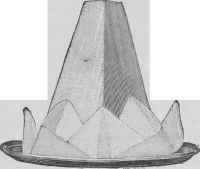
Fig. 628.
Continue to:


My Books

