


Recipes For Oysters (Huitres)
Description
This section is from the book "The Epicurean", by Charles Ranhofer. Also available from Amazon: The Epicurean, a Complete Treatise of Analytical and Practical Studies on the Culinary Art.
Recipes For Oysters (Huitres)
A bivalve having an irregular shell attached by hinges, and having an oblong, grooved indent across. It is headless, toothless and sexless; it cannot live out of water, and is specially fond of the mouths of rivers. The fishing begins in September, and finishes in the latter part of April; in all the intervening months, or those containing no letter R in their names.
The Oysters are replaced by Little Neck clams. Fresh oysters are easier digested in the raw state than when cooked, for the heat hardens them while the sea water in the raw ones facilitates digestion. Oysters contain plenty of water, very little solid animal matter, a great deal of lime and sulphate of iron, ostnazome and gelatin. These bivalves agree with worn-out constitutions, but should be eaten very fresh. Like certain fishes, oysters contain phosphorus.
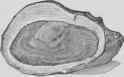
Fig. 275.

Fig. 276.
(1052). Oysters A La Bearnaise, Tomatoed (Huitres A La Bearnaise Tomatee)
Place some large oysters in a saucepan on the fire; poach them slightly in their own liquor, drain and suppress the hard parts, then roll them in a sautoir containing cooked fine herbs. Butter some boat-shaped tartlet molds, line them with a delicate chicken forcemeat (No. 62); and lay one oyster and some of the fine herbs in every mold; cover over with more forcemeat, so that it is well filled and rounded on the top, then poach, unmold. and dip them in beaten eggs; roll in bread-crumbs, and fry in clarified butter. Serve a separate sauce-boat of tomato bearnaise sauce (No. 433).
(1053). Oysters A La Boucicault (Huitres A La Boucicault)
Butter a deep dish; pour into it some oysters with their own liquor; season with salt, pepper, tomato catsup and tobasco sauce; scatter over a few bits of butter, here and there, and then set the dish into a hot oven; serve as soon as the oysters are poached, that is as soon as they are firm to the touch.
(1054). Oysters Rissolettes A La Pompadour (Rissolettes D'Huitres A La Pompadour)
After blanching medium-sized oysters, drain and suppress the hard parts; prepare some round pieces of thin pancake, two and a half inches in diameter; fill half of each with a little thick Italian sauce (No. 484); lay an oyster on top with more sauce over, then force a quarter inch cord of fish quenelle forcemeat (No. 90) through a cornet on one half of the pancake; fold over and fasten the edges together; dip them in beaten eggs, then in bread-crumbs, and fry a fine color; then dress on a folded napkin and garnish with a bunch of tried parsley.
(1055). Oysters A La Rubino (Huitres A La Rubino)
Butter a deep dish and pour into it the oysters with their own liquor; season with salt and black pepper, and add the heart stalks of a head of celery cut into thin lengthwise slices, and a few small pieces of fresh butter; cover it over with another dish and set it into a moderate oven for fifteen minutes, then serve.
Continue to:


My Books

