


Recipes For Sturgeon (Esturgeon)
Description
This section is from the book "The Epicurean", by Charles Ranhofer. Also available from Amazon: The Epicurean, a Complete Treatise of Analytical and Practical Studies on the Culinary Art.
Recipes For Sturgeon (Esturgeon)
(1288). Sturgeon Fricandeau, With Sorrel Or With Green Peas (Fricandeau D'Esturgeon A L'Oseille Ou Aux Petits Pois)
Cut a fillet of sturgeon from the middle part of the fish; remove the skin, pare, and if too thick, split it in two without detaching the parts; flatten down the meat and lard it the same as for a veal fricandeau, then season. Line a flat saucepan with fragments of fat pork, minced roots and onions, lay the fricandeau on top, and moisten to half its height with some veal blond stock (No. 423); set the saucepan on a moderate fire and let the liquid fall very slowly to a glaze, then moisten it once more, and again reduce it to a glaze, and finish the cooking by adding a very little broth at a time, while basting it constantly; finally glaze the fricandeau in the oven. Drain, dress it on a dish, pour its own stock over after straining and skimming it. Serve a separate garnishing of either sorrel or green peas.
(1289). Sturgeon Or Sterlet With Quenelles And Olives - Small (Petit Esturgeon Ou Sterlet Aux Quenelles Et Olives)
Take a small sturgeon or sterlet weighing eight to ten pounds; scale, suppress all the large scales from the back and sides; open it on the belly side in order to empty and notch the inside ligament, taking the place of the spinal bone, at equal distances, with the tip of a knife, then tie the head down with a string. Place the fish in a small narrow fish kettle, sufficiently long, garnish with fat pork, minced roots and onions, salt, and cover over with thin slices of pork, keeping them down in their place with some string. Moisten to half the height with white wine and very rich veal blond (No. 423); boil the liquid for ten minutes, remove it on one side so as to cook the fish slowly while covered, for about an hour. Drain the sturgeon, untie, then strain and skim the stock, reducing it to a half-glaze, and incorporating into it slowly a few gills of a good, reduced brown sauce (No. 414), finishing with a few spoonfuls of Madeira wine, then strain once more. At the very last moment, drain the fish, place on a dish, and surround it with garnishing of quenelles and stuffed olives; cover with some of the sauce, sending the rest to the table in a sauce-boat.
(1290). Trout A La Beaufort (Truite A La Beaufort)
A genus of fish of the salmon family, all their species being carnivorous; they live a greater part of the time in fresh water, generally that which is the purest and the most rapid. They are very highly esteemed.
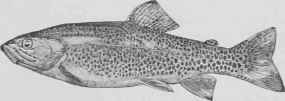
Fig. 301.
Continue to:


My Books

