


Recipes For Tenderloin Of Beef (Filet De Boeuf). Part 9
Description
This section is from the book "The Epicurean", by Charles Ranhofer. Also available from Amazon: The Epicurean, a Complete Treatise of Analytical and Practical Studies on the Culinary Art.
Recipes For Tenderloin Of Beef (Filet De Boeuf). Part 9
(2434). Tenderloin Of Beef A La Bouquetiere (Filet De Boeuf A La Bouquetiere)
Prepare and cook a fine tenderloin, the same as described in l'Ambassade (No. 1441), only omitting the larding. Let it get cool, keeping it very straight, and when thoroughly cold trim it to a nice shape, and pour over it a brown chaudfroid sauce (No. 594); when the chaudfroid is firm cover it entirely with half-set jelly. Put the tenderloin on top of a two-tier foundation, made either of rice or hominy, the bottom one being two inches thick, the top one three-quarters of an inch, and shaped symmetrically. Fill each of thirty small paper cases with a different vegetable, or several of each kind - say three of each - such as green peas, string beans, flageolets or kidney beans, Brussels sprouts, beets, cauliflower, artichoke bottoms, mushrooms, truffles and celery, seasoned and mixed with a little mayonnaise (No. 606). Prepare fifteen roses cut from turnips, and fifteen cut from carrots, each one inch in diameter, blanched and cooked separately in white broth (No. 194a). Set a rose on the top of each and alternate the colors when decorating the upper tier with fourteen of these, and the lower one with sixteen; force some chopped jelly through a cornet or a bag between each ease around the bottom and the edge, and outside of this place a row of jelly squares.
Garnish the top of the tenderloin with five hatelets of vegetables (No. 2526), imitating natural flowers, the center one representing a vase decorated with small flowers.
(2435). Tenderloin Of Beef A La Evers (Filet De Boeuf A La Evers)
This tenderloin is to be prepared and cooked exactly the same as for a la Bienvenue (No. 144")); when done, pare it nicely, and cut it into quarter of an inch thick slices; lay these in an oblong mold the same shape as the tenderloin but smaller than the one to be decorated. Reduce the gravy, add some aspic jelly (No. 103), (test the consistency of this by putting a small quantity of it in a mold on the ice, and if it should not be firm enough add some gelatine), fill in the mold containing the meat with this, and set it aside on ice to get very cold. Decorate the largest mold with pieces of tongue, pistachio nuts, and white of egg; cover the decoration with a heavy layer of jelly; unmold the one containing the meat, lay it in the center of the decorated one, and fill it in with jelly. Fill the entire center up to the inside of the dish destined for the tenderloin, edge with jelly, and when very firm unmold the tenderloin on to the center of it. Lay on each end half a nicely carved rice vase, these being filled with imitations of small truffles made of mousseline of foies-gras, and then rolled in finely chopped truffles.
When cold dip them in partly cold jelly, and arrange chopped jelly all around, also oblong-shaped jelly croutons, and fasten three hatelets decorated in Bellevue (No. 2526) on the top of the meat.
(2436). Tenderloin Of Beef A La Lucullus (Filet De Boeuf A La Lucullus)
1n order to arrange this tenderloin it will be necessary to have eight molds in two series of four each, four to be decorated and four in which the tenderloins are molded, these being an inch narrower in diameter than those to be decorated. Prepare and cook the tenderloin as explained in l'Ambassade (No. 1441); when done, cut it into slices and reshape the meat into its original form and fill the four smallest molds with it. Reduce the stock with aspic jelly (No. 103). (if necessary add some isinglass to have it very firm), pour over the meat in the molds and set on ice to get very cold. Decorate the four larger molds (see Fig. 455) intended to receive the tenderloin after they are ,1,, orated; cover the decoration with a layer of thick jelly, unmold the smaller ones, put their con-inside the larger ones and fill up with very firm jelly. After the jelly is very firm unmold the whole on a cloth, set at the bottom of the slope on each side of the bridge a strong tin square three and a halt inches in width and three inches high, having rounded corners and bent in the center to form a right angle; these squares are intended to keep up the tenderloins on the inclined slope, and are most necessary; place the small molds at the ends, and set around the piece twenty-four small croustades made of short paste (No. 135), and filled with goose livers taken from a terrine of foies-gras; around these throw some chopped jelly, making a very regular border of croutons of the same.
Stick two hatelets, one at each end, and in the center put a small figure holding up a cup filled with glazed truffles.
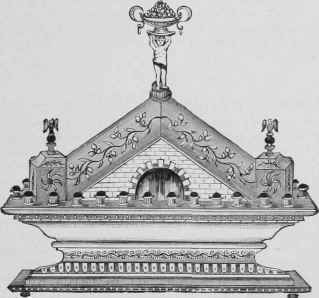
Fig. 455.
Continue to:


My Books

