


Appendix. Japanese Art Of Arranging Cut Flowers. Part 3
Description
This section is from the book "Pot-Pourri From A Surrey Garden", by C. W. Earle. Also available from Amazon: Pot-pourri from a Surrey Garden.
Appendix. Japanese Art Of Arranging Cut Flowers. Part 3
From all these select those of a most suitable shape-i.e. either broad and flat for water decorations; or narrow-necked with a wide mouth; or a tall, narrow-necked shape, suitable for supporting only one branch without a wedge. If the vessel bo small, and made only of thin pottery or china, it should bo weighted by placing stones or something heavy inside to balance the weight of the flower erection; without this precaution a tall arrangement might overbalance the whole thing. If the vessel be heavy in itself-of bronze, brass, silver, or other metals, or if of earthenware, sufficiently large to become heavy when filled with water-then this additional weighting is not necessary.
Your next step should be to procure some narrow wood-fire-lighting wood, or laths of any kind. Measure the width of the vase at the place where the wedge is to be fixed; this should be slightly below the surface, so as to be concealed when the vase is filled with water. Cut two pieces of wood to the required length, and shape them at the end to fit the sides of the vase; then scoop out the inner side of each piece of wood, so as to form an oval-shaped opening when they are placed together, slightly narrower below than at the top surface, so as to allow the stalks a freer play of direction, at the same time holding them firm. Then cut out a small notch at each angle of the wood, at a distance of about half an inch from the ends; place the two pieces together, and tie them firmly with string at both ends in the rut of the notches. The string should first be soaked, wound round two or three times, and firmly knotted; it will then remain quite secure. Wire is even better adapted to the purpose than string.
A yet simpler way is, instead of scooping out an oval-shaped opening, to insert a small extra piece of wood at each end between the two woods that form the wedge, and, by thus keeping them apart, make an opening large enough for the width of the stems.
When the wedge is made, soak it in water for a few seconds to make the wood swell; then fix it firmly in the neck of the vase.
Yet another fastener, and perhaps the most adaptable of any, consists simply of a spiral coil made of sheet-lead cut into ribbons. This can be bent about to suit the various sizes of the stems. The weight of the leaden coil will balance flowers and branches of considerable height, and it can always be additionally weighted with stones if necessary. This fastener may be used in almost every shaped vase, of no matter what material; for there is no danger, as in the case of the fitting wooden fasteners, that it will crack glass or fine china. Any plumber will supply the strips of sheet-lead, which should be about 2 ft. long, 5/8 in. wide, and 1/8 in. thick, though the sizes vary, of course, according to the vase. It is quite easy to bend these strips into a spiral coil.
These are simple ways of making flower-holders at home with the most ordinary materials; but, of course, with more trouble a great variety of fasteners can be made.
The next thing to be done is to get a branch of Bamboo or other thin stick, not too brittle, and cut it up into pieces of about an inch long, so as to have a heap of different thicknesses. Before proceeding to cut or buy your flowers, you must decide in what part of the room to place the decorations, so as to have an idea of what would be suitable as to colour, size, and form. If for the corner of a shelf or mantelpiece, the arrangement might be high on one side of the vase, with a long streamer pendent on the other. If for a table under a picture, it might tend upwards, and the Tertiary line form almost a right angle -in complement, as it were, to the shape of the frame when placed to one side underneath it. For any purpose special kinds of flowers are required, as it would be contrary to the fundamental laws of the art to try and make a stiff or upward-growing plant hang downwards, or to try and erect a flower with a limp stem. One place, too, requires a tall, narrow decoration; another a wide or more solemn one. When you have the destined situation of the decoration in your mind, go out and choose flowers and shrubs accordingly, bearing in mind as you pick them the directions the stems will have to take. It is as well always to have a basin of water ready in which to place the flowers immediately after picking them, as in the process of selection, fixing in the wedge, etc.-especially until you are practised in the art-the flowers are apt to wither and the vigour in the curves of the stems to get limp, so that it is difficult to carry out any design. The best plan is to place the vase, before filling it, where it will eventually be required to stand, so as to be sure and procure the suitable effect. It is advisable not to put water in the vessel until the composition is completed, as it sometimes tips over in the process of fixing the stems in the wedge.
Before beginning the bouquet, make up your mind, in a general way, what branches and flowers to use and how to dispose them. Then first place the principal ones, fixing each firmly in turn with the bits of Bamboo if not large enough to fill the space, or by pruning the bottom of the stems if too thick, so as exactly to fit the wedge. All tree-branches and shrubs should have the bark peeled off the part which is under water, as this allows a freer entrance to the moisture, and so enables the plant to last fresh for a much longer time. When you have finished the arrangement, stand at a little distance, and remove all leaves, shoots, or flowers which interfere with the clearness and beauty of line from various points of view. Then fill the vase with water-slightly tepid is best, especially if the flowers are at all faded. If the wedge is still visible above or through the water, cover it over with a little Moss or other very light leafage or, in the case of a water-plant decoration, with some small water weed.
The diagrams showing the trilineal arrangement of stems are taken from Mr. Conder's book, and are in strict accordance with the rules of the Japanese art. The other two illustrations of flower decorations are photographed from life, and are merely casual examples of the effect produced by this system of supporting flowers by fasteners, even without conforming with any great precision to the laws adhered to in Japan.
There is hardly a flower, shrub, or tree which is not, at one stage of growth or other, adaptable to this style of arrangement, but some of the most obviously suited are here mentioned by way of suggestion. All fruit blossoms, wild or cultivated: Blackthorn, May, Dog Rose, Bramble, Willow (more especially in bud, known as 'palm'), Maple, Oak, Rhododendron, Azalea, Laburnum, Wistaria, Tree Paeony, Syringa, Berberis, Laurus-tinus, Holly, and almost all kinds of Pine trees; Irises, Narcissi, Bulrushes, Marsh Marigolds, Water Lilies, Honeysuckle, Clematis, Chrysanthemums, etc.
I have dwelt almost entirely upon the technical side of the art, this being the indispensable means to the end in view. But the goal is one untouched by theory, unmolested by hardand-fast rules. The wonderful beauty of proportion and balance, the choiceness of selection, the effect of growth and vitality, of dignity and grace, with which the whole of this art is penetrated, are not to be expressed in any doctrinal terms. The tender solicitude which it exacts for the habits and characteristics, tastes and welfare of each plant, endows the least thing utilised by this art with almost a personality. The relative connection of one plant with another-the tall, aspiring Principal; the Secondary, which seems inclined to follow its lead, yet hesitates half-way with questioning doubt; the Tertiary below, in squat contentment-these admit of endless variety of interpretation. To the Japanese every flower has its meaning and associations, as well as every combination of flowers. The force of contrast is ever present in their designs; the opposite sexes are supposed to be represented, strength and weakness, sternness and tenderness, etc. Without learning the grammar of their complicated flower-language, might we not nevertheless increase our artistic pleasure in flower arrangements by trying to give them a suitableness and a meaning which they have hitherto lacked? The old, long established English fashion of massing together in a vase may still hold its own for certain kinds of flowers; but, so strong is the fascination of the Japanese principle, that, once it is adopted, it will probably assert its authority even amongst a bunch of Primroses or Violets.
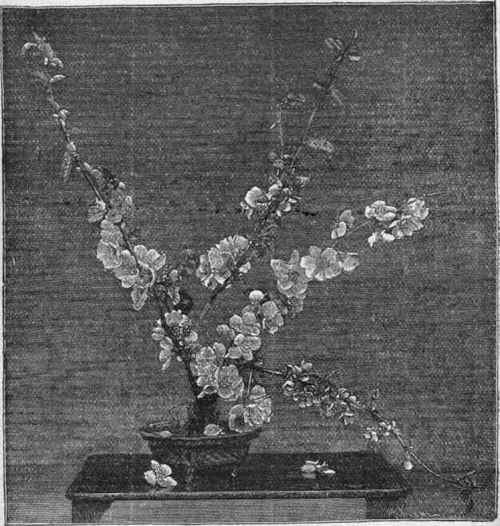
Pyrus Japonica In Metal Vase Constance Lytton.
Continue to:


My Books

