


Appendix. Japanese Art Of Arranging Cut Flowers
Description
This section is from the book "Pot-Pourri From A Surrey Garden", by C. W. Earle. Also available from Amazon: Pot-pourri from a Surrey Garden.
Appendix. Japanese Art Of Arranging Cut Flowers
It is now some years since Mr. J. Conder's excellent book, 'The Flowers of Japan and the Art of Floral Arrangement,'was first published. But the principles laid down in it have so little penetrated the art of cut-flower arrangements in England that it may be assumed either that the book is still very little known or that its teaching has been set down as unsuited to English flowers and flower-vases. The book is not published in England, but almost any bookseller will get it from Japan; the cost is 21. 2s. The coloured plates, to which chiefly this high price is due, do not materially contribute to the expounding of the theory and, although full of character and beanty in themselves, could be omitted without loss to the main object of the book. A smaller and much cheaper edition of the work could then be produced and published in England.2
1 From the Garden of October 6, 1894.
2 Mr. Conder has lately published three articles on the same subject in the October, December '96, and January '97 numbers of the Studio-that unusually artisti'c magazine which is to be had monthly for one shilling. Mr. Conder's articles are beautifully illustrated with numerous plates of Japanese designs, reproduced from photographs; and in the text he sums up many of the most interesting points contained in his book. He does not suggest that the art of which he writes could be applied to the arrangement of cut flowers in England, but it is to be hoped that these articles-which are, unfortunately, already out of print-may be republished in book form. The great beauty of the illustrations would do more to spread the practice of the art amongst English people than any written theory upon it.-C. L., March 1897.
In the moan while, however, it is my object to spread its teaching and to show how, with but slight modifications and relaxation from the stricter Japanese rules, this artistic science may be adapted to English flowers and English drawing-rooms. It has a strong claim to being adopted by all lovers of the beautiful and the practical combined because, first, these decorations have a quite unique beauty and refinement; secondly, cut flowers and shrubs live long in water when supported by a flower-holder in the Japanese way, to be described presently; thirdly, only very few flowers or branches are required-a great advantage to those who have but small gardens, to people living in towns where flowers are expensive, and for the seasons of the year when flowers are scarce. Also an extremely decorative effect can be produced without making the room airless from the scent of many flowers. Fourthly, the infinite variety of design it is possible to produce with but few branches on the Japanese principle as compared to the English may be likened to the number of changes that can be rung on a few bells when a given system is followed, whereas the different bells rung simultaneously produce only one, and that a discordant, sound.
Roughly speaking, the Japanese art of cut-flower decorations may be classified into three fundamental principles:1. Not alone the flowers and leaves, but also the stems or branches should be considered as part of the design-in fact, it is the most important part.
2. The branches are not allowed to lean against the edge of the vase, as in the English manner, but must be firmly supported either by a wooden fixer fitted into the neck of the vase, or by coils of iron if open basin-shaped or flat-bottomed vessels are used, this giving to the stems the appearance of growth and self-support.
3. Only such flowers and trees as are easily obtainable should be used. Riarity is not considered a merit, and foreign or out-of-the-way plants are only permitted to be used by those who have a thorough knowledge of the nature of their growth, characteristics, etc. The flowers used should be in season, and the design of the decoration suited to its position in the room-i.e. if under a picture, on a shelf, in the centre of an alcove, etc.-as well as adapted to the vase which holds it.
Although one of my objects is to show how much the English method may be improved without too great a subservience to the strictest laws of the Japanese art, yet it would be difficult to make myself understood by the uninitiated without first giving an outline of that science, which was originally, it is supposed, a religious rite, and which to-day is still a much-reverenced art in Japan. For this purpose I shall quote freely from Mr. Conder's book, as it would be impossible to improve
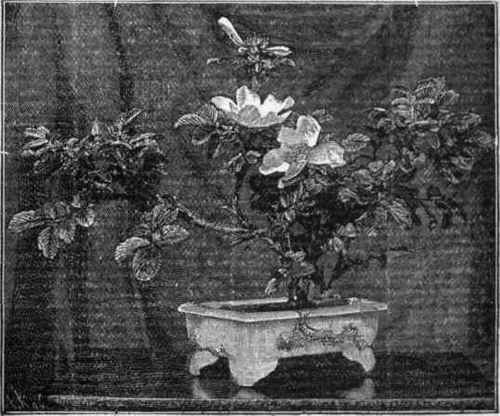
Japanese Rose (Rosa Rugosa) In A Metal Vase upon his lucid and concise treatment of the subject. The following are selected as the most important rules to be observed:The surface of the water in which the flowers are placed is technically considered to be the soil from which the floral growth springs, and the designer must here convey the impression of stability and strength.
The springing, or point of origin of the floral group, is of great importance, and the firm and skilful fixing of the sterna or branches in the vessel which holds them is one of the most difficult parts of the manipulation. Ordinarily, the stems are held in position by small cylindrical pieces of wood, fitting tightly across the neck of the flower vase, and having a slit, wider above than below, for threading them through. The wedge-shaped form, wider towards the top, which is given to the slit allows slightly different inclinations to be imparted to the several branches. The fastener should be fixed about half an inch below the surface of the water, and should not be visible from the front of the vessel. Some schools affect a rustic simplicity in their appliances, and employ a naturally forked twig to hold the flowers in position. For arrangements in neckless vases, such as sand-bowls or shallow tubs, other sorts of fasteners are necessary. One kind consists of a sheet of copper perforated with holes of different sizes, to receive the extremities of the different stems. Another fastener is made of rings or different sections of bamboo of varying diameters attached to a wooden board, the stems finding lodgment in the sockets thus formed, and being further held in position by pebbles being placed over them.


Slower Fasteners
Continue to:


My Books

