


Recipe For Cooking Roasted Saddle Of Mutton
Description
This section is from the book "Practical Cooking And Serving", by Janet McKenzie Hill. Also available from Amazon: Practical Cooking and Serving: A Complete Manual of How to Select, Prepare, and Serve Food [1919].
Recipe For Cooking Roasted Saddle Of Mutton
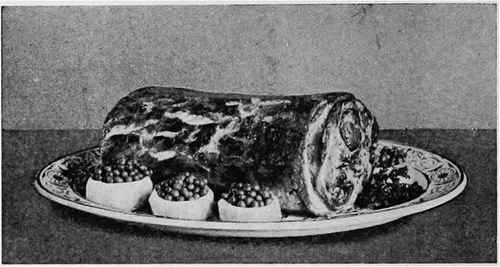
Roasted Saddle Of Mutton. Garnish: Glazed turnip cups filled with peas.
The saddle may be cut either with or without the flank. The flank is more satisfactory cooked some other way, but the saddle presents a better appearance when the flank is retained; it is often rolled up on each side and kept in place by stitches in three or four places. If the flank be thus rolled, to insure thorough cooking, this side of the saddle should be placed uppermost - that is, to the greatest heat - when the joint is first put into the oven, or rather after the initial process of searing over the outside has been completed. All superfluous fat should be removed. Dredge with salt, pepper, and flour; cook from one hour and three fourths to two hours and half. Garnish with rings of cooked carrot holding asparagus, or with turnip cups, glazed and filled with creamed peas, or asparagus tips. Carve in long slices parallel with the backbone, then turn the knife and cut down to the rib bones. Turn the saddle and cut the tenderloin, also, in slices, parallel to the backbone. The tenderloin may be carefully removed, cut in slices, and returned to place, before the joint is sent to the table. Let currant jelly accompany the dish.
Continue to:


My Books

