


Veal
Description
This section is from the book "Practical Cooking And Serving", by Janet McKenzie Hill. Also available from Amazon: Practical Cooking and Serving: A Complete Manual of How to Select, Prepare, and Serve Food [1919].
Veal
AVERAGE CHEMICAL COMPOSITION OF VEAL AS PURCHASED (ATWATER) | ||||||
Refuse Per Cent. | Water Per Cent. | Protein NX 6.25 Per Cent. | Fat Per Cent. | Ash Per Cent. | Fuel Val. per lb. Calories | |
Breast | 21.3 | 52.0 | 15.4 | 11.0 | .8 | 750 |
Leg | 14.2 | 60.1 | 15.5 | 7.9 | .9 | 620 |
Loin | 16.5 | 57.6 | 16.6 | 9. | .9 | 690 |
Shank, hind | 62.7 | 27.8 | 7.7 | 11.7 | .4 | 215 |
Liver | 73.0 | 19.0 | 5.3 | 1.3 | 575 | |
Veal and lamb, being immature, are not as nutritious as beef and mutton, nor are they as digestible. Like pork, veal needs be thoroughly cooked to be at all wholesome. The lean of good veal is of a pinkish color, the fat is white. Veal is lacking in flavor; its popularity, however, is due to this fact and to its delicacy of text
Veal and lamb, being immature, are not as nutritious as beef and mutton, nor are they as digestible. Like pork, veal needs be thoroughly cooked to be at all wholesome. The lean of good veal is of a pinkish color, the fat is white. Veal is lacking in flavor; its popularity, however, is due to this fact and to its delicacy of text ure. Both of these facts render veal desirable as a foundation for "made" dishes.
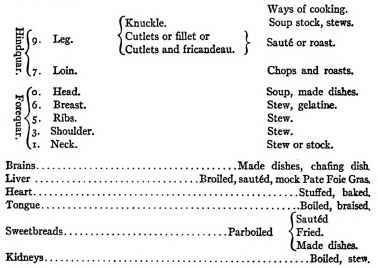
Veal is cut up in a manner similar to that in which mutton is cut. The hind quarter is divided into loin and leg. From the leg is cut the "fillet," "fricandeau" and cutlets. The "knuckle" of veal is that part of the leg just about the knee bone; the shank is below, and cutlets or a fillet may be cut above. The loin is more delicate and less dry than the leg, but it is not as economical; this can be seen by a glance at the chemical composition. It is used as a roast, or in chops. The breast is used for a roast, the knee and knuckle, for soups and stews. Veal is rich in gelatine, and a soup stock in which it is present usually jellies when cold. The flavor of pork seems particularly well adapted to veal, and pork is usually chosen either alone, or with other flavors to make up for the deficiency of veal this respect. When roasted or braised a fillet and a fricandeau are larded, or daubed with pork; sometimes a stuffing is used in the place of the pork, any cavity from which a bone can be taken affording a convenient place for its entrance. The stuffing may be seasoned with sweet herbs, parsley, onion, mace, chopped mush' rooms, and grated lemon. In England a fillet of veal is simmered in equal parts of milk and water, the liquid is thickened for a sauce, and to this parboiled oysters are added. The brains and sweetbreads are considered choice delicacies; both spoil quickly, and should be cooked without delay. Soaking in cold water is followed by parboiling in hot water, salted and acidulated, after which they may be kept for some little time. The points to be remembered in the cooking of veal are: flavor is to be added, and, to insure digestibility, long, slow cooking is required.
Continue to:


My Books

