


Cold Entrees For Ball Suppers, Etc. Part 6
Description
This section is from the book "The Modern Cook: A Practical Guide to the Culinary Art in All Its Branches", by Charles Elme Francatelli. Also available from Amazon: The Modern Cook: A Practical Guide to the Culinary Art in All Its Branches.
Cold Entrees For Ball Suppers, Etc. Part 6
1232. Potted Lobster
Lobsters for potting must be quite fresh. Take the meat, pith, and coral out of the shells ; cut this up in slices, and put the whole into a stewpan with one-third part of clarified fresh butter, and to every pound of lobster, add four whole anchovies (washed and wiped dry); season with mace, pepper corns, and a little salt, then put the lid on the stewpan, and set the lobster to simmer very gently over a slow fire for about a quarter of an hour." After this, it must be thoroughly pounded in a mortar, rubbed through a sieve, put into small pots, steamed, and when cold, should be pressed down with the bowl of a spoon, and the surface covered with a little clarified butter.
1233. Potted Prawns, Or Shrimps
Pick one pound of fresh-boiled prawns or shrimps, and reserve the heads and shells; pound them in a mortar with four anchovies (previously washed and wiped dry for the purpose), and then rub the whole through a hair-sieve, and put the produce, with the picked shrimps, into a stewpan with six ounces of clarified fresh butter; season with some grated nutmeg, Cayenne pepper, and a little salt; simmer the whole together over a slow fire for about ten minutes, then toss the shrimps in the seasoning occasionally, until they become nearly cold; they must then be put into pots, with a little clarified butter poured over the surface, and set aside in a cool place, for use.
1234. Potted Yarmouth Bloaters
Take six fresh-cured bloaters, immerse them in scalding water, and remove the skins; wipe them dry, take out the bones, and put the fillets of the herrings into a stewpan with half a pound of clarified fresh butter, a blade of mace, and enough cayenne to season them ; set this on a slow fire to simmer for about ten minutes, then thoroughly pound the whole well together in a mortar, and rub it through a sieve. Put this preparation into pots, run a little clarified butter over the surface, and keep them in a cool place for use.
Note. - Smoked, or kippered salmon, or Finnan haddocks, may be potted in the same way as the foregoing. By submitting any of the above described potted shell-fish, etc, to the action of steam, a sufficient time for the meat to be thoroughly penetrated by the heat, they may keep good for months. Much will, however, depend on the freshness of the butter used in this preparation ; should it become rancid, as frequently happens after keeping for a few weeks, it will, of course, considerably impair the flavor of the potted fish.
1235. Galantine Of Poulard, With Aspic-Jelly
Chop up one pound of white veal, with the same quantity of fat bacon, and season with chopped mushrooms, parsley, nutmeg, pepper, salt,.and aromatic seasoning (No. 1250); when these are chopped quite fine, pound the whole in a mortar, with the yolks of three eggs, and remove the force-meat into a basin. Peel one pound of truffles, and cut up a boiled red tongue, and about one pound of fat bacon or boiled calf's udder, into long narrow fillets, about a quarter of an inch square. Next, bone a fine poulard, and draw the skin from the legs and pinions, inside; then, spread the poulards out upon a napkin, and with a sharp knife, pare off some part of the fillets, to cover the thinner parts of the skin; season slightly with pepper, salt, and aromatic spices; spread a layer of the prepared force-meat, about an inch thick, then place the fillets of tongue and bacon upon this, about an inch apart, and insert rows of truffles between these; after which, spread another layer of force-meat over the whole, then repeat the tongue and truffles, and so on, until a sufficient quantity of both has been placed in the poulard.
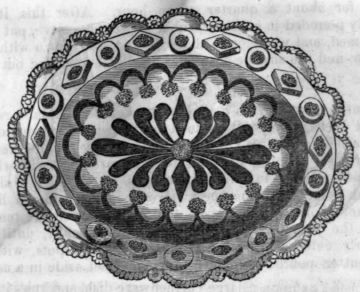
It must then be sewn up the back, placed upon a napkin thickly spread with butter, rolled up tightly, and fastened at each end with string: thus giving to the galantine the appearance of a cushion. This must be then put into an oval stewpan with the carcasses and any trimmings of veal or poultry that may be at hand, also two calves'-feet, two carrots, two onions stuck with four cloves, a faggot of parsley, garnished with green onions, two bay-leaves, sweet basil and thyme, two blades of mace, and a dozen pepper-corns; moisten with two glasses of brandy, and set the pan over a stove-fire to simmer for five minutes, then mois-teu the galantine with as much white stock as will suffice to cover it, and put it back on the stove-fire to boil ; it must then be placed on a very slow stove-fire, or in the oven, to continue gently braizing (not boiling) for about two hours and a half. It should then be removed from the fire, and the galantine taken carefully out of the napkin ; the latter, after being washed in clean hot water, must be spread out upon the table, and the galantine, after being placed in it again, and bound up tightly as before, should be put back into its braize, and left in to become partially cold : it must then be put in press between two dishes with a heavy weight upon it. Strain the stock, remove all the grease from the surface, and clarify it in the usual manner, then pass it through a napkin or a jelly-bag, and place it on some rough ice to become firmly set. When the galantine is quite cold, take it out of the napkin, and use a clean cloth to absorb any moisture or grease there may be on the surface ; it must then be glazed, and placed upon its dish. Decorate it with aspic-jelly, as represented in the foregoing wood-cut, and serve.
Note. - Galantines of turkeys, geese, capons, fowls, pheasants, partridges, etc, are made in the same way as the above.
Continue to:


My Books

