


Vol-Au-Vent, Tourte, And Patty Cases. Part 2
Description
This section is from the book "The Modern Cook: A Practical Guide to the Culinary Art in All Its Branches", by Charles Elme Francatelli. Also available from Amazon: The Modern Cook: A Practical Guide to the Culinary Art in All Its Branches.
Vol-Au-Vent, Tourte, And Patty Cases. Part 2
1263. Tourte Cases, For An Entree
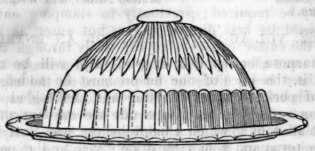
First, prepare half a pound of puff-paste, and give it four turns, in the usual manner; make also half a pound of common short paste, take half of this, knead it into a round ball, roll it out to the size of a dinner-plate, put it on a round baking-sheet, and place a tampoon* of paper in the centre. The puff-paste must then be rolled out about twenty inches long, wetted over with the brush dipped in water, and folded lengthwise in three; this must be rolled again in its width, just sufficient to make it about four inches wide: the paste should then be slightly wetted over, and then folded as before : by this time, it should form a baud, measuring about twenty inches long by nearly two inches wide, and about half an inch thick. The edges of the paste must now be pared away, with a small sharp knife, held perpendicularly in the right hand, whilst the paste must be slightly pressed on the slab with the fore-part of the fingers. Next, add the trimmings of the puff-paste to the remaining half of the common paste, knead both together, roll this out to the size of a plate, and after having first wetted the foundation round the edge, place it over the tampoon and press it down all round with the thumb ; then wet the edge of the tourte round again, and apply the band in the following manner. Take hold of the band at both ends, and begin by fastening that held in the right hand round the edge of the tourte, and continue fixing the band all round as fast as it is dropped in its place with the left hand; press the first end down so as to thin it, wet this part with the brush, and after paring away a little of the other end, so as to thin that also, fasten both together by effectually joining them. Press the band down all round with the thumb, and flute it round the edge by jagging it slightly with the back of a knife.
The tourte must then be edged over with a paste-brush, so as to carefully avoid smearing the edges of the band. Place it in a moderately-heated oven, and let it be baked of a light color; when done, withdraw it, make an incision with a small knife all round the bottom of the crown, inside the band, remove the crown or top, take out the tampoon, and the case will then be ready for garnishing.
* From the French word tampon, a kind of small, hard cushion : in the present ease, it should consist of a largo sheet of rather soft paper, twisted in the form of a circular cushion, about four inches in diameter.
1264. Puff-Paste, Patty-Cases
Make one pound of puff-paste in the manner described in No. 1261, and give it seven turns, wetting the last turn before folding it; then roll the paste out so as to leave it scarcely a quarter of an inch thick, and about three minutes afterwards, take a fluted circular tin-cutter about two inches in diameter, and use this to stamp out as many patties as may be required ; previously to stamping out each patty, the cutter should be first dipped in very hot water, as the heat thus imparted to the cutter causes it to slip easily through the paste, and produces the same effect as if it were cut with a sharp knife; in consequence of there being little or no pressure on the edges, the paste has thus a much better chance of rising while baking, especially in the summer season. As soon as the patties are cut out, they should be immediately placed in rows, on a baking-sheet previously wetted over, about two inches apart from each other; then egg them over with a soft brush dipped in beaten egg, being careful not to smear the edges, and stamp them in the centre, making a slight incision through their surface, with a plain circular tin-cutter about one inch and a half in diameter (this cutter must also be dipped in hot water each time it is used). The patties should then be quickly put in the oven and baked of a light color ; when done, let the covers or tops be removed, pick out the inner crumb carefully with the point of a small knife, and then place the patties with their tops on a baking-sheet lined with clean paper.
Continue to:


My Books

