


Cuts Of Beef. Continued
Description
This section is from the book "Food Facts For The Home-Maker", by Lucile Stimson Harvey. Also available from Amazon: Food facts for the home-maker.
Cuts Of Beef. Continued
Plate D Side Of Beef New York Cuts

1 Neck
2 Chuck
3 Rib Roast
4 Loin
5 Rump
6 Round
7 Bottom Of Round
8 Hind Shin
9 Flank
10 Plate
11 Navel
12 Cross Ribs
13 Brisket
14 Clod
15 Fore Shin
The round of beef (Plate A, 9, and Plate D, 6) is much the same cut in both methods. It is divided into "top" and "bottom" round (Plate C) according to the way the piece lies on the counter with the leg bone parallel to the counter. The top is used for steaks and roasts, though the farther down the leg the slice is cut the tougher the muscle becomes. The bottom round is tougher than the top and is used for beef-juice, Hamburg steak, and sometimes for stew meat.
The piece cut from the round in Boston, known as the "vein" (Plate A, 10), is used for a roast or for braised beef. It is stringy but juicy. The hind shin (11) is used for soup stock.
Round
Part Boston cut Fore Quarter Neck
Chuck ribs Prime ribs Fore shin Rattle rand Brisket
Part New York cut
How cooked
Neck | Stewed |
Chuck | Roasted, wasteful |
Prime ribs | Roasted, high grade |
Fore shin | Stewed and for soup |
Plate Cross ribs (roasted) Navel Brisket | |
Corned | |
Hind Quarter | ||
Sirloin | Loin | Roasted or broiled, tender and well-flavored |
Rump | Sirloin steaks Part of rump | Roasted or broiled, juicy, no waste |
Part of rump Aitch bone Part of round | ||
Rump | Stewed or corned | |
Round | Round | Broiled, stewed, or for pot roast |
Hind shin | Hind shin | Stewed for soup |
Flank | Flank | Braised or boiled |
It has been shown by the Department of Agricul-ture in a long series of experiments that there is practically no difference in digestibility or nutritive value between the various cuts of the same animal or of different types of animals. The sole difference lies in the convenience of handling and in the length of time involved in preparing the meat for use. When the ways given in a cook-book for cooking meat are looked over, it is found that they fall easily into three groups, depending upon the result desired. The first group includes all recipes in which the juices only of the meat are used. This would include meat soups and broths of all kinds. The second group comprises those recipes in which the piece of meat is served as a whole and great care is taken to retain all the juices, such as roasts and beefsteak. All others would fall under the third head, where the meat and the juices are served together. This includes stews of all kinds, pot roasts, beef a la mode, and all so-called "made" dishes, where the juices in the form of gravy are served with the meat itself.
Since it is the juice of the meat that is desired for soup, a cut is chosen from a muscle that has had much use, not only because this is cheaper, but because it contains more juice. Every kind of meat may be used alone or in combination; bones, pieces left from roasts, and trimmings may all go into the soup-pot. It is well to have some bone with the meat, for from the bone as well as from the connective tissue, gelatine is formed on boiling. If the broth is to be used for a child or an invalid, instead of using fragments it is better to buy meat especially for this purpose, either the neck of mutton for mutton-broth, or the shin of beef for beef-broth. The meat for soup should be cut in small pieces so as to have as large a surface exposed as possible. It should be well covered with cold water, and well salted and allowed to stand for about an hour. This draws out the juices. It is then put over a slow fire and allowed to heat gradually, but should never be allowed to boil, since boiling will harden all the protein material present in the juices. This is what forms the scum on the top of a soup-pot that ordinarily is carefully removed and thrown away as being unsightly. Soup at best, when made under the most careful conditions, contains only a small proportion of the total nourishment of the meat, since only that protein present in the juices is in the soup. If this is skimmed off and thrown away, it leaves only the flavor, mineral salts, and whatever gelatine has been formed from the bones and connective tissue. A cleared soup, such as bouillon or consomme, contains practically no nourishment, but is merely a stimulant and should be used as an appetizer before a heavy meal. It should be noted that the meat left from soup-making contains by far the larger proportion of the protein material of the original piece. To be sure, it is tough and has no flavor, but it is far too valuable to be thrown away. It can be put through the meat-chopper and used, when highly seasoned, in "made-up" dishes of various kinds.
Ways of cooking meat
Soup-making
Plate E New York Cuts
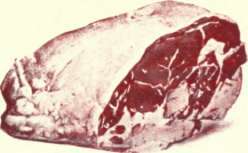
Rump Of Beef
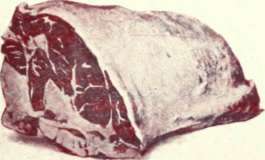
Loin Of Beef
Plate F Boston Cuts
In order to retain all the juices as for a roast, it is necessary to seal up the outside of the meat. This is done by sprinkling a roast well with flour to form a paste with the water in the meat, and then by putting it into a hot oven which quickly sears the outside. After this is done, the heat is reduced and the cooking completed at a steady low temperature. When a roast is red in the inside, it shows that it has not been subjected to such heat as would coagulate the protein material and would toughen the meat. The same idea is carried out in broiling a piece of meat there it is turned frequently until seared on both sides and then allowed to finish cooking more slowly.
Roasting
With our third group, which is by far the largest, the process involved is practically the same, even though there is a great variety in the finished products. The idea is to use a cut of meat that is both juicy and tough, so to treat it as to make it tender, and to serve it with the juices extracted during the process. If a large piece of meat is used, as for a pot roast, it is usually browned all over on a frying-pan before it is subjected to a long, slow cooking in hot water. This latter may be done in the oven or on the top of the stove. Vegetables or various kinds of seasonings may be added during the process of cooking and a brown gravy made from the juices. The meat for a stew is cut up into one-inch cubes. These may be browned in a pan for a brown stew or may be left as they are for an Irish stew. Then they are covered with boiling water and allowed to cook for a long time below the boiling point. If stews are allowed to boil, the protein material becomes tough and the pieces of meat are hard and leathery. Vegetables are usually added during the process and the gravy is slightly thickened with flour. The great variety of recipes in this group is due to different combinations of flavors used by various cooks, each one having a distinct name. This process may well be carried out in a fireless cooker. In this case, however, the stew must be boiled for fifteen minutes before being put into the cooker.
Broiling
Stewing
Continue to:


My Books

