


Arbors, Summer-Houses, Pergolas, And Other Garden Features
Description
This section is from the book "Amateur Gardencraft", by Eben E. Rexford. Also available from Amazon: Amateur gardencraft.
Arbors, Summer-Houses, Pergolas, And Other Garden Features
FEW persons who daily pass attractive homes in the suburban districts of our large cities and the outlying country, realize that much of their charm is due to effects which require a comparatively small outlay in dollars and cents. Good taste, combined with a degree of skill that is within reach of most of us, represent the chief part of the investment. And yet - these little, inexpensive things are the very ones that produce the pleasing effects we are all striving after in our efforts to make home attractive. Most of them convey an impression of being made for use, not show. They are in a class with the broad-seated, wide-armed "old hickory" rockers with which we make our modern verandas comfortable nowadays, and the hammock swung in shady places, wherein one may lie and take his ease, and forget everything but the fact that it is sometimes a pleasant thing to be lazy - frankly, unblushingly lazy. It is a healthy indication in our American life when so many persons go in for getting all the comfort they can from outdoors in summer. Every home whose grounds are large enough to accommodate them ought to have benches here and there, made for comfort, rather than looks, garden-seats, summer-houses - all suggestive of rest and relaxation. In this chapter I propose to briefly describe a few such home-made features, hoping that the man or boy who has the "knack" of using tools to advantage, actuated by a desire to make home-environments pleasant, may be led to copy some of them.
Let me say, right here, that the work demanded in the construction of rustic features about the home is just the kind of work I would encourage boys to undertake. It will be found so enjoyable that it will seem more like play than labor. There is the pleasure of planning it - the sense of responsibility and importance which comes to the lad who sets out to do something "all by himself," and the delightful consciousness that what is done may result in making home more home-like, and add to the comfort and pleasure of those whose love and companionship go to make home the best place on earth.
 SUMMER HOUSE
In constructing summer-houses, bridges, and other rustic work, there should be a careful plan made before the work is begun. Never work "by guess." Go at the undertaking precisely as the mechanic sets about the construction of a house. Draw a diagram of what the structure is to be. A rough diagram will answer quite as well as any, provided it covers all particulars.
Figure out just how much material the plan calls for. Get this on the ground before anything else is done. The material required will be poles of different sizes and lengths, large and substantial nails, a few planks for floors and benches - possibly tables - and shingles for covering such structures as need roofing in, unless bark is used for this purpose. Of course bark gives more of a "rustic" look to a roof, but it is not an easy matter to obtain a good quality of it, and shingles, stained a mossy-green or dark brown, will harmonize charmingly with the rest of the building, and furnish a much more substantial roof than it is possible to secure with even the best kind of bark.
If possible, use cedar poles in preference to any other, for several reasons: First of all, they are more ornamental, because of their bark, which is more permanent than that of any other wood. They are light, and easy to handle, and take a nail as readily as pine. And then - their aromatic odor makes it a constant delight to work among them to those who like sweet, fresh, wild-woody smells. But all kinds of poles can be substituted for cedar if that is not obtainable. The kind of wood used in the construction of rustic work is not a matter of prime importance, though it may be, and is, largely a matter of taste. But when we cannot do as we would like to we must do the best we can.
Provide yourself with a good saw, a hammer, a square, and a mitre-box. These will be all the tools you will be likely to need. Use spikes to fasten the larger timbers together, and smaller nails for the braces and ornamental work of the design. Speaking of ornamental work reminds me to say that the more crooked, gnarled, and twisted limbs and branches you can secure, the better will be the effect, as a general thing, for formality must be avoided as far as possible. We are not working according to a plan of Nature's but we are using Nature's material, and we must use it as it comes from Nature's hand in order to make it most effective.
Take pains in making joints. If everything is cut to the proper length and angle, it will fit together neatly, and only a neat job will be satisfactory.
Let me advise the reader who concludes to try his hand at the construction of rustic work to confine his selection of design to something not very elaborate. Leave that for wealthy people who can afford to have whatever their taste inclines them to, without regard to cost, and who give the work over to the skilled workman. I am considering matters from the standpoint of the home-maker, who believes we get more real pleasure out of what we make with our own hands than from that which we hire some one to make for us.
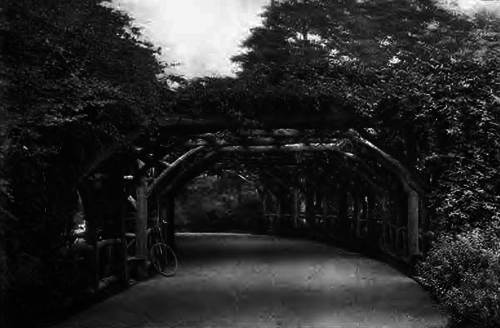
In one of the illustrations accompanying this chapter is shown a combination summer-house and arbor that is very easily made, and that will cost but little. The picture gives so clear an idea of framework and general detail that a description does not seem necessary. As a considerable weight will have to be supported by the roof, when vines have been trained over it, it will be necessary to use stout poles for uprights, and to run substantial braces from them to the cross-poles overhead. The built-in seats on each side add greatly to the comfort of the structure, and invite us to "little halts by the wayside," in which to "talk things over," or to quiet hours with a book that would lose half its charm if read indoors, as a companion. The original of this picture is built over a path that is sometimes used as a driveway, and is known as "the outdoor parlor" by the family on whose grounds it stands. You will find some member of the family there on every pleasant day, throughout the entire season, for it is fitted out with hammocks and swinging seats, and a table large enough to serve as tea-table, on occasion, with a cover that lifts and discloses a snug box inside in which books and magazines can be left without fear of injury in case of shower or damp weather. Tea served in such surroundings takes on a flavor that it never has indoors. The general design of this summer-house, as will readily be seen by the illustration, is simplicity itself, and can very easily be copied by the amateur workman.
Continue to:


My Books

